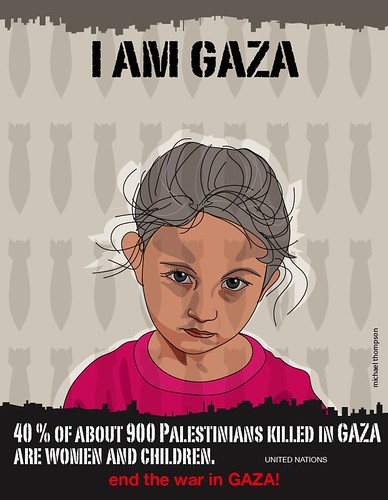
Showing posts with label Gaza. Show all posts

Thursday, January 7, 2010

Gaza - one year later

"It’s desperate. If I give you a tiny example only to give you an example, I’m here in quite a nice hotel, except there is no food in the hotel. There’s no food for breakfast, there’s no food for lunch. Now I make that point only to illustrate that if there’s no food in the best hotel in Gaza, imagine what the people are suffering. I’ve watched with my own eyes Palestinian women and girls in the early morning mists on top of garbage heaps, combing through the garbage heaps looking for food. In an Arab Muslim country in 2009 and ’10, it’s a absolutely scandalous situation.

And, Amy, remember why and how it came about. It’s been imposed by men. It’s not a natural disaster. It’s been imposed by men to punish the people of Palestine for voting for a party in a free election that the big powers, including yours and mine and Israel, don’t like. Now, I myself would not have voted for them; I’m not a Hamas supporter. But the only people entitled to choose the leadership of the Palestinians are the Palestinians themselves." George Galloway on Democracynow.org

..


Monday, March 9, 2009

International Women's Day in Gaza


What happened to the thousands in the under staffed hospitals in Gaza?  Without proper supplies, inside of buildings that were bombed, what could be happening to them?

-----
Democracynow.org
March 9, 2009
Pulitzer Prize-Winning Author Alice Walker, CODEPINK Founder Medea Benjamin in Gaza to Mark International Women’s Day


Millions around the world marked International Women’s Day on Sunday by celebrating advances made by women and honoring the ongoing global struggle for gender equality and equal rights. We go to Gaza, where a women’s delegation just made it in, to speak with Pulitzer Prize-winning author Alice Walker and CODEPINK founder Medea Benjamin...more

Tuesday, February 24, 2009

Empathy for Gaza

link to image

There is a billboard on Houston's Southwest Freeway that says only 3 words accompanied by a photo of a small child.  It says "Pray for Gaza."

see Washington Post article,  "Whose Israel Should it Be?" February 24, 2009
---
The Daily Cougar
University of Houston
Gaza in need of humanitarian aid

Lihue Rearte
Published: Tuesday, February 24, 2009


Reuters estimated Jan. 17 that there have been 5,300 Palestinian casualties, including 1,300 deaths, in comparison to 500 Israeli casualties, including 13 deaths.

Students around the world and across the U.S. are standing in solidarity with Gaza to support the Palestinian victims of violence.

“Their demands are reasonable and very, and I should emphasize, very humble,” pre-med junior Bissan Rafe Qasawari said. “What has been done to Gaza is a violation of human rights and basic integrity measures.”

Recent sit-ins and occupations in New York, organized by student groups such as Take Back NYU! and Students for a Democratic Society, demand their universities give scholarships to Palestinian students.

The student protesters also request the institutions donate “excess supplies and materials” to help restore the education in Gaza. Included in the list of recipients are institutions such as the Islamic University of Gaza, one of the targets of Israeli air raids in December.

As a symbol of solidarity with the people of Gaza, events and protests were held in Europe last month. Students from 16 different universities across the U.K. occupied facilities, condemning “atrocities perpetrated by Israel in the Gaza Strip” and asking their universities to end their investments in “companies complicit in human rights abuses,” according to the Associated Press.

“The Palestinian people are viewed as stateless citizens. They have less rights in other countries, which makes it very hard to cope with life anywhere,” Qasawari said.

Similar actions against injustice took place in front of the M.D. Anderson Library. The UH Muslim Student Association and the Houston Coalition for Justice and Peace in Palestine gathered Monday to raise awareness of the massive numbers of civilian deaths. They plan to gather again from 10 a.m. to 5 p.m. today

“We are here to honor the people that were killed in Gaza,” chemistry graduate student Kellie Abou-awad said. “Any time something like this happens, people need to know what’s going on.”

We should all stand with those whose schools have been completely destroyed and whose friends and professors have been murdered. Why aren’t we demanding our University for scholarships and more aid to the Palestinians?

The least we could do is raise awareness by protesting against U.S. companies that manufacture weapons and profit from it. This is not the kind of help people in Israel or Afghanistan need. The situation in Gaza is a humanitarian crisis that needs peaceful investing initiatives.

Our tuition, the money that all of us pay to fund our “public” universities, could partially be provided by the billions of dollars that the U.S. government gives to the Israeli violence in the Middle East.

In an effort to end an arms embargo on Israel, the human rights group Amnesty International demands the UN to stop this “aid” from abroad. Also, Amnesty researchers found proof of Israeli munitions, which were made by Americans.

“To a large extent, Israel’s military offensive in Gaza was carried out with weapons, munitions and military equipment supplied by the U.S.A. and paid for with U.S. taxpayers’ money,” Malcolm Smart, Amnesty’s Middle East director, said in a report.

In addition, the U.S. is to provide $30 billion in military aid to Israel under a 10-year agreement that runs until 2017, Amnesty said.

Perhaps this is a good time to ask ourselves if the University of Houston is, like many others, investing in corporations who could potentially profit from the war.

The Palestinian-Israeli conflict is an ongoing war dominated by military atrocities. Hundreds of militants and civilians are being murdered and the numbers keep increasing. Surely we can and should do something to ease their suffering.

Thursday, January 29, 2009


My terror as a human shield: The story of Majdi Abed Rabbo


As battle raged in Gaza, Israeli soldiers forced Majdi Abed Rabbo to risk his life as a go-between in the hunt for three Hamas fighters. This is his story...

By Donald Macintyre in Jabalya, Gaza
Friday, 30 January 2009
London Independent


After yet another fierce, 45-minute gun battle, Majdi Abed Rabbo was ordered once again to negotiate his perilous way across the already badly-damaged roof of his house, through the jagged gap in the wall and slowly down the stairs towards the first-floor apartment in the rubble-strewn house next door. Not knowing if the men were dead or alive, he shouted for the second time that day: "I'm Majdi. Don't be afraid."

All three men – with Kalashnikov AK-47 rifles, wearing camouflage and headbands bearing the insignia of the Izzedine el Qassam brigades – were still alive, though one was badly injured and persuaded Mr Abed Rabbo to tighten the improvised bandage round his right arm. The youngest – perhaps 21 – was taking cover behind fallen masonry from where he could see the Israeli troops who had sent the visitor. Nervously, Mr Abed Rabbo told them: "They sent me back so I can take your weapons. They told me you are dead." It was the youngest who replied defiantly: "Tell the officer, 'If you're a man come up here'."...more

Tuesday, January 27, 2009

More Violence in Gaza - Wednesday morning

Last update - 07:35 28/01/2009
IAF strikes Hamas tunnels in response to Gaza border blast
By Amos Harel, Anshel Pfeffer and News Agencies
Haaretz - Israel


Israel Air Force aircraft struck before dawn Wednesday tunnels used for smuggling goods and weapons on the border between the Gaza Strip and Egypt.

Rafah residents began to flee their homes in panic as the Israeli aircraft struck three times, Hamas officials said. There was no initial word of any casualties.

The Israel Defense Forces spokesman said the attack came in response to a remote-control bomb attack at the Gaza Strip security fence Tuesday, which killed an Israel Defense Forces tracker and wounded three other soldiers, one seriously...more

Monday, January 26, 2009

Gaza, Empathy, and the Holocaust

In the previous post I mention Robert Fisk's article about the mail he receives regarding Gaza. I focus on a letter from a professor who believes the Gaza war was about oil.

Yet Fisk mentions a number of other issues in the article. He reports about the email going around with photos of the WWII Holocaust as compared to Gaza. I received one of these emails too.

Fisk says that there is no way the two can be compared. I agree. Millions and millions compared to 1500+ is a big difference. But what we have to remember is that for the families and supports of the 1500+ it feels like a holocaust.

This does not mean I am against Israel. I am saying that there needs to be empathy for what people are feeling, even if what they say is not totally accurate. The Israeli's still feel the WWII Holocaust. Each Hamas rocket that lands on Israeli land is a prickly reminder of the past.

What we need to say and repeat over and over again, is that the sadness and despair created by these events does not warrant more violence. Israel and Hamas have to find a better way.

link to Fisk article

Oil and Gaza: surprise?

Robert Fisk writes an interesting article in the London Independent, where he speaks of some of the letters he has received about Gaza.  He tells of a professor in Canada who believes the Gaza War was about oil. 
----

Robert Fisk: Plots, sense and nonsense: the view from the post bag

Saturday, 24 January 2009
London Independent


Mail that you don't see in the Letters to the Editor column. First, here's reader Jack Hyde tipping me off about a possible (real) reason behind Israel's bloodletting in Gaza. He encloses a paper by University of Ottawa economist Michel Chossudovsky who says that "the military intervention of the Gaza Strip by Israeli Forces bears a direct relation to the control and ownership of strategic offshore gas reserves". It's not exactly The Plot. But it's something that Obama and his lads and lasses may need to study in the next few days.

For according to Chossudovsky, British Gas and its partner, the Athens-based Consolidated Contractors International Company – owned, apparently, by two Lebanese families – were granted 25-year oil and exploration rights off the Gaza coast by Yasser Arafat's Palestinian Authority in 1999. About 60 per cent of reserves along the Gaza-Israel coastline belong to "Palestine" (wherever that is these days).

But since the Hamas election victory in 2006 and its coup in Gaza in 2007, the Hamas government has been by-passed, even though poor old "President" Mahmoud Abbas, marooned in the West Bank, can only glimpse the Mediterranean from a hill near Jenin. Many negotiations later – and after Israeli "defence" officials claimed that the Palestinians could be paid only in goods and chattels for their gas rather than cash which might go to the dreaded Hamas – there was a proposed agreement under which Palestinian gas from Gaza wells would be channelled via undersea pipelines to the Israeli port of Ashkelon, thus transferring the control of gas sales to Israel. British Gas withdrew from these talks in December 2007.

But in June of 2008 – when, according to the Israeli daily Haaretz, Israel began its invasion plans for Gaza – Israel suddenly asked British Gas to resume talks. And, so says Chossudovsky, negotiations began again for the purchase of natural gas from the Gaza offshore fields. Israeli tanks have now driven out of the Gaza Strip, but Israeli naval vessels still control the coast and there's an obvious question: if the Israelis can continue to violate international law by seizing Palestinian land in the West Bank, why cannot they seize the sovereignty of Palestinian gas fields off Gaza? If Israel can annex Jerusalem, why not annex Gaza's maritime areas?.
..more


link to image

Sunday, January 25, 2009

What the BBC refuses to air

This is the GAZA Charity appeal by the UK DEC that the BBC and Sky refuse to air:


BBC crisis over refusal to broadcast Gaza appeal

• Archbishop in attack on aid decision
• Isolated Thompson urged to rethink

* Caroline Davies, Vanessa Thorpe and Gaby Hinsliff
* guardian.co.uk, Saturday 24 January 2009 19.55 GMT

The BBC was in crisis last night as politicians including government ministers, religious leaders and senior members of its own staff condemned the decision not to broadcast a charity appeal to help the stricken people of Gaza rebuild their homes.

The corporation's director general, Mark Thompson, was left isolated as rival broadcasters ITV and Channel 4 agreed to put out the plea for aid made jointly by 13 British charities. The BBC has decided the broadcast of the appeal might be seen as evidence of bias on a highly sensitive political issue.

The Archbishop of York, John Sentamu, has accused the broadcaster of "taking sides". He said yesterday: "This is not a row about impartiality but rather about humanity.

"This situation is akin to that of British military hospitals who treat prisoners of war as a result of their duty under the Geneva convention. They do so because they identify need rather than cause. This is not an appeal by Hamas asking for arms but by the Disasters Emergency Committee asking for relief. By declining their request, the BBC has already taken sides and forsaken impartiality," the archbishop added.

Communities secretary Hazel Blears said: "The BBC's decision should not discourage the public from donating to this important appeal. I sincerely hope the BBC will urgently review its decision."

The BBC's unrepentant stance has stirred up rebellion in the ranks of it own reporters and editors. One senior BBC news presenter told the Observer: "I've been talking to colleagues and everyone here is absolutely seething about this. The notion that the decision to ban the appeal will seem impartial to the public at large is quite absurd..
.more

Saturday, January 24, 2009


ITV and Channel 4 to air Gaza appeal as pressure mounts on BBC
by Nicholas Watt
London Guardian
January 24, 2009

Agreement reached between majority of commercial networks to show appeal as protesters picket BBC


ITV and Channel 4 today announced they would screen an appeal to raise emergency funds for Gaza, as the BBC came under intense pressure from the government to reverse its decision not to transmit the appeal by the Disasters Emergency Committee..
.more


BBC faces protest for blocking Gaza appeal

By Nicky Shaw
Saturday, 24 January 2009


Hundreds of protesters are expected to gather outside Broadcasting House in London today after the BBC defended its decision not to broadcast a public appeal to raise funds for Gaza.

The corporation said the decision was taken with other broadcasters not to show the Disasters Emergency Committee (DEC) crisis appeal because of impartiality concerns. There were also doubts about the delivery of aid in such a volatile situation, the BBC said..
. more

Friday, January 23, 2009

Phosphorus in Gaza

from Los Alamos National Laboratory:

"Phosphorus is very poisonous, 50 mg constituting an approximate fatal dose. Exposure to white phosphorus should not exceed 0.1 mg/m3 (8-hour time-weighted average per 40-hour work week). White phosphorus should be kept under water (as it is dangerously reactive in air) and should be handled with forceps, as contact with the skin may cause severe burns."

Growing concern over Israel's weapons use

By Donald Macintyre in Atatra, northern Gaza Strip
Friday, 23 January 2009
London Independent


...If the investigation which the Israeli military announced this week into the use of white phosphorous is serious, it will have to examine the events at the Abu Kalima house here in this semi-rural suburb of of Beit Lahiya, among many other locations. It's unlikely to dwell for long on the fact that the war saw the first use of artillery in Gaza since late 2006.

The military ended it after 18 members of one family were killed by shelling on a civilian house in Beit Hanoun in November 2006.

But it will have to take into account that the Amnesty International have no doubt that the shells which killed the Abu Kalima family contained phosphorus. Nafez al Shaban, the Glasgow and US trained head of Shifa Hospital’s Burns Unit is certain that the bone-deep tissue destruction sustained by Mrs Kalima, her critically injured daughter in law and grandaughter, were caused by it. And finally fragments of the brown spongy substance, with its unpleasantly pungent smell, are still lying in the debris outside the Abu Kalima house.
..more


link to article in London Telegraph "Gaza's phosphorus casualties relive 3 week Israeli war"January 23, 2009


Children of Gaza: stories of those who died and the trauma for those who survived
Rory McCarthy reports from Gaza City on the individual stories of some victims and the physical and psychological toll on an estimated 350,000 youngsters

* guardian.co.uk, Friday 23 January 2009 17.34 GMT


Amira Qirm lay on a hospital bed today with her right leg in plaster, and held together by a line of steel pins dug deep into her skin. For several days after her operation Amira, 15, was unable to speak, and even now talks only in a low whisper.

In her past are bitter memories: watching her father die in the street outside their home, then hearing another shell land and kill her brother Ala'a, 14, and her sister Ismat, 16, and then the three days that she spent alone, injured and semi-conscious, trying to stay alive in a neighbour's abandoned house before she could be rescued last Sunday.

Ahead of her, she has a long recovery. First there is an imminent flight to France for the best possible medical treatment, many more operations and then months of rehabilitation and psychiatric care.

Only now, after most of the dead have been buried, is the first properly researched reckoning of the toll emerging. What already stands out is the striking cost borne by the children of Gaza, who make up more than half of the 1.5 million people living in this overcrowded strip of land
...more

Gaza & the Bush Admin. denial of Geneva Convention Rules could have encouraged Israel

If the U.S. is supporting Israel financially - and politically (just about everyone in Congress voted to support the Gaza invasion) - then it makes sense that Israel could have been copying our stance regarding the Geneva Convention.  If we tortured, why wouldn't they.

It will be interesting to see if Israel takes a different turn now that Obama is in office and has brought the Geneva Convention Rules back to light. Considering how most Israeli's feel about Arabs; how well will they negotiate with a peacemaker (George Mitchell) who is half Lebanese?  

Last update - 11:44 23/01/2009
UN human rights official: Gaza evokes memories of Warsaw Ghetto
By Haaretz Service and Reuters


There is evidence that Israel committed war crimes during its 22-day campaign in the Gaza Strip and there should be an independent inquiry, UN investigator Richard Falk said Thursday.

...Falk, speaking by phone from his home in California, said compelling evidence that Israel's actions in Gaza violated international humanitarian law required an independent investigation into whether they amounted to war crimes.

"I believe that there is the prima facie case for reaching that conclusion," he told a Geneva news conference...."To lock people into a war zone is something that evokes the worst kind of international memories of the Warsaw Ghetto, and sieges that occur unintentionally during a period of wartime," Falk, who is Jewish, said, referring to the starvation and murder of Warsaw's Jews by Nazi Germany in World War Two.
..more


Thursday, January 22, 2009

BBC denies help to Gaza Charity


Broadcasters refuse to air Gaza charity appeal

BBC declines to show DEC appeal under agreement dating back to 1963, leading to other outlets following suit

* Jenny Percival
* guardian.co.uk, Thursday 22 January 2009 19.27 GMT

The BBC has refused to broadcast a national humanitarian appeal for Gaza, leaving aid agencies with a potential shortfall of millions of pounds in donations.

The Disasters Emergency Committee (DEC), an umbrella organisation for 13 aid charities, launched its appealtoday saying the devastation in Gaza was "so huge that British aid agencies were compelled to act".

...The corporation said it had been concerned about the difficulties of getting aid through to victims in a volatile situation. The BBC, which has faced criticism in the past over alleged bias in its coverage of the Middle East, said it did not want to risk public confidence in its impartiality.

The DEC's chief executive, Brendan Gormley, said the decision could have a big impact on its appeal. "We are used to our appeal getting into every household and offering a safe and necessary way for people to respond. This time we will have to work a lot harder because we won't have the free airtime or the powerful impact of appearing on every TV and radio station."

DEC appeals have recently raised £10m for the Congo and £18m for Burma.

Gormley rejected the BBC's claim that it was difficult for aid to reach those in need, saying 100 lorries a day were entering Gaza. He challenged the corporation's concerns about impartiality. "We are totally apolitical and are driven by the principles of the Geneva conventions in terms of impartiality and neutrality. This appeal is a response to those humanitarian principles. The BBC seems to be confusing impartiality with equal airtime."

A BBC spokesperson said: "Along with other broadcasters, the BBC has decided not to broadcast the DEC's public appeal to raise funds for Gaza. The BBC decision was made because of question marks about the delivery of aid in a volatile situation and also to avoid any risk of compromising public confidence in the BBC's impartiality in the context of an ongoing news story. However, the BBC will of course continue to report the humanitarian story in Gaza.".
..more

Close your eyes and pretend you can't see death

At 1 a.m. I was woken up by sirens. Small red lights in my room started blinking. I called the front desk and was told that nothing was going on. Two days later, as a friend and I were getting into a taxi to go to a museum, the siren goes off again. We are just leaving the campus of Hebrew University. We ask about the siren. We are told that it is just a "test."

This was my experience in Israel. Where Isreali colleagues constantly told me it would be safe, that the rockets from Gaza justified retaliation. Some people were hateful. Others mournful.

The denial screamed in my ears. I woke up the last night from bad dream, so anxious I had to call home to Houston. The next morning it was all calmness. I went to the airport and without incident checked in my luggage and got my boarding pass.

The fact that the Israeli security person asked me where my grandparents were from did not rile me. I knew it was the worst form of ethnic profiling, but then, the country is afraid.

When there is death all around, some people think its better to keep your eyes closed, and only open them to see the enemy somewhere else.

---

In Israel, detachment from reality is now the norm

All these years on from Sabra and Chatila, has anything changed?
by Patrick Cockburn
London Independent

Thursday, 22 January 2009

..Israeli society was always introverted but these days it reminds me more than ever of the Unionists in Northern Ireland in the late 1960s or the Lebanese Christians in the 1970s. Like Israel, both were communities with a highly developed siege mentality which led them always to see themselves as victims even when they were killing other people. There were no regrets or even knowledge of what they inflicted on others and therefore any retaliation by the other side appeared as unprovoked aggression inspired by unreasoning hate...
more

Obama's Silence on Gaza

The inauguration speech was great. It made me feel like this country could actually become what Jefferson said it would be....  All people would have an equal chance.

Then I began to think about what wasn't said... No talk of Gaza --- at the same time more bodies are being discovered. No talk of the DREAM Act and immigration. Let's hope the silence has to do with strategy- -

Obama is a wise man. Maybe he is thinking of a solution, and believes that it should be done quietly.


---
So far, Obama's missed the point on Gaza...
by Robert Fisk
London Independent
Thursday, 22 January 2009

...for the people of the Middle East, the absence of the word "Gaza" – indeed, the word "Israel" as well – was the dark shadow over Obama's inaugural address. Didn't he care? Was he frightened? Did Obama's young speech-writer not realise that talking about black rights – why a black man's father might not have been served in a restaurant 60 years ago – would concentrate Arab minds on the fate of a people who gained the vote only three years ago but were then punished because they voted for the wrong people? It wasn't a question of the elephant in the china shop. It was the sheer amount of corpses heaped up on the floor of the china shop...more

Monday, January 19, 2009

Stories from Gaza

link to audio from Gaza - Rory McCarthy reporting for the London Guardian, January 19, 2009.  What would Martin Luther King say to this?

Who is responsible for the proxy war?

As Robert Fisk is wondering if there should be a War Crimes Tribunal, I'm thinking about who should be tried. Yes, of course, everyone is angry at Israel. They were the ones that bombed the houses; that used the phosphorus; that stopped the aide from coming in.

Yet, maybe we need to look at the bigger picture. I believe that Israel was used by the E.U. and the U.S. Killing the Gazans was a proxy for getting at Iran. Sure, the Israelis took it as their own. There is plenty of anger about the rockets hitting Israeli cities for months on end. But then, what about the embargo?

It's like a cat and mouse game that is no game. Its about death and destruction. And the U.S., in it's timely manner, just before Obama takes office, pushes Israel into becoming the aggressor (again).

As strong as Israel is said it be. I believe it is fragile. The Holocaust has colored their responses. There is no doubt the Holocaust was one of the most horrible thing that has happened in the history of mankind (along with the Middle Passage, the genocide of the Native Americans and other catastrophys that I can't remember at this moment). I applaud the Israelis for making sure we don't forget it. The thousands of photographs I saw last week at the Holocaust museum in Jerusalem are like ghosts that follow me everywhere I go. I see faces in my mind and can't imagine the horror.

The people are dead but the injuries live on, in the living and their descendants. The U.S. knows this and only has to push a little bit to get them going. Remember what happened at the U.N. - Condi Rice was about to go against U.S. policy in endorsing a cease fire and her boss called her up and told her to stop. Why is that? Why would anyone want to let a murderous rampage continue?

Israel is strategically placed in the Middle East. Is it the most secure outpost for the U.S. against it's imagined war with Muslim extremists who have become terrorists (not all Muslim extremists are terrorists, we have to keep reminding ourselves of that). More Jews live in New York than in all of Israel. So Bloomberg thinks its a good thing to take the trip to Israel and show his constituency that he cares. We have so many connections.

What is very important to remember at this point is that the Israelis are not the only culprits. They have acted out for the U.S. and the E.U. - just think.... Sarkozy makes life miserable for Arabs (and their descendants) in France, he desperately tried to broker a ceasefire. Why would he care? Actually he doesn't care. It's a political move, and the Israelis are doing it for all of us.

---

So, I asked the UN secretary general, isn't it time for a war crimes tribunal?

London Independent
By Robert Fisk

Mr Ban said it would not be up to him to launch a war crimes tribunal. It was pathetic

Monday, 19 January 2009

It's a wrap, a doddle, an Israeli ceasefire just in time for Barack Obama to have a squeaky-clean inauguration with all the world looking at the streets of Washington rather than the rubble of Gaza. Condi and Ms Livni thought their new arms-monitoring agreement – reached without a single Arab being involved – would work. Ban Ki-moon welcomed the unilateral truce. The great and the good gathered for a Sharm el-Sheikh summit. Only Hamas itself was not consulted. Which led, of course, to a few wrinkles in the plan. First, before declaring its own ceasefire, Hamas fired off more rockets at Israel, proving that Israel's primary war aim – to stop the missiles – had failed. Then Cairo shrugged off the deal because no one was going to set up electronic surveillance equipment on Egyptian soil. And not one European leader travelling to the region suggested the survivors might be helped if Israel, the EU and the US ended the food and fuel siege of Gaza..
.more

Sunday, January 18, 2009

Winning but Losing: Israel's New Legacy

the timing of all of this is so interesting.  Why stop two days before the inauguration?

see dreamacttexas post "I went to Israel" - January 17, 2009

from the London Guardian, January 18, 2009:

"While the Obama inauguration is probably not the only factor that determined the timing of this ceasefire, it is hard not to see a connection with Israel almost certainly not wanting an ongoing Gaza crisis to rain on Tuesday's parade and to force their conflict with the Palestinians any higher up the new administration's agenda than it already is. Nevertheless, solidifying the ceasefire and the aftermath of this conflict will exercise the Obama team from day one in office, forcing them to make early choices in how they will approach the Israel/Palestine issue. The Obama administration will likely have to ensure the full Israeli withdrawal from Gaza, follow-up on US support for weapons smuggling efforts, while simultaneously taking a position on Gaza reconstruction efforts."


-----
Victorious, but vilified: Israel has 'destroyed its image and its soul'

By Kim Sengupta in Jerusalem and Donald Macintyre on the Gaza-Egypt border
Sunday, 18 January 2009
London Independent

After three weeks of carnage in Gaza, there were tentative signs of a ceasefire last night. But the bitter legacy of the past 22 days for Israel is that, while it declares victory on the battlefield, the country's reputation has rarely sunk so low.

Yesterday the United Nations called for a war crimes investigation after two children, aged five and seven, were killed when, it claimed, an Israeli tank shell hit a school sheltering some of the more than 40,000 internally displaced refugees.

"These two little boys are as innocent, indisputably, as they are dead," said John Ging, head of the UN Relief and Works Agency (UNRWA) in Gaza. In Jerusalem, Chris Gunness, the organisation's spokesman, added: "There has to be an investigation to determine whether a war crime has been committed."

Mr Gunness used unusually strong language. But the call came at the culmination not only of a rising civilian death toll but also a series of attacks on UN installations and, in some cases, the people who were under the UN's care at the time. The most lethal of these was an earlier shelling in which 43 internally displaced Gazans, sheltering in the Fakhura UNRWA school in Jabalya, were killed on 6 January.

Yet last week, an attack was launched that was – or should have been – as diplomatically embarrassing. For while the UN Secretary-General Ban Ki-moon was in the region for talks with Israeli ministers, an attack was launched on the main UNRWA compound, injuring three, setting fire to fuel and food in the depot with what Mr Ging said was white phosphorus, and sending up a dense plume of black smoke which became the defining image of the day's television coverage.

While Mr Ban said that the defence minister, Ehud Barak, had apologised for a "grave error", government spokesmen immediately suggested – just as they had initially in the Jabalya case, although UNRWA officials say this was later retracted in private conversations – that there had been firing by militants from in or around the UN compound. Mr Ging described the claim as "nonsense", adding that the UN had warned the Israelis that the compound was in danger from shelling, and had provided them with GPS co-ordinates to prevent an attack.

It began to seem like a pattern: after each episode of "collateral damage", international organisations would accuse the Israeli military of targeting buildings and civilian areas; then the Israelis would respond that they had simply returned fire after Hamas fighters had used these places to launch attacks. There was no discussion of whether the Israeli military's use of force was proportionate or not.

But while international concern grew over the rising daily toll of deaths in Gaza, the Israeli government continued to receive consistent majority support domestically. A common view expressed by many Israelis was that Hamas had brought it all upon itself by continuing to fire rockets into southern Israel for the past eight years.

By last night, it was beginning to look as if the Israeli mood was changing. With an election looming and, even more decisively perhaps, a new US president ready to take office on Tuesday, foreign minister Tzipi Livni and Mr Barak were both – however belatedly – ready to call a halt at the beginning of last week. Only the Prime Minister Ehud Olmert, apparently eager to exorcise the failures of Lebanon in 2006, appeared to be pursuing the war with enthusiasm. Few Israelis have yet publicly recalled the prescient remark of one of the fathers of modern Zionism, Chaim Weizmann: "The world will judge the Jewish state by the way it will treat the Arabs."

For many Israelis the cost of the war became clear when a Hebrew-speaking physician, Izz el-Deen Aboul Aish, who had been frequently interviewed on prime-time TV by a top reporter, Shlomi Eldar, phoned the journalist live on air to announce that his three daughters had been killed. "My God, my girls, Shlomi," viewers heard him say. "Can't anybody get to us, please?" As Mr Eldar got the authorities to allow rescue services to the stricken family, it was not lost on commentators that the same disaster was striking hundreds of other families without direct access to Israeli TV.

Ari Shavit, a leading columnist on the newspaper, 'Haaretz', was a fervent proponent of the "just war" at the outset. By Friday, he was writing: "Shelling a United Nations facility is something not to be done at any time, but doing it on the day when the UN Secretary-General is visiting Jerusalem is beyond lunacy. The level of pressure the Israel Defence Forces have been exerting on Gaza may be squeezing Hamas, but it is destroying Israel. Destroying its soul and its image. Destroying it on world television screens, destroying it in the living rooms of the international community... "

Saturday, January 17, 2009

I went to Israel

Jerusalem, at the Wailing Wall, January 16, 2009, by M.T. Hernandez

Amidst my parents, colleagues, and friends telling me it was too dangerous, I went to Israel on January 9th.  I gave a talk at a conference at Hebrew University.  The topic -  the Jewish influence on the Catholic Church in New Spain.  It was one of those situations that I just couldn't stay home... no matter what the risk management office of my university told me.

Well, I have gone and come back.  I am still alive; I was not near any terrorist bombings, and I had no trouble getting out of the country after a week.  Life in Israel goes on, even if 1000+ people are dying a few miles away.  

I saw lots of soldiers, and lots and lots of rifles.  The university felt like a bunker.  Our passports were checked every time we went on campus.  There were over two hundred soldiers at the Wailing Wall. I couldn't tell if you were guarding the place or they were their because of order to leave for Gaza.  We were checked for weapons as we entered a small cafe a block from campus.  I'm told that is normal.

The strangest thing (for me) was the television access in my hotel room.  I stayed at the faculty club on campus.  The TV stations listed CNN, but when I turned on the the TV, there was just a fuzzy screen.  I guess we weren't supposed to see what was going on in Gaza.  We weren't kept from the internet however - so I kept up with the news on-line.

The place is beautiful.  But at least on the Jewish side of town, there is a quiet sadness everywhere.  I walked to the Arab section of Old Jerusalem with a friend - that scene was different.  There was more movement, more talking, and actually more life.

My Jewish colleagues at the conference were fantastic hosts.  A few spoke to me about the Gaza conflict.  I kept hearing that the rockets from Gaza had been going on for a long time and the U.S. and other nations had not responded in support of Israel on this.  There is a sense of being locked in - that there was no option but to blow the Gazans away.

Everybody is locked in actually.  The Gaza population is trapped, but so are the Jews.  While the Gaza people are dying now, the is also a sense that the Jews could be blown away at any time.

---


Gaza op may be squeezing Hamas, but it's destroying Israel's soul
By Ari Shavit, Haaretz Correspondent
January 16, 2009

On Thursday it happened, conclusively - Operation Cast Lead turned insane. Attacking any densely populated city is a serious act at any time, but when Israel's international legitimacy is being ground to dust, such an attack is nothing but madness.


Shelling a United Nations facility is something not to be done at any time, but doing it on the day when the UN secretary general is visiting Jerusalem is beyond lunacy. The level of pressure the Israel Defense Forces has been exerting on Gaza may be squeezing Hamas, but it is destroying Israel. Destroying its soul and its image. Destroying it on world television screens, in the living rooms of the international community and most importantly, in Obama's America.

Israel is not Russia and Gaza is not Chechnya. Israel cannot deal with its enemies the way belligerent superpowers deal with theirs. Wars must be just and proportional.

Without being just, Israel cannot triumph on the battlefield. Without a sound moral foundation any Israeli victory is Pyrrhic.

Twenty-one days ago the campaign against Hamas was balanced and right. About a week ago it started slipping and in the last few days it has crossed every line. True, Hamas is in distress, its leaders are being killed, its prestige is dwindling. But this cannot change the fact that what began as a vital, calculated military operation has become a riotous rampage in a populated area. At any given moment the rampage could end in disaster.

The prime minister has apparently decided to act like some kind of Putin. If he ended his first war with no clear conclusion, he will end his second one with a scorched earth. But one should also ask, where is Defense Minister Ehud Barak, who is supposed to "look the truth in the eye" in his election campaign? And where is Foreign Minister Tzipi Livni, who claims to have the courage to change things?

After two weeks of serving their state, they are now in cahoots with licentious military moves.

In a few days the fire will cease and the fog will disperse, revealing the horror. Hamas will be crushed, but pictures of outrageous destruction and killing will flood the world. Beirut's "Waltz with Bashir" will pale by comparison to Gaza's waltz with Olmert.

Then we'll discover that we will not be paying the price of the past week's belligerent escapade only in Obama's America. We will be paying it with the damaged souls of our sons and daughters.


At a gate to the Old City in Jerusalem. A group of students with their body guard. January 16, 2009. Photo by M.T. Hernandez

A short history of war and exaggeration - the Middle East

speaking of genocide, proportionate response, and the Nazis.

link to Democacy Now program on Gaza, January 17, 2009, Bloody Israeli Assault on Gaza Enters Fourth Week, Palestinian Death Toll Tops 1,100
--

Robert Fisk’s World: When it comes to Gaza, leave the Second World War out of it

How do Holocaust survivors in Israel feel about being called Nazis?
London Independent
Saturday, 17 January 2009

Exaggeration always gets my goat. I started to hate it back in the 1970s when the Provisional IRA claimed that Long Kesh internment camp was "worse than Belsen". It wasn't as if there was anything nice about Long Kesh – or the Maze prison as it was later politely dubbed – but it simply wasn't as bad as Belsen. And now we're off again. Passing through Paris this week, I found pro-Palestinian demonstrators carrying signs which read "Gaza, it's Guernica" and "Gaza-sur-Glane".

Guernica, as we all know, was the Basque city razed by the Luftwaffe in 1937 and Oradour-sur-Glane the French village whose occupants were murdered by the SS in 1944. Israel's savagery in Gaza has also been compared to a "genocide" and – of course – a "holocaust". The French Union of Islamic Organisations called it "a genocide without precedent" – which does take the biscuit when even the Pope's "minister for peace and justice" has compared Gaza to "a big concentration camp".

Before I state the obvious, I only wish the French Union of Islamic Organisations would call the Armenian genocide a genocide – it doesn't have the courage to do so, does it, because that would be offensive to the Turks and, well, the million and a half Armenians massacred in 1915 happened to be, er, Christians.

Mind you, that didn't stop George Bush from dropping the word from his vocabulary lest he, too, should offend the Turkish generals whose airbases America needs for its continuing campaign in Iraq. And even Israel doesn't use the word "genocide" about the Armenians lest it loses its only Muslim ally in the Middle East. Strange, isn't it? When there's a real genocide – of Armenians – we don't like to use the word. But when there is no genocide, everyone wants to get in on the act.

Yes, I know what all these people are trying to do: make a direct connection between Israel and Hitler's Germany. And in several radio interviews this past week, I've heard a good deal of condemnation about such comparisons. How do Holocaust survivors in Israel feel about being called Nazis? How can anyone compare the Israeli army to the Wehrmacht? Merely to make such a parallel is an act of anti-Semitism.

Having come under fire from the Israeli army on many occasions, I'm not sure that's necessarily true. I've never understood why strafing the roads of northern France in 1940 was a war crime while strafing the roads of southern Lebanon is not a war crime. The massacre of up to 1,700 Palestinians in the Sabra and Chatila camps – perpetrated by Israel's Lebanese Phalangist allies while Israeli soldiers watched and did nothing – falls pretty much into the Second World War bracket. Israel's own estimate of the dead – a paltry 460 – was only nine fewer than the Nazi massacre at the Czech village of Lidice in 1942 when almost 300 women and children were also sent to Ravensbrück (a real concentration camp). Lidice was destroyed in revenge for the murder by Allied agents of Reinhard Heydrich. The Palestinians were slaughtered after Ariel Sharon told the world – untruthfully – that a Palestinian had murdered the Lebanese Phalangist leader Bashir Gemayel.

Indeed, it was the courageous Professor Yeshayahu Leibovitz of the Hebrew University (and editor of the Encyclopaedia Hebraica) who wrote that the Sabra and Chatila massacre "was done by us. The Phalangists are our mercenaries, exactly as the Ukrainians and the Croatians and the Slovakians were the mercenaries of Hitler, who organised them as soldiers to do the work for him. Even so have we organised the assassins of Lebanon in order to murder the Palestinians". Remarks like these were greeted by Israel's then minister of interior and religious affairs, Yosef Burg, with the imperishable words: "Christians killed Muslims – how are the Jews guilty?
" - more