Showing posts with label Senator Hillary Clinton. Show all posts

Monday, November 17, 2008

Secretary of State Hillary Clinton


Hillary Clinton has accepted Obama's offer of the position of U.S. Secretary of State.  Now this is going to be an interesting administration.  I wonder how Bill Clinton will be involved, because as most people imagine, Bill can't imagine not being in the middle of things.

At least most of us can say that Hillary Clinton will represent the nation with dignity and (hopefully) honesty.  Let's hope Bill can stay in line.


News
World news
Obama White House
Hillary Clinton to accept Obama's offer of secretary of state job
President-elect Barack Obama reaching out to former rivals to build a broad coalition administration

Ewen MacAskill in Washington
guardian.co.uk, Monday November 17 2008 21.48 GMT

Hillary Clinton plans to accept the job of secretary of state offered by Barack Obama, who is reaching out to former rivals to build a broad coalition administration, the Guardian has learned.

Obama's advisers have begun looking into Bill Clinton's foundation, which distributes millions of dollars to Africa to help with development, to ensure that there is no conflict of interest. But Democrats do not believe that the vetting is likely to be a problem.

Clinton would be well placed to become the country's dominant voice in foreign affairs, replacing Condoleezza Rice. Since being elected senator for New York, she has specialised in foreign affairs and defence. Although she supported the war in Iraq, she and Obama basically agree on a withdrawal of American troops...
more

Friday, June 6, 2008

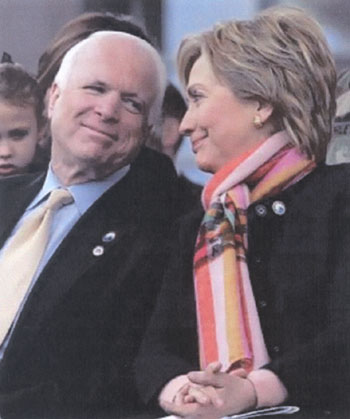
A Tryst Between John and Hillary


link to photo

In an article about a meeting between Obama and Clinton, the Washington Post throws in a very brief mention of how John McCain visited with Hillary Clinton a few weeks ago. The WP didn't say much, just:

[McCain's] unexpected visit with Clinton did raise a few eyebrows.

Seems like an odd occurrence. Does this happen between candidates of opposing parties? What could they have talked about? Why hasn't it been mentioned anywhere else, or with more emphasis in the WP if, as the reporter says the meeting did "raise a few eyebrows?"

If "raising eyebrows" means that someone is questioning the appropriateness of an event, then why weren't there more questions published?


----
In D.C., Obama Meets With Clinton
Nominee Apparent Also Sets Fundraising Curbs

By Jonathan Weisman and Shailagh Murray
Washington Post Staff Writers
Friday, June 6, 2008; A04

Sen. Barack Obama moved quickly yesterday to unite his party around his candidacy, paying an unexpected visit to his soon-to-be-former Democratic rival, while dispatching one of his top field operatives to help run the Democratic National Committee.

After a day spent campaigning across Virginia, Obama delayed a trip home to Chicago last night to visit Clinton at the Washington home of Sen. Dianne Feinstein (D-Calif.), a senior Democratic source said. A joint statement issued by the campaign said: "Senator Clinton and Senator Obama met tonight and had a productive discussion about the important work that needs to be done to succeed in November." Coming just before Clinton's expected departure from the race, it was seen as a reconciliation gesture to the senator from New York and her millions of disappointed supporters.

In addition to DNC staff changes, Obama extended his campaign's prohibition on raising funds from lobbyists and political action committees on the party's fundraising operations. Paul Tewes, one of the architects of Obama's primary strategy and the field general of his critical victory in the Iowa caucuses, will serve as Obama's point man at DNC.

The party chairman, Howard Dean, has been pursuing a "50-state" strategy since 2005, an effort many Democrats have criticized because it has been an enormous drain on the party's resources. The DNC has trailed its Republican counterpart badly this election cycle and had just $4.4 million in the bank at the end of April, compared with the Republican National Committee's $40.6 million.

Obama said his special-interest money ban is "not a perfect solution" but is an important symbolic move. "It does at least signal that we are going to make an effort to reverse a culture in Washington that has come to be dominated by the wealthy and the powerful," he said in a news conference aboard his campaign plane en route from Bristol in the state's southwest corner to the Nissan Pavilion in Northern Virginia, where he held a rally to kick off his general-election campaign...

Clinton, meanwhile, tried to quiet a campaign by her allies to force her onto the Democratic ticket. "While Senator Clinton has made clear throughout this process that she will do whatever she can to elect a Democrat to the White House, she is not seeking the vice presidency, and no one speaks for her but her," her campaign said in a news release. "The choice here is Senator Obama's and his alone."

Obama said he "appreciated very much" the statement, and he instructed reporters to dismiss all speculation about possible running mates. He said he will neither discuss the selection process nor parade prospects in public, as the GOP candidate, Sen. John McCain, appeared to do last month when Florida Gov. Charlie Crist, Louisiana Gov. Bobby Jindal and former opponent Mitt Romney visited his Arizona ranch -- although his unexpected visit with Clinton did raise a few eyebrows...

for complete WP article click here

Friday, March 14, 2008

Accuracy in Campaigning - Is Hillary fudging?


Greg Craig, former director, Policy Planning Office, U.S. State Department. Photo by CNN


How do we know when people are telling the truth? Can we trust Hillary? Can we trust Obama? Actually, we really don't know either of them.

Hillary is older, so she has left more of a trail behind her. Greg Craig, former director, Policy Planning Office, U.S. State Department is saying in a recent memo that she has not been giving out the right information regarding her foreign policy experience.
----
Huffington Post | March 14, 2008 12:30 PM

Originally from The National Journal

Q: So you have written a provocative memo for the Obama campaign making the argument that Hillary Clinton's experience as first lady, in terms of its relevance to being commander in chief and an expert on foreign policy, may have been exaggerated. How so?

Craig: Well, that was the point of my memo. If you're running for president on the basis of your claims of experience, when you then cite examples, you should be careful to be accurate. The evidence should be accurate. And my point is that Senator Clinton and her supporters have in serious ways overstated, if not grossly exaggerated, the nature of her experience. Take the Irish peace process -- which was a lengthy and arduous and difficult negotiation. She said, initially, that "I helped bring peace to Northern Ireland." Well, if you took the many, many heroes who were responsible for achieving that agreement -- I could name 20 people in Ireland. Primarily, the Irish were responsible for doing this, and the Americans were strong supporters.

But it's a little bit presumptuous for the first lady, who would meet people and support people to take credit away from the Irish themselves who did it. Terry McAuliffe said, "We would not have peace today had it not been for Hillary's hard work in Northern Ireland." That's just not true. This morning, Senator Clinton said on NPR that the role that she played in the Irish peace process was "instrumental." Well, that's not accurate. That's an overstatement. And anybody who is really knowledgeable about what went on, including George Mitchell, who wrote a book about it -- he wrote a book about the peace process, and he never mentioned any role whatsoever that Senator Clinton, or the first lady at the time, played.
http://nationaljournal.com/onair/transcripts/080314_craig_greg.htm

----

From TIME/CNN

Obama Foreign Policy Memo

To: Interested Parties

From: Greg Craig, former director, Policy Planning Office, U.S. State Department

RE: Senator Clinton’s claim to be experienced in foreign policy: Just words?

DA: March 11, 2008

When your entire campaign is based upon a claim of experience, it is important that you have evidence to support that claim. Hillary Clinton’s argument that she has passed “the Commander- in-Chief test” is simply not supported by her record.

There is no doubt that Hillary Clinton played an important domestic policy role when she was First Lady. It is well known, for example, that she led the failed effort to pass universal health insurance. There is no reason to believe, however, that she was a key player in foreign policy at any time during the Clinton Administration. She did not sit in on National Security Council meetings. She did not have a security clearance. She did not attend meetings in the Situation Room. She did not manage any part of the national security bureaucracy, nor did she have her own national security staff. She did not do any heavy-lifting with foreign governments, whether they were friendly or not. She never managed a foreign policy crisis, and there is no evidence to suggest that she participated in the decision-making that occurred in connection with any such crisis. As far as the record shows, Senator Clinton never answered the phone either to make a decision on any pressing national security issue – not at 3 AM or at any other time of day.

When asked to describe her experience, Senator Clinton has cited a handful of international incidents where she says she played a central role. But any fair-minded and objective judge of these claims – i.e., by someone not affiliated with the Clinton campaign – would conclude that Senator Clinton’s claims of foreign policy experience are exaggerated.

Northern Ireland:

Senator Clinton has said, “I helped to bring peace to Northern Ireland.” It is a gross overstatement of the facts for her to claim even partial credit for bringing peace to Northern Ireland. She did travel to Northern Ireland, it is true. First Ladies often travel to places that are a focus of U.S. foreign policy. But at no time did she play any role in the critical negotiations that ultimately produced the peace. As the Associated Press recently reported, “[S]he was not directly involved in negotiating the Good Friday peace accord.” With regard to her main claim that she helped bring women together, she did participate in a meeting with women, but, according to those who know best, she did not play a pivotal role. The person in charge of the negotiations, former Senator George Mitchell, said that “[The First Lady] was one of many people who participated in encouraging women to get involved, not the only one.”

News of Senator Clinton’s claims has raised eyebrows across the ocean. Her reference to an important meeting at the Belfast town hall was debunked. Her only appearance at the Belfast City Hall was to see Christmas lights turned on. She also attended a 50-minute meeting which, according to the Belfast Daily Telegraph’s report at the time, “[was] a little bit stilted, a little prepared at times.” Brian Feeney, an Irish author and former politician, sums it up: “The road to peace was carefully documented, and she wasn’t on it.”

Bosnia:

Senator Clinton has pointed to a March 1996 trip to Bosnia as proof that her foreign travel involved a life-risking mission into a war zone. She has described dodging sniper fire. While she did travel to Bosnia in March 1996, the visit was not a high-stakes mission to a war zone. On March 26, 1996, the New York Times reported that “Hillary Rodham Clinton charmed American troops at a U.S.O. show here, but it didn’t hurt that the singer Sheryl Crow and the comedian Sinbad were also on the stage.”

Kosovo:

Senator Clinton has said, “I negotiated open borders to let fleeing refugees into safety from Kosovo.” It is true that, as First Lady, she traveled to Macedonia and visited a Kosovar refugee camp. It is also true that she met with government officials while she was there. First Ladies frequently meet with government officials. Her claim to have “negotiated open borders to let fleeing refugees into safety from Kosovo,” however, is not true. Her trip to Macedonia took place on May 14, 1999. The borders were opened the day before, on May 13, 1999.

The negotiations that led to the opening of the borders were accomplished by the people who ordinarily conduct negotiations with foreign governments – U.S. diplomats. President Clinton’s top envoy to the Balkans, former Ambassador Robert Gelbard, said, “I cannot recall any involvement by Senator Clinton in this issue.” Ivo Daalder worked on the Clinton Administration’s National Security Council and wrote a definitive history of the Kosovo conflict. He recalls that “she had absolutely no role in the dirty work of negotiations.”

Rwanda:

Last year, former President Clinton asserted that his wife pressed him to intervene with U.S. troops to stop the Rwandan genocide. When asked about this assertion, Hillary Clinton said it was true. There is no evidence, however, to suggest that this ever happened. Even those individuals who were advocating a much more robust U.S. effort to stop the genocide did not argue for the use of U.S. troops. No one recalls hearing that Hillary Clinton had any interest in this course of action. Based on a fair and thorough review of National Security Council deliberations during those tragic months, there is no evidence to suggest that U.S. military intervention was ever discussed. Prudence Bushnell, the Assistant Secretary of State with responsibility for Africa, has recalled that there was no consideration of U.S. military intervention.

At no time prior to her campaign for the presidency did Senator Clinton ever make the claim that she supported intervening militarily to stop the Rwandan genocide. It is noteworthy that she failed to mention this anecdote – urging President Clinton to intervene militarily in Rwanda – in her memoirs. President Clinton makes no mention of such a conversation with his wife in his memoirs. And Madeline Albright, who was Ambassador to the United Nations at the time, makes no mention of any such event in her memoirs.

Hillary Clinton did visit Rwanda in March 1998 and, during that visit, her husband apologized for America’s failure to do more to prevent the genocide.

China

Senator Clinton also points to a speech that she delivered in Beijing in 1995 as proof of her ability to answer a 3 AM crisis phone call. It is strange that Senator Clinton would base her own foreign policy experience on a speech that she gave over a decade ago, since she so frequently belittles Barack Obama’s speeches opposing the Iraq War six years ago. Let there be no doubt: she gave a good speech in Beijing, and she stood up for women’s rights. But Senator Obama’s opposition to the War in Iraq in 2002 is relevant to the question of whether he, as Commander-in-Chief, will make wise judgments about the use of military force. Senator Clinton’s speech in Beijing is not.

Senator Obama’s speech opposing the war in Iraq shows independence and courage as well as good judgment. In the speech that Senator Clinton says does not qualify him to be Commander in Chief, Obama criticized what he called “a rash war . . . a war based not on reason, but on passion, not on principle, but on politics.” In that speech, he said prophetically: “[E]ven a successful war against Iraq will require a US occupation of undetermined length, at undetermined cost, with undetermined consequences.” He predicted that a U.S. invasion of Iraq would “fan the flames of the Middle East,” and “strengthen the recruitment arm of al Qaeda.” He urged the United States first to “finish the fight with Bin Laden and al Qaeda.”

If the U.S. government had followed Barack Obama’s advice in 2002, we would have avoided one of the greatest foreign policy catastrophes in our nation’s history. Some of the most “experienced” men in national security affairs – Vice President Cheney and Secretary Donald Rumsfeld and others – led this nation into that catastrophe. That lesson should teach us something about the value of judgment over experience. Longevity in Washington, D.C. does not guarantee either wisdom of judgment.

Conclusion:

The Clinton campaign’s argument is nothing more than mere assertion, dramatized in a scary television commercial with a telephone ringing in the middle of the night. There is no support for or substance in the claim that Senator Clinton has passed “the Commander-in-Chief test.” That claim – as the TV ad – consists of nothing more than making the assertion, repeating it frequently to the voters and hoping that they will believe it.

On the most critical foreign policy judgment of our generation – the War in Iraq – Senator Clinton voted in support of a resolution entitled “The Joint Resolution to Authorize the Use of U.S. Military Force Against Iraq.” As she cast that vote, she said: “This is probably the hardest decision I have ever had to make — any vote that may lead to war should be hard — but I cast it with conviction.” In this campaign, Senator Clinton has argued – remarkably – that she wasn’t actually voting for war, she was voting for diplomacy. That claim is no more credible than her other claims of foreign policy experience. The real tragedy is that we are still living with the terrible consequences of her misjudgment. The Bush Administration continues to cite that resolution as its authorization – like a blank check – to fight on with no end in sight.

Barack Obama has a very simple case. On the most important commander in chief test of our generation, he got it right, and Senator Clinton got it wrong. In truth, Senator Obama has much more foreign policy experience than either Bill Clinton or Ronald Reagan had when they were elected. Senator Obama has worked to confront 21st century challenges like proliferation and genocide on the Senate Foreign Relations Committee. He possesses the personal attributes of a great leader – an even temperament, an open-minded approach to even the most challenging problems, a willingness to listen to all views, clarity of vision, the ability to inspire, conviction and courage.

And Barack Obama does not use false charges and exaggerated claims to play politics with national security.


for link to Craig memo click the title of this post

Sunday, March 2, 2008

Clinton at Mason Park in Houston


Bill and Chelsea Clinton at Lakewood Church.
detail of photo by Steve Ueckert, Houston Chronicle


Hillary campaign continues to court Hispanic vote in Houston

06:23 PM CST on Sunday, March 2, 2008
By Leigh Frillici / 11 News

In a southeast Houston neighborhood known to be a Hispanic stronghold, over 1,000 people awaited a special visitor Sunday.

“The road to the White House is coming through our neighborhood. That was amazing,” Tim Rios said.

It was the Hillary campaign that swung through Mason Park.

And even though the New York senator wasn’t there in person, the people there had a message for the candidate.

“To keep constantly counting on the Hispanic vote. We’re out there. We’re a very large group, a large minority group,” Carolina Chavana said.

They’re also a group that could be critical to Clinton’s success in the Lone Star State.

So while Hillary was off in Ohio over the weekend, her favorite ground crew stayed behind.

Former President Clinton continued to rally support in the Bayou City.

“We need a president who will create more jobs, who will make this country energy independent,” he said.

His speech was just about 10 minutes long. It was one of six stops scheduled for Sunday, including College Station, Marshall, Wichita Falls and Abilene.

Earlier in the day, he and his daughter, Chelsea, joined thousands of worshippers at Lakewood Church.

There weren’t any campaign speeches, but the pair got valuable face time in a venue that’s more akin to an Obama rally in its size...


for video and complete KHOU article click the title of this post


Friday, February 22, 2008

Mana speaks for immigrants at Premios lo Nuestro


Last nite was the annual Premios Lo Nuestro presented in Univision. Premios lo Nuestro is the version of MTV Video Music Awards for Spanish television.

I must admit that i never really sit to watch these shows, but last night i changed the channel as Mana, the mexican rock group won artist of the year. Everything looked normal and ordinary until Fher, the singer of the band spoke for immigrant rights by saying that the United States had to recognized the need for the dignity of immigrants and the need for an immigration reform. I was shocked and was expecting Univision to cut the sound at any second. The crowd did not react much.

Mana is known for its efforts in environmental activism worldwide and for having talks with Irish band U2 in contributing musically, but i must say that last nite certainly came as a surprise.

I also found this article in Univision where Mana sympathizes with Hillary Clinton in women and immigration issues. Worth reading.

On another different note, did u guys watch the democratic debate last night? Senator Obama mentioned the need for the DREAM Act!!!

Monday, February 18, 2008

Last time the Dems battled this way, Reagan won the election


My daughter was telling me about something she read in the Huffington Post... Last time there was such a division in the Democratic Party - Reagan was elected (the guy whose name is all over the buildings in D.C.).

Clinton is not going to get anywhere by attacking Obama, especially now that the country is beginning to see him as the anointed one. It will just make her look like a sore loser.

Obama has been accused of plagiarism because he lifted 2 lines from a 2 year old speech given by one of his present campaign managers (Gov. Patrick). Personally, I don't think this is a big deal, considering the two work so closely together. It would have been totally different if it was someone else's speech and not Patrick's.

It is a shame the Clinton campaign is resorting to this... it undermines her credibility - and sees her less as a fair-minded lawmaker and more as an angry woman scorned.


-----
Clinton Steps Up Attacks on Obama


Plagiarism, Financing Accusations Come on Eve of Wisconsin Primary

By Matthew Mosk and Peter Slevin
Washington Post Staff Writers
Tuesday, February 19, 2008; A01

Aides to Sen. Hillary Rodham Clinton (N.Y.) accused Sen. Barack Obama (Ill.) yesterday of plagiarizing portions of a recent speech and continued to question his vows to reform the campaign finance system as she sought to drive home the idea that her Democratic rival's presidential bid is built on style more than substance.

The two-pronged attack came as Clinton attempts to slow Obama's momentum in today's contests in Wisconsin, which neighbors his home state of Illinois, and Hawaii, where he was born.

The race in Wisconsin, where Clinton dug in over the weekend in an effort to break a string of eight straight primary and caucus defeats, has turned increasingly negative. Just days earlier, Clinton aides accused Obama of breaking his pledge to accept public financing in place of private donations during the general election. Obama's aides say he did not make a firm commitment to accept public financing if he wins the nomination.

Yesterday, key Clinton supporters accused Obama of "lifting" a passage of the rousing speech he delivered to a party gathering in Milwaukee on Saturday night from Massachusetts Gov. Deval Patrick, a longtime friend and supporter. The two passages, captured on side-by-side YouTube videos and distributed to reporters by the Clinton campaign, show Obama repeating, almost verbatim, lines from a speech Patrick gave two years earlier.

"The point we're making overall is that Senator Obama's record as a senator and as a public official is thin," said Howard Wolfson, a senior Clinton adviser. "If you're asking an electorate to judge you on your promises and you break them, and on your rhetoric and you lift it, there are fundamental problems with your campaign."

Appearing in Niles, Ohio, Obama said he didn't believe "this is too big a deal."

"Well, look, I was on the stump," Obama said when asked why he did not attribute the lines. Patrick, he said, "had suggested we use these lines. I thought they were good lines. I'm sure I should have. Didn't this time."

Obama later returned to Wolfson's assertion while speaking with reporters on his campaign plane. "The notion that using a line from one of my national campaign co-chairs . . . is somehow objectionable, somehow doesn't make sense," he said.

Obama's aides also called Clinton's criticism of his public financing plans "curious." They noted that she was also the first candidate in the 2008 field to announce plans to reject the public financing system, saying more than a year ago that she would attempt to use private contributions to finance a general election bid were she to become the party's nominee.

"We're just not going to be lectured on this," Obama campaign manager David Plouffe said.

Obama first raised the notion of accepting public funds in the general election a year ago, when he sought a ruling from the Federal Election Commission that would preserve that option for him. He said at the time that if the eventual Republican nominee entered the system -- in which the candidate accepts $85 million to fund a general election campaign and agrees to raise no additional money -- he would enter it as well.

Sen. John McCain (Ariz.), who is moving ever closer to accumulating the delegates he needs for the GOP nomination, reaffirmed last week that he would be willing to accept that deal and urged Obama to "keep his word" on the issue.

Longtime advocates of campaign finance reform sent Obama a letter last week expressing "deep concern" that he would back away from the financing system. At the same time, several left-wing blogs urged Obama to "break the pledge," arguing that he should do nothing to cede the fundraising advantage that Democrats appear to have gained heading into the general election.

The candidate's advisers said yesterday that his pledge came before anyone realized how explosive his fundraising effort would become. Reports due to the FEC this week will show that Obama raised $32 million in January, almost triple what Clinton raised. Nearly all of Obama's total came via the Internet.

"The outpouring from small donors has been unprecedented and perhaps unexpected, and I would not want to do anything to deny those donors the chance to participate [in the general election], regardless of who the Democratic nominee is," said Alan D. Solomont, a longtime Democratic fundraiser who is a member of Obama's national finance team. "To be blunt, the ability of Democrats to raise money from both small donors and others is a significant competitive advantage."

Obama spokesman Bill Burton said yesterday he considers the entire discussion premature, given the tough, unresolved battle for the party's nomination. To both campaigns, Wisconsin has emerged as a critical steppingstone to the March 4 primaries in Ohio and Texas, as well as a fight for the state's 74 pledged delegates.

As Clinton crisscrossed Wisconsin yesterday, she returned to what has become a central theme of her retooled, sharper-edged campaign. She told a standing-room-only crowd of more than 1,000 at the Wausau Labor Temple in central Wisconsin yesterday afternoon: "There's a difference between speeches and solutions, between talk and action. I was raised to believe that actions speak louder than words."

It was that very notion that Obama had tried to address when borrowing Patrick's turn of phrase during the Saturday night speech in Milwaukee. "Don't tell me words don't matter," he said. " 'I have a dream.' Just words? 'We hold these truths to be self-evident, that all men are created equal.' Just words? 'We have nothing to fear but fear itself.' Just words? Just speeches?"

Patrick used a nearly identical formulation during his 2006 campaign for governor, when he was drawing fire from his Republican opponent, who said his stylish speechmaking disguised a lack of substance.

At a titanium plant in Niles, Obama also noted that Clinton had appeared to borrow lines from other candidates, including her use of the signature Obama rallying cry "Fired up! Ready to go!"

"When Senator Clinton says 'it's time to turn the page' in one of her stump speeches or says she's 'fired up and ready to go,' I don't think that suggests that she's not focused on the issues she's focused on," Obama said.

Obama beat Clinton to Wisconsin, arriving last Tuesday to celebrate his victories in the Potomac Primary in front of more than 16,000 cheering supporters in Madison. He devoted more staff members to Wisconsin -- opening 11 offices in the state, to Clinton's four, and had television ads in circulation six days before she did. But Clinton made a late play for a state that offers her some advantages.

Although repeatedly detoured by winter weather, Clinton paid attention to rural and working-class voters in areas far from Madison and Milwaukee, which are considered Obama's prime territory. She ran television ads in markets including Green Bay, Eau Claire and La Crosse, challenging Obama's proposals on health care and energy policy and accusing him of refusing to debate her.

After a brief trip to Ohio to prepare for the potentially pivotal votes that will be held there and in Texas, Obama returned to Wisconsin for an election-eve rally.

Even before his return, though, Obama had retooled his speech so that he defended the transformative power of a rousing speech without using any of Patrick's lines.

"The only way that we're going to bring about change is if all of you get excited about change," he said in Youngstown, Ohio. "So I make no apologies for being able to talk good."

Slevin is traveling with the Obama campaign. Staff writers Jose Antonio Vargas and Alec MacGillis contributed to this report.


for link to article click the title of this post

photo: http://images.salon.com/news/feature/2007/10/13/hillary/story.jpg

Sunday, February 10, 2008

Manipulating the race card

---
Next Up for the Democrats: Civil War
New York Times
February 9, 2008


...The untold story in the run-up to Super Tuesday was Hillary Clinton’s elaborate live prime-time special the night before the vote. Presiding from a studio in New York, the candidate took questions from audiences in 21 other cities. She had plugged the event four days earlier in the last gasp of her debate with Barack Obama and paid a small fortune for it: an hour of time on the Hallmark Channel plus satellite TV hookups for the assemblies of supporters stretching from coast to coast...

[The Clinton] campaign’s ...most potent form of currency remains its thick deck of race cards. This was all too apparent in the Hallmark show. In its carefully calibrated cross section of geographically and demographically diverse cast members — young, old, one gay man, one vet, two union members — African-Americans were reduced to also-rans. One black woman, the former TV correspondent Carole Simpson, was given the servile role of the meeting’s nominal moderator, Ed McMahon to Mrs. Clinton’s top banana. Scattered black faces could be seen in the audience. But in the entire televised hour, there was not a single African-American questioner, whether to toss a softball or ask about the Clintons’ own recent misadventures in racial politics.

The Clinton camp does not leave such matters to chance. This decision was a cold, political cost-benefit calculus. In October, seven months after the two candidates’ dueling church perorations in Selma, USA Today found Hillary Clinton leading Mr. Obama among African-American Democrats by a margin of 62 percent to 34 percent. But once black voters met Mr. Obama and started to gravitate toward him, Bill Clinton and the campaign’s other surrogates stopped caring about what African-Americans thought. In an effort to scare off white voters, Mr. Obama was ghettoized as a cocaine user (by the chief Clinton strategist, Mark Penn, among others), “the black candidate” (as Clinton strategists told the Associated Press) and Jesse Jackson redux (by Mr. Clinton himself).

The result? Black America has largely deserted the Clintons. In her California primary victory, Mrs. Clinton drew only 19 percent of the black vote. The campaign saw this coming and so saw no percentage in bestowing precious minutes of prime-time television on African-American queries.

That time went instead to the Hispanic population that was still in play in Super Tuesday’s voting in the West. Mayor Antonio Villaraigosa of Los Angeles had a cameo, and one of the satellite meetings was held in the National Hispanic Cultural Center in Albuquerque. There’s nothing wrong with that. It’s smart politics, especially since Mr. Obama has been behind the curve in wooing this constituency.

But the wholesale substitution of Hispanics for blacks on the Hallmark show is tainted by a creepy racial back story. Last month a Hispanic pollster employed by the Clinton campaign pitted the two groups against each other by telling The New Yorker that Hispanic voters have “not shown a lot of willingness or affinity to support black candidates.” Mrs. Clinton then seconded the motion by telling Tim Russert in a debate that her pollster was “making a historical statement.”

It wasn’t an accurate statement, historical or otherwise. It was a lie, and a bigoted lie at that, given that it branded Hispanics, a group as heterogeneous as any other, as monolithic racists. As the columnist Gregory Rodriguez pointed out in The Los Angeles Times, all three black members of Congress in that city won in heavily Latino districts; black mayors as various as David Dinkins in New York in the 1980s and Ron Kirk in Dallas in the 1990s received more than 70 percent of the Hispanic vote. The real point of the Clinton campaign’s decision to sow misinformation and racial division, Mr. Rodriguez concluded, was to “undermine one of Obama’s central selling points, that he can build bridges and unite Americans of all types.”

If that was the intent, it didn’t work. Mrs. Clinton did pile up her expected large margin among Latino voters in California. But her tight grip on that electorate is loosening. Mr. Obama, who captured only 26 percent of Hispanic voters in Nevada last month, did better than that in every state on Tuesday, reaching 41 percent in Arizona and 53 percent in Connecticut. Meanwhile, the Clinton campaign’s attempt to drive white voters away from Mr. Obama by playing the race card has backfired. His white vote tally rises every week. Though Mrs. Clinton won California by almost 10 percentage points, among whites she beat Mr. Obama by only 3 points.


for link to complete article click the title of this post

Saturday, February 2, 2008

The good and bad of Presidente Hillary


It would be great to have a female president. But just because she is female does not necessarily mean she is the best candidate or that all female voters should support her. We would be doing ourselves a disservice if we voted for her based on her gender (same if we voted for Obama because he is black).

Here is a very simplified listing of some pros and cons regarding the viability of a Presidente Hillary. Energy, Environment, Education, Health Care and numerous other issues are not mentioned... in many of these areas, Obama and Clinton have similar positions. Her candidacy is described in more detail in the NYT editorial I have posted below my comments.

Pro:

1. Knows the system, and would maneuver well within the role of national leader and head diplomat.

2. Has been very competent in her work as a New York senator, and has kept her constituents happy (for the most part).

3. Is extremely intelligent and articulate. She has a manner of speaking that helps her get the last word when in debate, which will help her deal with the other (mostly male) national leaders.

4. Would have a great consultant (in her husband) available 24 hours a day.

Why she shouldn't be president:

1. She allowed her campaign and her husband to inappropriately insert the race card into the campaign. Some of Bill's comments were clearly provocative - why would she allow for such a thing?

2. She voted for the Iraq war and refuses to admit that was a mistake (sounds familiar?)

3. She has hopped around the issue of immigration. In last night's debate she said that undocumented people should not have driver's licenses because they would be identified by the authorities as "illegal." Her answer was inaccurate... the immigrants would only be in danger of detainment if the license program that was implemented was one of the two tier system (like what was presented in New York). If the same license was available to everyone, there would be no risk of being deported.

5. This is a more personal reason, but I believe highly relevant. She would be a poor role model for young women in that she continued her marriage even after her husband repeatedly humiliated her with his extra-marital involvements. I'm not sure I would want this as an example for my daughter. The message to American women would be that one should stay in the relationship at all costs which is a story that became no longer viable after the mid-20th century.


I cannot officially say I would prefer one candidate over another. Generally I vote Democrat, but lately I have begun to think of myself more as an Independent. My doubts about the political process were greatly intensified after the 2000 presidential election - I have not yet been convinced that things have gotten much better. I have watched the debates with hope that the candidates will present themselves as real people instead of political robots. Unfortunately, campaign politics in the U.S. has become like a rigged game show.

As a last word, even with all my doubts, I have to admit I'm fascinated - and I'm looking forward to the results of Super Tuesday.

-----

January 25, 2008
Editorial
New York Times
Primary Choices: Hillary Clinton

This generally is the stage of a campaign when Democrats have to work hard to get excited about whichever candidate seems most likely to outlast an uninspiring pack. That is not remotely the case this year.

The early primaries produced two powerful main contenders: Hillary Clinton, the brilliant if at times harsh-sounding senator from New York; and Barack Obama, the incandescent if still undefined senator from Illinois. The remaining long shot, John Edwards, has enlivened the race with his own brand of raw populism.

As Democrats look ahead to the primaries in the biggest states on Feb. 5, The Times’s editorial board strongly recommends that they select Hillary Clinton as their nominee for the 2008 presidential election.

We have enjoyed hearing Mr. Edwards’s fiery oratory, but we cannot support his candidacy. The former senator from North Carolina has repudiated so many of his earlier positions, so many of his Senate votes, that we’re not sure where he stands. We certainly don’t buy the notion that he can hold back the tide of globalization.

By choosing Mrs. Clinton, we are not denying Mr. Obama’s appeal or his gifts. The idea of the first African-American nominee of a major party also is exhilarating, and so is the prospect of the first woman nominee. “Firstness” is not a reason to choose. The times that false choice has been raised, more often by Mrs. Clinton, have tarnished the campaign.

Mr. Obama and Mrs. Clinton would both help restore America’s global image, to which President Bush has done so much grievous harm. They are committed to changing America’s role in the world, not just its image.

On the major issues, there is no real gulf separating the two. They promise an end to the war in Iraq, more equitable taxation, more effective government spending, more concern for social issues, a restoration of civil liberties and an end to the politics of division of George W. Bush and Karl Rove.

Mr. Obama has built an exciting campaign around the notion of change, but holds no monopoly on ideas that would repair the governing of America. Mrs. Clinton sometimes overstates the importance of résumé. Hearing her talk about the presidency, her policies and answers for America’s big problems, we are hugely impressed by the depth of her knowledge, by the force of her intellect and by the breadth of, yes, her experience.

It is unfair, especially after seven years of Mr. Bush’s inept leadership, but any Democrat will face tougher questioning about his or her fitness to be commander in chief. Mrs. Clinton has more than cleared that bar, using her years in the Senate well to immerse herself in national security issues, and has won the respect of world leaders and many in the American military. She would be a strong commander in chief.

Domestically, Mrs. Clinton has tackled complex policy issues, sometimes failing. She has shown a willingness to learn and change. Her current proposals on health insurance reflect a clear shift from her first, famously disastrous foray into the issue. She has learned that powerful interests cannot simply be left out of the meetings. She understands that all Americans must be covered — but must be allowed to choose their coverage, including keeping their current plans. Mr. Obama may also be capable of tackling such issues, but we have not yet seen it. Voters have to judge candidates not just on the promise they hold, but also on the here and now.

The sense of possibility, of a generational shift, rouses Mr. Obama’s audiences and not just through rhetorical flourishes. He shows voters that he understands how much they hunger for a break with the Bush years, for leadership and vision and true bipartisanship. We hunger for that, too. But we need more specifics to go with his amorphous promise of a new governing majority, a clearer sense of how he would govern.

The potential upside of a great Obama presidency is enticing, but this country faces huge problems, and will no doubt be facing more that we can’t foresee. The next president needs to start immediately on challenges that will require concrete solutions, resolve, and the ability to make government work. Mrs. Clinton is more qualified, right now, to be president.

We opposed President Bush’s decision to invade Iraq and we disagree with Mrs. Clinton’s vote for the resolution on the use of force. That’s not the issue now; it is how the war will be ended. Mrs. Clinton seems not only more aware than Mr. Obama of the consequences of withdrawal, but is already thinking through the diplomatic and military steps that will be required to contain Iraq’s chaos after American troops leave.

On domestic policy, both candidates would turn the government onto roughly the same course — shifting resources to help low-income and middle-class Americans, and broadening health coverage dramatically. Mrs. Clinton also has good ideas about fixing the dysfunction in Mr. Bush’s No Child Left Behind education program.

Mr. Obama talks more about the damage Mr. Bush has done to civil liberties, the rule of law and the balance of powers. Mrs. Clinton is equally dedicated to those issues, and more prepared for the Herculean task of figuring out exactly where, how and how often the government’s powers have been misused — and what must now be done to set things right.

As strongly as we back her candidacy, we urge Mrs. Clinton to take the lead in changing the tone of the campaign. It is not good for the country, the Democratic Party or for Mrs. Clinton, who is often tagged as divisive, in part because of bitter feeling about her husband’s administration and the so-called permanent campaign. (Indeed, Bill Clinton’s overheated comments are feeding those resentments, and could do long-term damage to her candidacy if he continues this way.)

We know that she is capable of both uniting and leading. We saw her going town by town through New York in 2000, including places where Clinton-bashing was a popular sport. She won over skeptical voters and then delivered on her promises and handily won re-election in 2006.

Mrs. Clinton must now do the same job with a broad range of America’s voters. She will have to let Americans see her power to listen and lead, but she won’t be able to do it town by town.

When we endorsed Mrs. Clinton in 2006, we were certain she would continue to be a great senator, but since her higher ambitions were evident, we wondered if she could present herself as a leader to the nation.

Her ideas, her comeback in New Hampshire and strong showing in Nevada, her new openness to explaining herself and not just her programs, and her abiding, powerful intellect show she is fully capable of doing just that. She is the best choice for the Democratic Party as it tries to regain the White House.


for link to article click the title of this post


photo: http://www.theonion.com/content/files/images/onion_imagearticle1223.jpg

Monday, January 28, 2008

Present, Past or Future for Clinton on Immigration?


As easily as it is to remember Ronald Reagan and the far reaching amnesty law of 1986 when hundreds of thousands of immigrants regularized their status in the U.S. -- it is also easy to forget the "very ugly" immigration law passed in 1996. It was during the Clinton Administration that one of the harshest anti-immigration laws in the 20th century was approved.


The National Immigration Law Center states in a report:

The draconian restrictions on immigrants' rights imposed by the 1996 welfare and immigration laws have created an unprecedented demand for NILC's services. In response, NILC has doubled its staff and number of offices and forged new alliances. The 1996 laws targeted low income immigrants for the laws' harshest treatment, making it more difficult for immigrants to reunite with family members, obtain work, and receive the health care and other services they need to support their families.
http://www.nilc.org/nilcinfo/index.htm


-----
Immigration Policy: Will the Real Senator Clinton Please Stand Up?

Posted January 28, 2008 | 12:32 PM (EST)

Huffington Post

Al Giordano

One of the major media narratives since the Nevada caucuses, when entrance polls showed Clinton winning widely among Hispanic-Americans (64 percent to 25 for Obama), has been the presumption that the New York senator had the Latino vote similarly locked up on Tsunami Tuesday in California and other states.

The news that Ted Kennedy (and most of his organization) is now backing Obama has spurred a second look. The presumption that Clinton has been a leader on immigrant rights - spun heavily by Los Angeles Mayor Antonio Villaraigosa and other surrogates - is not withstanding scrutiny of her actual record.

Add to that spin the way in which the race card has been deployed in recent weeks to divide Latino from black - I wrote about that in detail after witnessing those divide-and-conquer politics at work in Nevada - and previous assumptions about Clinton as an immigrant rights defender have begun to unravel in a way that could have consequences in the February 5 primaries and caucuses.

It's one thing to mouth slogans like "no woman is illegal" as Clinton did in Nevada earlier this month. But according to today's New York Sun, Clinton's true position is that some women and men are so "illegal" that she favors deporting them without any of the due process that the US Constitution guarantees:

"Anybody who committed a crime in this country or in the country they came from has to be deported immediately, with no legal process. They are immediately gone," Mrs. Clinton told a town hall meeting in Anderson, S.C., Thursday. On Wednesday, she told a crowd in North Bergen, N.J., that such criminals "absolutely" need to be deported. A day earlier, she told a rally in Salinas, Calif., that aliens with criminal records "should be deported, no questions asked."...


"No legal process," the New York senator said at a forum in Tipton, Iowa, according to a political news outlet, the Politico. "You put them on a plane to wherever they came from."

This has provoked important immigrant rights organizations and advocates - including perhaps the most important, Cecilia Muñoz, to correct the record:

"It's disturbing that she would make a statement like that, that we should deport everybody without due process of law," a vice president of the American Immigration Lawyers Association, David Leopold, said. "That's a very disturbing statement. This country is all about due process of law."

"It is worrisome," an official with the National Council of La Raza, Cecilia Muñoz, said. "The semantics and nuances make or break families. As you can imagine, the sensitivity on these issues in the Latino community is very high."

...One subtext to the concern is that immigrant-rights advocates are still angry with President Clinton over legislation he signed in 1996 that effectively stripped judges of the power to block the deportation of foreigners convicted of an "aggravated felony." The term was broadly defined and has led to automatic deportations even for what some might consider minor offenses.

"How about two public urinations? How about driving a car recklessly and your sister dies in the passenger seat and you get deported for that?" a law professor at the University of California at Davis, Bill Hing, said...

While Mrs. Clinton's campaign stressed that she was referring to illegal aliens who commit crimes, it did not reply to a query about whether she favors automatic deportation of legal immigrants who run afoul of the law. In 2001, Mr. Kennedy introduced a bill to overturn part of the 1996 legislation, signed by Mr. Clinton, which made deportation automatic in many cases. The measure never got out of committee, but it had ten Democratic co-sponsors in the Senate. Mrs. Clinton was not among them.

"Mrs. Clinton keeps reminding us about going back to the 90s and talking about how great the 90s were," Mr. Leopold said. "If she's planning to bring back that approach to immigration, that's disturbing as well."

Ms. Munoz called the 1996 law "very ugly..."

The reopening of discussion on Clinton's record vs. rhetoric on immigration has refocused attention on her confused stance(s) during an October 30 candidate debate, when she took, in a matter of minutes, both sides of the dispute over whether undocumented immigrants should have drivers licenses:

New York Governor Eliot Spitzer, a leading Clinton supporter whose proposals came under fire in that discussion, quickly withdrew his proposal after that debate, temporarily removing the subject from wider national media scrutiny.

But the Obama campaign is now launching an offensive to distinguish its candidate's unequivocal position in favor of drivers licenses for undocumented immigrants, as well as differences between him and Clinton over whether each will tackle immigration reform in their first year in the White House:

The Illinois senator is differentiating himself in three key areas: driver's licenses, a promise to take up immigration reform his first year in office, and his background as the son of an immigrant (his father was Kenyan) and a community organizer in Chicago.


Obama made the promise to Latino leaders to take up immigration reform in his first year after Rep. Rahm Emanuel, D-Ill., chairman of the Democratic caucus, said his party might not raise the divisive issue again until the next president's second term, assuming a Democrat wins.

Latino leaders felt betrayed. For them, an immigration overhaul is a top priority in light of state and local crackdowns on illegal immigrants and federal raids in workplaces across the country.

Clinton has not made such a promise, saying only that she would make her best efforts.

"Those issues are huge," said Obama supporter and state Sen. Gilbert Cedillo, D-Los Angeles, vice chairman of the California Latino Legislative Caucus....

John Trasviña, president of the Mexican American Legal Defense and Educational Fund, said:

"Clinton and (Sen. John) Edwards have said no driver's licenses for unauthorized immigrants... Sen. Obama has said you get a driver's license if you know how to drive. And that message I think will resonate in the Latino community as we get closer to California."

Political consultant James Carville, a Clinton supporter, has sent various memos to Democratic politicians urging them to avoid the issue of drivers licenses for undocumented immigrants, or oppose the concept altogether, citing polls that a majority of Americans do not favor them. Obama has bucked that counsel (and I think this is an example of what Obama meant when he spoke about the leadership qualities of former Republican President Ronald Reagan, who similarly took unpopular positions without backing down, and was popular in part for his lack of fear of what polls say).

The Latino electorate is diverse. In the Mid-Atlantic states, much of the population is of Caribbean descent, particularly Puerto Rican and Dominican. In South Florida, Cuban-Americans are the largest and most politically influential ethnic group (and those voters may surprise the conventional wisdom tomorrow in the non-binding Democratic beauty contest on the ballot there). In the West (and increasingly nationwide) Mexican-Americans are on the rise as a blockbusting political force. For that largest group, immigration reform is the dominant issue (of the thousands of questions that viewers sent to Univision for the Spanish-language station's Democratic presidential debate, 70 percent were about that topic).

Kennedy is widely (and accurately) viewed among Latino voters as the champion of immigrants in Washington, and his endorsement is already provoking a second look at both Obama and Clinton. It has certainly unleashed the Hispanic-American advocacy organizations in Washington to now speak out about Clinton's true record after many months of silence.

What was thought, just two days ago, to be a demographic vote locked up for Clinton may now be in play. And with important national Hispanic-American leaders like Cecilia Muñoz now questioning Clinton's record, and the Kennedy organization highlighting Obama's leadership in the immigration reform battle as, in the words of one Kennedy associate "a politically touchy subject the other presidential candidates avoided," the competition for Latino votes is now very much on again.

This report originally appeared at The Field, where Al Giordano covers the 2008 presidential campaign.


for link to article click the title to this post

Saturday, January 12, 2008

The Racial Fairy Tale

Concerning the news on how the Clinton campaign has been making disparaging racial remarks in recent days - for those that haven't thought about it... In the United States, when there are "racial remarks" - it also means Latinos, Native Americans, Asian Americans. The Clinton campaign may have targeted Obama and the black community... but they are talking about people of color (all those that are not considered white).

It is unfortunate that a former president would speak in this manner (see below)- maybe the Clinton campaign is getting desperate. With the validity of the New Hamphire primary being questioned - and Obama's popularity still growing, they should be worried.

I am not saying that I endorse Obama or Clinton- just pointing out something I read in the Washington Post, see below:

"Bill Clinton...appeared to dismissively describe the campaign platform of hope and change offered by the strongest black presidential contender in history as the "biggest fairy tale I've ever seen."

"
A memo surfaced yesterday that listed allegedly racially tinged remarks made by Clinton and her surrogates, including a comment from New York Attorney General Andrew M. Cuomo that Obama would have to do more than "shuck and jive" his way through a news conference to get elected..."
-----

Clintons Move to Ease Some Racial Friction

By Anne E. Kornblut and Shailagh Murray
Washington Post Staff Writers
Saturday, January 12, 2008; A08

Former president Bill Clinton worked yesterday to smooth over comments from Sen. Hillary Rodham Clinton's presidential campaign and its allies that have raised hackles in the African American community, a week before Democrats will vote in the South Carolina primary, their first test involving a heavily black electorate.

The comments have come from Clinton (D-N.Y.) and several of her most prominent surrogates, including New Hampshire ally Billy Shaheen, who made insinuations about Sen. Barack Obama's admission of past drug use, and Clinton's husband, Bill Clinton, who appeared to dismissively describe the campaign platform of hope and change offered by the strongest black presidential contender in history as the "biggest fairy tale I've ever seen."

Publicly, Obama's campaign has so far only echoed the concerns expressed by others, without directly accusing the Clintons of trying to inject race into their primary showdown. But other Democrats have spoken out. "I think it was an unfortunate set of words that really set off a firestorm," said Donna Brazile, the campaign manager for Democratic presidential nominee Al Gore in 2000. The remarks by the former president, Brazile said, are particularly troubling.

"It struck us, coming from a president that has stood by and championed so many issues that African Americans cared about -- at first blush it really did hit you the wrong way," Brazile said last night.

Bill Clinton spent much of the day trying to explain his remarks and regain the confidence of a community that historically has provided some of the Clintons' strongest support. In a call-in interview on Al Sharpton's radio show, Clinton said he had meant only that Obama's statements about his position on the Iraq war are a "fairy tale," because Obama (D-Ill.) had voted to fund the war upon arriving in the Senate after saying he opposed the invasion.

In a July 2004 interview with the New York Times, Obama said of the war vote: "What would I have done? I don't know. What I know is that from my vantage point the case was not made."

"I stand by what I said," Bill Clinton said. But, he continued: "I was addressing a specific argument that had never been brought up in the debates." He went on to say that, in 15 debates, Obama has never been asked to explain the comment in which he said he did not know how he would have voted had he actually been in the Senate for the war vote. Obama has otherwise consistently said he would have opposed the war, as he did at the time, when he was running for the Senate.

"So, 'That story is a fairy tale' -- now, that doesn't have anything to do with my respect for him as a person or as a political figure in this campaign," Clinton told Sharpton. "He's put together a great campaign. It's clearly not a fairy tale. It's real."

Acknowledging the closeness of the race after the first two nominating contests, Clinton also said: "I have given hundreds of speeches on Hillary's behalf in this campaign. I don't believe I've given a single one where I did not applaud Senator Obama and his candidacy. It's not a fairy tale: He might win."

A memo surfaced yesterday that listed allegedly racially tinged remarks made by Clinton and her surrogates, including a comment from New York Attorney General Andrew M. Cuomo that Obama would have to do more than "shuck and jive" his way through a news conference to get elected, and remarks that Clinton herself incorporated into her stump speech that some read as a slight on the Rev. Martin Luther King Jr. The Obama campaign did not take responsibility for the memo, and campaign officials went to great lengths to avoid the appearance of fanning the flames of the debate. "People have to decide for themselves," Bill Burton, an Obama spokesman, said, without specifying what it is people have to decide. "It's not our focus."

In a statement issued yesterday evening, House Majority Whip James E. Clyburn, an African American representing South Carolina, said: "I encourage the candidates to be sensitive about the words they use. This is an historic race for America to have such strong, diverse candidates vying for the Democratic nomination."

One Clinton supporter suggested that Obama is trying to use allegations of racism to help boost his campaign after narrowly losing the New Hampshire primary to Clinton. Rep. Stephanie Tubbs Jones (D-Ohio), a Clinton supporter, described the Obama allegation as "a tactic to diminish their support in the African American community."

The Obama campaign's goal, she said, is to "nick at you and come up with something that may well stick."

"And I personally was offended that they would think the African American community is going to be blinded by their allegations," she said.

For months, African American voters have struggled to pick sides between the wife of a beloved former president and the first black candidate with a realistic shot at winning the White House. Now, as the South Carolina contest approaches, and as primaries in other states with large black populations loom on Feb. 5, when 22 states will vote, Obama may be narrowing the edge Clinton once held among black voters.

A new survey by the polling arm of the Alabama Education Association, the Capital Survey Research Center, shows Obama gaining ground on Clinton in Alabama, a Feb. 5 state where blacks are expected to make up more than a third of Democratic primary voters. The two are locked in a statistical dead heat, with Obama at 36 percent and Clinton at 34 percent. Last month, the same poll showed Clinton leading Obama, 40 percent to 25 percent.


http://www.washingtonpost.com/wp-dyn/content/article/2008/01/11/AR2008011103662.html?hpid+topnews

Wednesday, November 7, 2007

Complexity of Immigration Reform Finally Hits the Campaign Trail

Photo by Lukas Thoms


Hillary Clinton has at least taken the immigration issue past the one-liners. She also noted that if all undocumented people were rounded up and deported, we would turn into a police state. This is something candidates rarely say, probably because it sounds so extreme.

The truth is, we are already a police state. We have ICE raiding elementary schools, malls, McDonalds. ICE is entering homes without warrants. Some local governments are encouraging people to report undocumented immigrants. Visitors to the U.S. are more frequently detained and interrogated at airports - even when they have all the documentation needed - those from Latin American and African nations are targeted more often.

Clinton is not my favorite candidate. Perhaps the recent debate where she was blasted for changing her one liners from one side to another - has made her be more cautious.

I can't decide if the one liners are there because the American people have such a short attention span that they/we won't listen to a real explanation of policy - or if the candidates can more easily slip through things if they respond with the minimum words to make a sentence.

-----
Dan Balz's Take
Clinton's Answers on Immigration Grant License to Criticize
Washington Post
November 7, 2007


...During a town hall meeting in Iowa on Tuesday, Clinton got a question about the issue from who woman who wanted to know what she would do about the problem as president. Clinton spent more than six minutes outlining her views in support of comprehensive immigration reform and at one point said, "We've turned it into a great political football and people are scoring all kinds of political points."

At that point she appeared to be critical of conservatives who have fought against comprehensive reform, which she argued is the only practical way to solve the problem of porous borders and deal with the 12 million undocumented workers here in the country. She said those who have advocated rounding everybody up and deporting them would effectively turn the United States into a "police state" that would be intolerable.

Clinton's long answer to the immigration question during Tuesday's town hall meeting underscored why she does not want to deal with the issue in 30-second ads, debate lightning rounds or yes-or-no answers. The issue is complex, as those who have tried to craft a legislative solution have learned painfully, and politically charged. But there is no sanctuary on immigration for candidates along the campaign trail this year. John McCain learned that last spring and Clinton is coming to terms with that reality now.

--Dan Balz

for complete article: http://blog.washingtonpost.com/the-trail/2007/11/07/post_185.html