Showing posts with label Judge Sonia Sotomayor. Show all posts

Sunday, May 31, 2009

Twice a Minority - Twice the Anger

Sotomayor is a woman.  That becomes a significant issue for the Supreme Court since there have been only two women before her (in how many years?).  Adding to this is her "identity,"  which some people think is worth fighting about.

Of course, those who are honest and know about politics realize this the normal ideological battle that happens between Republicans and Democrats whenever an important appointment comes up.  As usual, the other side has a need to say a few nasty things.

For some of you that have access to this book through a library, it is worth looking at.  You can't buy it anymore:  Twice a Minority, by Margarita Melville


Here is a link to information from N.C.L.R.* on the Sotomayor nomination and the backlash:
http://capwiz.com/stopthehate/issues/alert/?alertid=13443366&type=CU


A blog post from the Houston Chronicle that addresses the "Raza" issue:
"Debate redux: Sotomayor, La Raza and racism," Houston Chronicle - Immigration Chronicles, May 28, 2009


thanks to the following blogs for passing this information on:
http://elrinconcitodeaurora.blogspot.com/
http://hladc-sf.blogspot.com/


Friday, May 29, 2009

A Few Comments on Judge Sotomayor's Words, part II

continued:

Sotomayor:  as Professor Martha Minnow has noted, there can never be a universal definition of wise. Second, I would hope that a wise Latina woman with the richness of her experiences would more often than not reach a better conclusion than a white male who hasn't lived that life.


 Let us not forget that wise men like Oliver Wendell Holmes and Justice Cardozo voted on cases which upheld both sex and race discrimination in our society. Until 1972, no Supreme Court case ever upheld the claim of a woman in a gender discrimination case. I, like Professor Carter, believe that we should not be so myopic as to believe that others of different experiences or backgrounds are incapable of understanding the values and needs of people from a different group. Many are so capable. As Judge Cedarbaum pointed out to me, nine white men on the Supreme Court in the past have done so on many occasions and on many issues including Brown.


Hernandez:  There are all sorts of ways of being wise.  Oliver Wendell Holmes said many wise things about the law, but as Sotomayor mentioned, he was part of those Justices who consistently voted against any claims of gender discrimination for decades and decades.  It could be a wise Latina with a richness of experience, or a wise woman, or a wise Bosnian that may have more sense about things than your typical White American Male.  No I am not a man hater, not at all (I am actually married to a white male - and I like him a lot).  But I am sure that the U.S. and many other Western countries have provided a societal framework that keeps white males from learning about the realities of the world.  There are many unconscious privileges some people have that we are often not aware of.

I could say that as a Latina professor I have experiences that white male professors don't have.  But I can also say that I was a social worker and psychotherapist for over fifteen years before I began my PhD studies in Cultural Anthropology.  I had a significant amount of mental health training, including that of the psychoanalytic study of groups.  I was also trained as a photographer.  So which experience makes me a better professor?  Is it being Latina?  Is it being a photographer (who certainly see the world in a unique way)?  Is it being a psychotherapist (some people say that could be a hindrance)?

Surely, hearing Agustin Lara and eating rice, beans and flour tortillas gave me a unique background and perspective while I was reading European social theorists.  Growing up in a Jim Crow town certainly helped me understand Faulkner.  Having brown skin made me stand out among the blonde kids at school, and sometimes their comments did hurt me (this did not keep me from making friends with some of them).  But now I understand a more realistic map of the world.  Most of the world is brown (or olive skinned) like me.  Many people that are my shade of brown are Jewish, highly educated, and well read.  I fit in most anywhere.  

If I had been born Jane Smith in Houston, Texas, and had blue eyes and blond hair, my life wouldn't nearly as interesting.  I can say the same for Judge Sotomayor. 

These comments are not necessarily about prejudice, they are about differences.

A Few Comments on Judge Sotomayor's Words, part I

Sonia Sotomayor with her parents


In this post I will expand on a few comments from her speech just published by the NYT - 

Sotomayor:  Who am I? I am a "Newyorkrican." For those of you on the West Coast who do not know what that term means: I am a born and bred New Yorker of Puerto Rican-born parents who came to the states during World War II.

Hernandez:  The family moved to NY during WWII - they were American citizens because all people born in Puerto Rico are U.S. citizens.

Sotomayor:  The Latina side of my identity was forged and closely nurtured by my family through our shared experiences and traditions.

Hernandez:  The stereotype that being Latina or Latino means being poor and uneducated is absolutely wrong.  There are millions of Latinos who are like Judge Sotomayor, we just don't stand out.  We blend in with the rest of the nation.  People don't write about us because we are regular people.  Actually, its a really rich experience to be educated, financially solvent and be Latina...  You develop a fascinating view of the world  - and of the people who stereotype you as poor and undocumented.

Sotomayor:  For me, a very special part of my being Latina is the mucho platos de arroz, gandules y pernil - rice, beans and pork - that I have eaten at countless family holidays and special events. My Latina identity also includes, because of my particularly adventurous taste buds, morcilla, -- pig intestines, patitas de cerdo con garbanzo -- pigs' feet with beans, and la lengua y orejas de cuchifrito, pigs' tongue and ears.

Hernandez:  Well, I can attest to the food thing.  Although I never ate pigs feet.  My family, who is of Mexican descent age cabrito (baby goat, considered a delicacy in northern Mexico and southern Texas) - to be honest I couldn't get myself to eat it.  But I loved beans, rice, and the flour tortillas that my aunt Rosa made me.  My Mom never made tamales, but lots of other people did and we always ate them at home.  We loved watermelon too...and canteloupe.  I lost a tooth eating canteloupe at a bull fight in Nuevo Laredo when I was six.

Sotomayor:  It is the memory of Saturday afternoon at the movies with my aunt and cousins watching Cantinflas, who is not Puerto Rican, but who was an icon Spanish comedian on par with Abbot and Costello of my generation.

Hernandez: In our small town, there was a movie theater just for Mexicans.  It was called the State Theater.  I used to go see movies with the singer/actor Miguel Aceves Mejia.  When I was six I saw him  in person and told all the kids at school I was going to marry him.

Sotomayor:  My Latina soul was nourished as I visited and played at my grandmother's house with my cousins and extended family. They were my friends as I grew up. Being a Latina child was watching the adults playing dominos on Saturday night and us kids playing loteria, bingo, with my grandmother calling out the numbers which we marked on our cards with chick peas.

Hernandez:  At my great grandmothers house (in Laredo, TX), the kids would gather around the bed of my great aunt Chata.  She would tell us stories about La Llorona.  Her sister, aunt Luisa would dance the charleston for us.  A couple of blocks away at my maternal grandmother's house I would run around the yard with my cousins and play hide and seek.  I was always afraid of the dark because the kids said a witch used to live next door in a house that had burnt down.

Sotomayor:  Being a Latina in America also does not mean speaking Spanish. I happen to speak it fairly well. But my brother, only three years younger, like too many of us educated here, barely speaks it. Most of us born and bred here, speak it very poorly.

Hernandez:  My brother and I did not speak Spanish as children.  We both learned it when we were older.  I wasn't actually fluent until I lived in Monterrey, Nuevo Leon when I was in my mid 40s.  While just about everyone in my grandparents generation only spoke Spanish, the family says my maternal grandfather, Eugenio E. Hernandez was fluently bi-lingual (he was a WWI Veteran).  Both my parents are fluently bi-lingual.  When my Dad was just starting school, his wealthy grandfather had an English speaking teacher come to the house so my Dad and his cousin would be bi-lingual.  

My daughter learned Spanish while we lived in Mexico, but doesn't speak it much now.  My son now lives in Argentina and is studying an MBA at an Argentine university - he has studied Spanish for four years- but didn't speak a word before then.  (When he was (really) little he said "carne," "leche," and "mamon")  

Sotomayor:  Many of us struggle with this tension and attempt to maintain and promote our cultural and ethnic identities in a society that is often ambivalent about how to deal with its differences.

Hernandez:  Being educated and wanting the best for my kids, I moved my family to an upscale Houston neighborhood (West University).  My mother had always told me not to live in the Barrio.  Now that the kids are grown and I am more secure with my identity I have moved to the Barrio (Houston's East End).  And I love it.  People are much nicer.  There are more trees.  There are chickens and roosters on every block.  Some of my neighbors and I trade plant cuttings.  

Sotomayor:  I became a Latina by the way I love and the way I live my life. My family showed me by their example how wonderful and vibrant life is and how wonderful and magical it is to have a Latina soul. They taught me to love being a Puertorriqueña and to love America and value its lesson that great things could be achieved if one works hard for it.


photo:  with my maternal grandmother Petra Paredes Hernandez, and my mother Maria de la Luz Hernandez


Hernandez:  I can say the same about my family.  It was a mixed experience (in terms of national identity), because while they didn't teach me Spanish, we were always listening to Agustin Lara.  My Dad told me all about Mexican history.  I knew about Mexican President Benito Juarez (who was a Zapotec Indian) and how the Catholic Church said all Masons should be excommunicated.  At the same time, my Dad took us to see the Alamo, the San Jacinto Battleground.  He is very proud of being a WWII veteran and an American citizen, but still sees himself as Mexican (he immigrated to the U.S. as an infant).


In Her Own Words - Sotomayor on being a Latina and a Jurist


Below is an excerpt from a speech that Judge Sotomayor gave at UC Berkeley in 2001

click here for the text of the speech

Judge Sotomayor:
...America has a deeply confused image of itself that is in perpetual tension. We are a nation that takes pride in our ethnic diversity, recognizing its importance in shaping our society and in adding richness to its existence. Yet, we simultaneously insist that we can and must function and live in a race and color-blind way that ignore these very differences that in other contexts we laud. That tension between "the melting pot and the salad bowl" -- a recently popular metaphor used to described New York's diversity - is being hotly debated today in national discussions about affirmative action. Many of us struggle with this tension and attempt to maintain and promote our cultural and ethnic identities in a society that is often ambivalent about how to deal with its differences. In this time of great debate we must remember that it is not political struggles that create a Latino or Latina identity. I became a Latina by the way I love and the way I live my life. My family showed me by their example how wonderful and vibrant life is and how wonderful and magical it is to have a Latina soul. They taught me to love being a Puertorriqueña and to love America and value its lesson that great things could be achieved if one works hard for it. But achieving success here is no easy accomplishment for Latinos or Latinas, and although that struggle did not and does not create a Latina identity, it does inspire how I live my life...link

Thursday, May 28, 2009

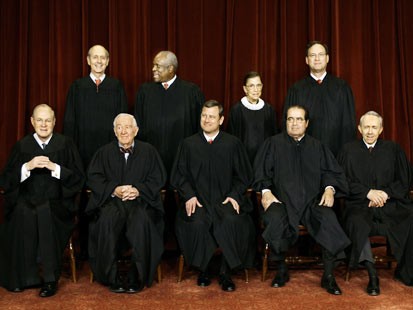
The White Wise Guys are Talking About Sotomayor

Can you see Sotomayor hanging around with these guys (and Ginsburg)?

The Sotomayor Supreme Court nomination is getting some tugs from those who think her comment about wise Latina women and white guys who haven't lived a life was a bad thing.

How can this comment even count after you look at her stellar achievements?  So what if she thinks Latina women are wise?  What is wrong with that?

To be honest, I don't think all Latina women are wise.  But a good number are.  If they have used their experience well, they become awesome people.  Some end up spending their lives doing too much for their husbands and watching too much TV.  But then that sounds like a lot of women in general.

Now, is it true that there are white guys out there that "haven't lived a life?"  I think many people agree that the white guys from our former presidential administration (Bush II) would be in this category, especially Bush, Cheney, and Rumsfeld.  I think Rove has actually lived a life and gone through a lot, but I don't think he has learned much from his experiences except to be mean.

If you want to use stereotypes, you can say that successful Latinas can be tough.  They work hard and study hard.  They are like Sotomayor.  I don't know if she and I could be friends, but I will certainly respect her as a Supreme Court judge.  I bet lots of white guys will too.

Sotomayor's "controversial comment" -

"I would hope that a wise Latina woman with the richness of her experiences would more often than not reach a better conclusion than a white male who hasn't lived that life,"


"Latina Woman - Tongue Tied Man," Washington Post, May 27, 2009

Wednesday, May 27, 2009

Thank Goodness for Justice - the nomination of Sotomayor


The writer of the article below is a law professor at the University of Houston.  He is well noted for his work on the DREAM Act and Civil Rights.
-
CNN
by Michael Olivas
May 26, 2009

 (CNN) -- I recently saw an old episode of "West Wing," where Edward James Olmos, playing a fictional Puerto Rican federal judge, was nominated to become the first Latino on the U.S. Supreme Court. I cried, thinking how remote this possibility seemed, yet how close.

Now that Judge Sonia Sotomayor has been nominated by President Barack Obama to the Court, that episode finally rings true. When I heard the news, I wept, for the long-overdue acknowledgement that Latinos matter.

Judge Sotomayor's life and legal career are arcs possible only in this country: a hardscrabble life in a south Bronx housing project, educational opportunities made possible by her own intelligence and hard work, and a legal career devoted to public service. When she assumes her position on the bench in October, no other justice will have had the depth of legal experience she holds, and none will have served as a trial judge.

The sum of her life is exactly what we should look for on this court: excellent academic credentials, an accomplished legal career in private and government practice, and appointments to federal benches by Republican and Democrat presidents. Her decisions have been well-reasoned and well-written, and she will ably take her place on the Supreme Court bench.

The search for a justice with "empathy" is no less coded than is the traditional search for "judicial temperament" and a person who will "judge, not legislate." All nominees have the requisite merit badges, as does Judge Sotomayor. And to make their way to such a short list, all have the combination of personal and professional lives that warrant their consideration.

What Sonia Sotomayor will have, as few other candidates, is the additional weight of historical expectations and the hopes of Latinos.

In today's culture, Latinos are marginalized and demonized and feared. In Judge Sotomayor's New York, roving gangs of thugs go "beaner hunting," looking to harm undocumented Mexicans. Such racial hatred knows no nuance, as one such mob killed a permanent resident Ecuadorian, thinking him to be Mexican.

Vigilantes along the Mexican border have taken the law of enforcement into their own hands. In cultural programming, this community is described as either lazy and shiftless, or stealing jobs from real Americans. They are typecast as drogeros or maids, long characterized as banditos or greasers. The racial rhetoric against Latinos has been tolerated for too long on cable television news and in political and polite discourse.

I will be carefully watching the confirmation hearings for the coded political messages, knowing that Justice-elect Sotomayor's many merits will ultimately win her confirmation. But also watching will be little girls in a south Bronx housing project, in the valley of South Texas, and in rural New Mexico.

Her service on our country's highest court will be the evidence that they, too, have reason to hope and to achieve. All of this country's citizens should realize that it is not just Latinos' dreams being realized, but our collective accomplishment. link to article


thanks to Tatcho Mindiola for passing this along

Tuesday, May 26, 2009

Sonia Sotomayor: She will not be like Alberto or Clarence

The Honorable Sonia Sotomayor, Nominee for the Supreme Court


Alberto Gonzalez embarrassed many of us.  He moved bad stereotypes of Mexican Americans back half a century.  Now Obama has nominated Judge Sonia Sotomayor for Supreme Court.  All indications are that she will do her job well and will help the image of Latinos in the U.S. and the world.

"Obama Picks Sotomayor for High Post," Boston Globe, May 26, 2009

 
link to Washington Post video of announcement

London Paper:   "Obama picks first Hispanic supreme court justice,"  The Guardian, May 26, 2009


,