Showing posts with label Senator John McCain. Show all posts

Tuesday, June 21, 2011

McCain blaming Immigrants for Fires

------------

John McCain blames illegal immigrants for Arizona wildfires

Activists condemn remarks as 'scapegoating' as 10,000 people remain unable to return to homes due to persistent fires

Wednesday, November 24, 2010

In Spanish: McCain on the line about the DREAM Act


TUCSON, Arizona.— Un grupo de estudiantes, muchos de ellos inmigrantes indocumentados, acudió hoy a las oficinas del senador John McCain en el sur de Arizona para solicitar su apoyo para la aprobación de la ley DREAM (por sus siglas en inglés: Development, Relief and Education for Alien Minors Act )...mas

Friday, January 23, 2009

The Gift of McCain's Loss

McCain's lost bid for the presidency may be a gift for DREAMers.  He's back to his maverick ways.  He has little to lose these days and will surely be a backer of the DREAM Act.  Immigration is back on his agenda
 
Senate Gets Reacquainted With McCain the Maverick
He Chides Republicans Who Hindered Clinton

By Shailagh Murray
Washington Post Staff Writer
Friday, January 23, 2009; Page A01

McCain's ...agenda in the Senate: immigration reform; overhauling energy and environmental policies; budget restraint; improving Social Security..
.more

Wednesday, November 26, 2008

McCain on Immigration in 2009

McCain can do more for the nation as a senator than as a president.

McCain will run again - and push immigration


...McCain said that he remains "honored" to have served Arizona and that he plans to run for reelection in 2010. He dismissed ideas that he might run for president again, saying that if he wins in 2010, he will pledge to serve a full six-year term.
ad_icon

He said he will continue pressing for immigration reform in the Senate, despite the issue's political pitfalls.

"Running for reelection has never been a concern of mine as far as issues like that are concerned. I intend to discuss that with the president-elect," he said of immigration.

Wednesday, November 5, 2008

McCain: really thinks Palin more trouble than a Pit Bull?


Wow! How word gets around.  According to the London Guardian:

"McCain has been telling friends in recent weeks that Palin is even more trouble than a pitbull"

Palin is not my favorite person, however, at one level it seems like a set up... make the woman look bad - Maybe if McCain would have been more careful in vetting her she wouldn't be in a situation where the entire world would be hearing she is worse than a pit bull.

Her campaign for vice-president could have pushed women in politics back twenty years - thank goodness Hilary was around to show that women in politics can be competent.


-----

http://www.guardian.co.uk/politics/blog/2008/nov/05/john-mccain-sarah-palin

Politics
McCain's verdict on Palin: more trouble than a pitbull
The British ambassador reveals what the defeated presidential candidate really thinks of his running mate


* Nicholas Watt
* guardian.co.uk,
* Wednesday November 05 2008 13.35 GMT


So now we know what John McCain really thinks of his running mate Sarah Palin – and that's not just because of the awkward body language between them during his concession speech in Phoenix, Arizona.

An exasperated McCain has been telling friends in recent weeks that Palin is even more trouble than a pitbull.

In one joke doing the rounds, the Republican presidential candidate has been asking friends: what is the difference between Sarah Palin and a pitbull? The friendly canine eventually lets go, is the McCain punchline.

McCain's joke is a skit on Palin's most famous line after she was picked as his surprise running mate. Palin delighted the Republican base when she said the only difference between a pitbull and a hockey mom was lipstick.

We owe the new glimpse into the tense McCain/Palin relationship to Sir Nigel Sheinwald, the British ambassador to Washington. Sheinwald recently wrote a lengthy assessment of McCain in a telegram that winged its way across the Atlantic to Whitehall.

The jaws of senior mandarins dropped when they read Sheinwald's account of McCain's thoughts on Palin which the ambassador reportedly picked up from a military friend of McCain's. The telegram was restricted to an even smaller group of people than usual for fear of another embarrassing leak. "We took one look at this and hid it away," one Whitehall source said...
more

Friday, October 17, 2008

The Faces We Make

We all make faces. But usually it is when we are alone or with someone who we really trust and are comfortable with. But WE DON'T do it in front of an audience, after a national debate, where news photographers are present.... esp. not a face where we are sticking out our tongue, obviously in disgust.

This post is not an endorsement for Obama. But I have to say, I'm glad they both didn't make a face. We can use this as a clue to what the candidate would do in future public situations they find distasteful.

It is hard to know what is going on with McCain. It is very likely that Obama might have the same feelings about his experience of the debate. But what you think in certain times needs to be very different than what behavior you display. McCain should have known better. I would encourage you to link to the comments to this WaPo post and see what people said about the photo:


link to WaPo photo and article


Washington Post
October 17, 2008


Counter-Intuition » Is This What McCain Thinks of Obama?


Psychologists believe that fleeting expressions can sometimes reveal how we really feel about other people. The photo above of John McCain, taken by Reuters photographer Jim Bourg, shows the presidential candidate going the wrong way around the table after the third presidential debate and sticking out his tongue in the direction of Barack Obama. Does it unwittingly convey what McCain really thinks of his opponent?

It seems unfair to pick a single photo to describe how a candidate feels -- all of us look like idiots during some part of each day. But we use expressions as guides all the time. Here is how John McCain, Hillary Clinton, and Barack Obama want us to see them. If unflattering pictures are deceptive, what about the flattering ones?

Or could it be that photos -- at least the ones that are not posed -- tell us something important? Psychologists such as Paul Ekman and John Gottman believe that microexpressions, rapid expressions often overlooked in everyday interactions, can give us important insights into a person's innermost thoughts and feelings.

So is that McCain photo a hatchet job, or a window into his soul?

Friday, October 3, 2008

Zigzagging to Public Opinion on Immigration

The conservative magazine Economist is not my favorite, yet this section of an essay on immigration provides more information than others have...regardless of their position.
---
Blowing in the wind
http://www.economist.com/displaystory.cfm?story_id=12321563

Until recently Mr McCain’s record on immigration was so liberal that the National Council of La Raza has twice given him an award for his political work. He has long fought for “comprehensive” immigration reform—code for any change that would provide a route to citizenship for illegals. This effort culminated in the Immigration Reform Act of 2007, which would have allowed virtually all illegal immigrants to remain in the country on a special “Z” visa. After paying a fine and back taxes, they could apply for permanent residency and, eventually, citizenship.

Although the bill also contained money for border security and was supported by George Bush, many of Mr McCain’s fellow Republicans turned against a measure that opponents had successfully labelled an “amnesty”. It died in June, 2007 following an extraordinary barrage of phone calls by anti-immigration groups. The episode revealed one of the few clear lessons of the politics of immigration: the people who feel strongly about it often feel very strongly indeed.

When Mr McCain talks about the issue these days he sounds chastened. The failure of immigration reform taught him a lesson, he says—that Americans will tolerate a move to legalise illegal immigrants only if they are assured the border has been fixed. The senator plans to achieve that through a combination of walls and electronic surveillance. Only when the governors of the border states say the border is secure, will he do something about America’s 12m illegal immigrants.

Unless the governors are prepared to overlook quite a lot, it is unlikely that a President McCain would ever get around to the second stage of his plan. America’s border with Mexico is 2,000 miles (3,200km) long. It runs through cities, mountains, rivers, desert and Indian reservations. It is possible to slash crossings in a particular area by flooding it with guardsmen or building walls. It is not, however, remotely possible to seal the whole thing. Britain, an island nation with a more centralised government and a far tighter surveillance web, contains illegal immigrants from as far away as China.

Mr McCain’s move rightward on the immigration issue has given Mr Obama considerable room to manoeuvre. He has nonetheless held a fairly orthodox liberal line on illegal immigration. He supports giving illegals a route to citizenship and promises to make it a priority during his first year in office. During the primaries he expressed support for Eliot Spitzer, then the governor of New York, who was trying to grant driving licences to illegals. This is a totemic issue for liberal Hispanics, but unpopular with many others.
Unwelcome guests

Like many politicians with roots in troubled cities, Mr Obama is much less keen on increasing the number of guest workers. This was also part of the immigration bill, but, thanks in part to Senator Obama, it was severely pruned even before the measure died. He backed a measure cutting the number of guest workers from 400,000 to 200,000. He introduced another measure that would have banned companies from employing guest workers in areas of high unemployment and required them to pay prevailing wages. He also supported a move to end the programme after five years. Since the programme was about the only thing many Republicans liked about the immigration bill, this ruined its chances.

Just as a President McCain would have to soften his stance on border security in order to pass an immigration bill, so a President Obama would have to tone down his anti-business rhetoric. Without support from businesspeople it will be extremely difficult to persuade Republican politicians to go along with reform. It is especially important to get farmers onside. They often depend on illegal labour and can be a heavy counterweight to nativist sentiments in rural areas. They also have powerful lobbyists in Washington.

The differences between the candidates’ positions are less striking than the contrast in how they speak about illegal immigration. Mr Obama talks of giving hope to families living in fear of raids and deportation. Mr McCain goes no further than a general expression of sympathy for “God’s children”. But he feels the pain of ordinary Americans who fret that they are being overrun.

Mr McCain’s stance on immigration is closer to that of the average American. Yet Mr Obama appears to have the edge. He can point out, fairly, that his opponent has flip-flopped on the issue. His liberal stance impresses Latinos, who remain angry at the Republican party for caving in to nativist pressure last year. They account for more than a tenth of the electorate in Arizona, California, Colorado, Florida, Nevada, New Mexico, New York and Texas. They may decide extremely close races even in states where they are thin on the ground, like Wisconsin.

Immigration is also one of the few areas where Mr Obama’s race helps him. Blacks are more threatened by competition from immigrants, particularly illegal ones. Many fights in schools and prisons are between blacks and Latinos. As a result, a black politician who supports immigration reform comes across as particularly brave.

Yet the issue can turn, and quickly. An effective ad campaign could dredge up submerged fears of immigrants and push the issue close to the top of people’s concerns. As the economy sours, Americans will probably become less tolerant of those who compete for their jobs. An illegal immigrant could commit a horrific, widely-publicised crime. Working-class whites are already wary of Mr Obama. If immigration suddenly rises from the swamp, they may well run straight into the arms of the newly tough Mr McCain.
.

Sunday, September 28, 2008

How Soon We Forget - the Keating Five

Have you every known anyone who was the wildest kid in town, but in his/her 50s says they always lived a placid, upright life?  What can you do when they tell you this but smile and think to yourself, right! why are you lying to yourself this way?  You don't want to respond directly because you know they won't hear you.  The lie has gotten so big in their head that they believe their own made up story.

I wonder if that has happened with McCain and his adventures as part of the Keating Five.  Only difference is that McCain was no kid, he was already in his fifties.

--
Rosa Brooks:
Keating 5 ring a bell?
McCain's past collides with the present Wall Street debacle.
Rosa Brooks
September 25, 2008
Once upon a time, a politician took campaign contributions and favors from a friendly constituent who happened to run a savings and loan association. The contributions were generous: They came to about $200,000 in today's dollars, and on top of that there were several free vacations for the politician and his family, along with private jet trips and other perks. The politician voted repeatedly against congressional efforts to tighten regulation of S&Ls, and in 1987, when he learned that his constituent's S&L was the target of a federal investigation, he met with regulators in an effort to get them to back off.

That politician was John McCain, and his generous friend was Charles Keating, head of Lincoln Savings & Loan. While he was courting McCain and other senators and urging them to oppose tougher regulation of S&Ls, Keating was also investing his depositors' federally insured savings in risky ventures. When those lost money, Keating tried to hide the losses from regulators by inducing his customers to switch from insured accounts to uninsured (and worthless) bonds issued by Lincoln's near-bankrupt parent company. In 1989, it went belly up -- and more than 20,000 Lincoln customers saw their savings vanish.

Keating went to prison, and McCain's Senate career almost ended. Together with the rest of the so-called Keating Five -- Sens. Alan Cranston (D-Calif.), John Glenn (D-Ohio), Don Riegle (D-Mich.) and Dennis DeConcini (D-Ariz.), all of whom had also accepted large donations from Keating and intervened on his behalf -- McCain was investigated by the Senate Ethics Committee and ultimately reprimanded for "poor judgment."

But the savings and loan crisis mushroomed. Eventually, the government spent about $125 billion in taxpayer dollars to bail out hundreds of failed S&Ls that, like Keating's, fell victim to a combination of private-sector greed and the "poor judgment" of politicians like McCain.

The $125 billion seems like small change compared to the $700-billion price tag for the Bush administration's proposed Wall Street bailout. But the root causes of both crises are the same: a lethal mix of deregulation and greed.

Today's meltdown began when unscrupulous mortgage lenders pushed naive borrowers to sign up for loans they couldn't afford to pay back. The original lenders didn't care: They pocketed the upfront fees and quickly sold the loans to others, who sold them to others still. With the government MIA, soon mortgage-backed securities were zipping around the globe. But by the time many ordinary people began to struggle to make their mortgage payments, the numerous "good" loans (held by borrowers able to pay) had gotten hopelessly mixed up with the bad loans. Investors and banks started to panic about being left with the hot potato -- securities backed mainly by worthless loans. And so began the downward spiral of a credit crunch, short-selling, stock sell-offs and bankruptcies.

Could all this have been prevented? Sure. It's not rocket science: A sensible package of regulatory reforms -- like those Barack Obama has been pushing since well before the current meltdown began -- could have kept this most recent crisis from escalating, just as maintaining reasonable regulatory regimes for S&Ls in the '80s could have prevented that crisis (McCain learned this the hard way).

But, despite his political near-death experience as a member of the Keating Five, McCain continued to champion deregulation, voting in 2000, for instance, against federal regulation of the kind of financial derivatives at the heart of today's crisis.

Shades of the Keating Five scandal don't end there. This week, for instance, news broke that until August, the lobbying firm owned by McCain campaign manager Rick Davis was paid $15,000 a month by Freddie Mac, one of the mortgage giants implicated in the current crisis (now taken over by the government and under investigation by the FBI). Apparently, Freddie Mac's plan was to gain influence with McCain's campaign in hopes that he would help shield it from pesky government regulations. And until very recently, Freddie Mac executives probably figured money paid to Davis' firm was money well spent. "I'm always in favor of less regulation," McCain told the Wall Street Journal in March.

These days, McCain is singing a different tune.

"There are no atheists in foxholes and no ideologues in financial crises," Fed Chairman Ben Bernanke said last week, explaining the sudden mass conversion of so many onetime free marketeers into champions of robust government intervention. Fair enough. But as you try to figure out what and who can get us out of this mess, beware of those who now embrace regulation with the fervor of new converts.

rbrooks@latimescolumnists.com


for link to LAT article click
here

Tuesday, September 23, 2008

John McCain: It's OK to be undocumented if you are Irish

So is it a color thing for McCain?
--
McCain Bemoans Fate of Undocumented Irish in America
By Robert Barnes
Washington Post
SCRANTON, Pa. -- An issue that has been largely missing from the English-language presidential debate recently -- immigration reform -- made a brief return here this morning when Republican John McCain addressed a largely Irish-American crowd.

McCain said there were "50,000 Irish men and women in this country illegally who want to become citizens'' and that "we have to give them a path to citizenship."

McCain was a leader of the failed effort in Congress last year to overhaul the nation's immigration policies, and told the audience that it was an example of his willingness to take on controversial issues despite the political costs -- a point McCain has been making of late in ads playing on Spanish-language radio stations in key states, but by and large eschewed before non-Hispanic audiences.

"It didn't make me the most popular member of my own party and it almost cost me the nomination of my party," McCain said.

McCain said it also showed he had a willingness to reach across the aisle to form common ground -- he specifically mentioned Sen. Edward M. Kennedy (D-Mass.), a hero in the Irish community -- which he said Democratic rival Barack Obama did not possess.

"To preserve that fragile coalition, I had to sometime take votes which were not popular," McCain said. "Senator Kennedy took votes that were not popular. Senator Obama took a hike."

McCain said he wanted to see tighter border security, a more highly regulated temporary worker program with penalties for companies that hire illegal workers and also a way for those here illegally to become citizens, although not ahead of those who have played by the existing rules.

"This nation is all the stronger -- this nation is stronger, this nation is stronger -- for the infusion of fresh blood and vitality that has come to this nation wave after wave: Irish, Italian, Poles, everybody who's come to this nation has enriched our nation, including our Hispanic citizenry. OK? That's what America's all about."

Still, immigration reform is not something that McCain often mentions as a priority, unless the subject is something of particular interest to his audience, or he is asked about it.

Posted at 2:15 PM ET on Sep 22, 2008

McCain goes back a few centuries


While in Paris last summer, my husband really wanted to see the Bastille - you know, that place where lots of people lost their heads - it is the place where the guillotine became famous...

Anyway, we hadn't looked at our tourist books well enough to know the place had been demolished.  So we walked across downtown Paris, looking for the place of doom.  When we found the location, it was just a concrete plaza with some benches.  We sat down a while to take a break before heading back ---  there were a few people around, looking kind of somber.

But I swear to you, the place had a heavy, nasty feeling to it.  The bad energy was still there... even if you aren't into New Age stuff, you have to agree that places where thousands of people were killed have to leave behind some kind of negative energy.

Anyway -- after reading George Will's essay, I wonder if McCain was Robespierre in a previous life...
----
McCain Loses His Head
By George F. Will
Washington Post
Tuesday, September 23, 2008; A21

"The queen had only one way of settling all difficulties, great or small. 'Off with his head!' she said without even looking around."

-- "Alice's Adventures in Wonderland"

Under the pressure of the financial crisis, one presidential candidate is behaving like a flustered rookie playing in a league too high. It is not Barack Obama.

Channeling his inner Queen of Hearts, John McCain furiously, and apparently without even looking around at facts, said Chris Cox, chairman of the Securities and Exchange Commission, should be decapitated. This childish reflex provoked the Wall Street Journal to editorialize that "McCain untethered" -- disconnected from knowledge and principle -- had made a "false and deeply unfair" attack on Cox that was "unpresidential" and demonstrated that McCain "doesn't understand what's happening on Wall Street any better than Barack Obama does."

To read the Journal's details about the depths of McCain's shallowness on the subject of Cox's chairmanship, see "McCain's Scapegoat" (Sept. 19, Page A22). Then consider McCain's characteristic accusation that Cox "has betrayed the public's trust."

Perhaps an old antagonism is involved in McCain's fact-free slander. His most conspicuous economic adviser is Douglas Holtz-Eakin, who previously headed the Congressional Budget Office. There he was an impediment to conservatives, including then-Rep. Cox, who, as chairman of the Republican Policy Committee, persistently tried and generally failed to enlist CBO support for "dynamic scoring" that would estimate the economic growth effects of proposed tax cuts.

In any case, McCain's smear -- that Cox "betrayed the public's trust" -- is a harbinger of a McCain presidency. For McCain, politics is always operatic, pitting people who agree with him against those who are "corrupt" or "betray the public's trust," two categories that seem to be exhaustive -- there are no other people. McCain's Manichaean worldview drove him to his signature legislative achievement, the McCain-Feingold law's restrictions on campaigning. Today, his campaign is creatively finding interstices in laws intended to restrict campaign giving and spending. (For details, see The Post of Sept. 17, Page A4; and the New York Times of Sept. 20, Page One.)

By a Gresham's Law of political discourse, McCain's Queen of Hearts intervention in the opaque financial crisis overshadowed a solid conservative complaint from the Republican Study Committee, chaired by Rep. Jeb Hensarling of Texas. In a letter to Treasury Secretary Henry Paulson and Fed Chairman Ben Bernanke, the RSC decried the improvised torrent of bailouts as a "dangerous and unmistakable precedent for the federal government both to be looked to and indeed relied upon to save private sector companies from the consequences of their poor economic decisions." This letter, listing just $650 billion of the perhaps more than $1 trillion in new federal exposures to risk, was sent while McCain's campaign, characteristically substituting vehemence for coherence, was airing an ad warning that Obama favors "massive government, billions in spending increases."

The political left always aims to expand the permeation of economic life by politics. Today, the efficient means to that end is government control of capital. So, is not McCain's party now conducting the most leftist administration in American history? The New Deal never acted so precipitously on such a scale. Treasury Secretary Paulson, asked about conservative complaints that his rescue program amounts to socialism, said, essentially: This is not socialism, this is necessary. That non sequitur might be politically necessary, but remember that government control of capital is government control of capitalism. Does McCain have qualms about this, or only quarrels?

On "60 Minutes" Sunday evening, McCain, saying "this may sound a little unusual," said that he would like to replace Cox with Andrew Cuomo, the Democratic attorney general of New York who is the son of former governor Mario Cuomo. McCain explained that Cuomo has "respect" and "prestige" and could "lend some bipartisanship." Conservatives have been warned.

Conservatives who insist that electing McCain is crucial usually start, and increasingly end, by saying he would make excellent judicial selections. But the more one sees of his impulsive, intensely personal reactions to people and events, the less confidence one has that he would select judges by calm reflection and clear principles, having neither patience nor aptitude for either.

It is arguable that, because of his inexperience, Obama is not ready for the presidency. It is arguable that McCain, because of his boiling moralism and bottomless reservoir of certitudes, is not suited to the presidency. Unreadiness can be corrected, although perhaps at great cost, by experience. Can a dismaying temperament be fixed?

georgewill@washpost.com

..
link to image of John McCain
link to image of Robespierre

Monday, September 22, 2008

Immigration Roller Coaster for McCain

---
McCain zigzags on immigration
By: Gebe Martinez
September 17, 2008 04:49 PM EST
POLITICO.COM

Republican presidential nominee John McCain is zigzagging again.

On comprehensive immigration legislation, McCain has not been a “straight-talker,” nor has he been a classic flip-flopper. You know the type: “He was for it before he was against it.” No, McCain has chosen a more twisted path.

Well-known is McCain’s co-sponsorship with Sen. Edward M. Kennedy (D-Mass.)of the 2006 Senate immigration bill, which proposed combining border security with tougher employer sanctions, temporary worker visas and legalization of about 12 million undocumented immigrants. When Republican voters protested in 2007, McCain backed away from the measure, calling for “border security first.”

Then, a few weeks ago, he asked Latino community leaders to “trust” him on the immigration issue and uttered “comprehensive” — as in “one bill” — for the first time in months. But then came a hard right turn at the Republican National Convention, when the party adopted a conservative platform that rejected McCain’s support for the comprehensive measure. The language was a far cry from what Karl Rove negotiated for President Bush’s 2004 reelection campaign.

A few days ago, in what was clearly an insult to anyone who participated or watched the Senate immigration debates, McCain issued a Spanish-language ad that wrongly blamed his Democratic rival, Barack Obama, and fellow Democrats for blocking approval of the Senate’s broad immigration bill. But the bill fell when only 12 of the 49 Senate Republicans supported it.

The ad is jaw-dropping stuff. It contends Obama is “not ready to lead” because he introduced and voted for “poison pill” amendments — language that, if approved, would have undermined the delicately negotiated bipartisan bill, which Obama supported. As opposed to McCain, who turned the bill over to the White House and Sen. Jon Kyl (R-Ariz.) so that he could go to the campaign trail, abandon his full-throated support of his own measure and talk about border security first?

The ad targeted Latino voters in Colorado, Nevada and New Mexico, leaving Latino political leaders disappointed, frustrated and confused by the zigzagging.

They question McCain’s ability to lead on immigration as president if he cannot stand up to his party conservatives as a candidate.

“Having worked with Sen. McCain for a long time [on comprehensive immigration reform], I truly believe he’s a firm believer on this issue,” said Cecilia Munoz, vice president of National Council of La Raza, the civil rights group that hosted McCain this summer when he appealed for trust and understanding. However, she added, “the fact that the [GOP] platform turned out so differently than Sen. McCain’s position has confused some people as to whether or not he can deliver his party.”

Frank Sharry, executive director of America’s Voice, a pro-comprehensive immigration group, is less sanguine. He said conservatives have remained steadfast in their opposition to visa expansions and other parts of the bill, favoring only tough enforcement such as the recent immigration raids that rounded up hundreds of suspected illegal immigrant workers, separated families and instilled fear.

“We may never move legislation even if ‘President’ McCain wants to move the legislation,” Sharry said. Expecting a better outcome after his rhetorical shifts to the right “is like giving an alcoholic a drink and hoping they get sober tomorrow.”

The fear among Latinos is palpable. Harsh anti-immigrant rhetoric often makes no distinction between legal and illegal immigrants or between native-born and foreign-born Latinos. While the issue is not the top concern of Latino voters, according to public polls, it is a “threshold” issue that separates “who the good guys are and who the bad guys are,” Munoz said.

A survey conducted last month in Colorado, New Mexico, Nevada and Florida for NDN, a progressive group, showed two-thirds of all voters and at least 73 percent of Hispanic voters supporting the broad immigration plan. Republicans fared poorly on their handling of the issue in the poll that was conducted in the days before McCain chose Alaska Gov. Sarah Palin to be his running mate — a choice that wowed conservatives but leaves a question mark on the immigration issue.

In reaching out to Latino voters, McCain has highlighted his serious, decades-long work on behalf of Hispanics with hopes of overcoming the negative Republican brand. But the party’s tough stance on immigration has hurt McCain. “I think the die is cast when it comes to the immigration issue,” said NDN’s pollster, Sergio Bendixen.

Obviously, McCain tries to sound tough on immigration to avoid further angering his party’s conservative base. With the national media paying scant attention to the issue — a situation that should end when the debates begin — McCain has rarely been called out for playing to both sides.

The closest McCain and Obama came recently to exchanging immigration views occurred last week.

McCain’s campaign released a letter to the Congressional Hispanic Caucus Institute that explained his last-minute decision not to attend their gala. The letter foreshadowed the attack about to be released in his Spanish-language ad.

“My efforts were stymied by ideologues in both parties, including my opponent, who voted five separate times for poison pills by special interests to kill immigration reform, votes that Sen. Kennedy and I opposed,” McCain stated. “I will first convince the American people that we can secure our borders. I will then work to enact a practical and fair immigration policy, one that ensures respect for the laws of this country, recognizes the important economic contribution of immigrant laborers, apprehends those who came here illegally to commit crimes, and deals practically and humanely with those who came here to build a better, safer life for their families, without excusing the fact that they came here illegally.”

Later, Obama reaffirmed his support for the immigration bill and struck back: “You’ve got to ask yourself: If Sen. McCain won’t stand up to opponents of reform at his own convention, how can you trust him to stand up for change in Washington?”

Obama told the 2,300-member, bipartisan audience, “Well, I don’t know about you, but I think it’s time for a president who won’t walk away from comprehensive immigration reform when it becomes politically unpopular.”

Sen. Robert Menendez (D-N.J.) said McCain should have shown up because the Latino vote will matter this year. “He gave in on the Republican platform,” said Menendez. “He certainly has, in my mind, abandoned the [Latino] community.”

If Menendez is wrong, McCain can clear up the ongoing confusion by answering the question posed in his campaign ad: “Which side are they on?”

Gebe Martinez is a longtime journalist in Washington and a frequent lecturer and commentator on the policy and politics of Capitol Hill.

© 2008 Capitol News Company, LLC

Sunday, August 31, 2008

McCain's Delirium


For me it isn't about Democrats and Republicans, although I must say that the GOP has really entrenched itself into the Dark Side these past eight years.  Democrats oftentimes aren't any better.  But once in a while the ridiculous nature of either party stands out so much it is impossible to stay quiet...  As has happened with the nomination of Governor Palin for VP.

Obama hasn't made the same inane mistakes as McCain, but he is yet to convince me he can deal with a hard headed and often unintelligent Congress...


"[McCain's]... last-minute choice of a woman he barely knows to be his running mate underscored concerns about his impulsiveness, and her utter lack of experience in world affairs undermined his claimed seriousness about national security." Washington Post

-----
The McCain Paradox
Americans know the man better than they understand where he would lead the country.
Washington Post
Editorial
Monday, September 1, 2008; A12

LAST WEEK, the Democrats faced the task of presenting a relative newcomer to politics as their nominee for president. This week, the Republicans face a different challenge, one greatly complicated now by the anticipated arrival of Hurricane Gustav on the Gulf Coast. After a long career of public service, and on his second presidential campaign, John McCain is a familiar figure to many Americans. But where he would lead the nation is less clear to many, and his vice presidential selection last week didn't help. Out of respect for potential hurricane victims in Mississippi, Louisiana or Texas, Republicans may nominate Mr. McCain without the usual fanfare of a party convention -- and without nearly as much public attention as Barack Obama attracted last week. That only heightens the difficulty of the task Mr. McCain faces: to offer a vivid picture of why he wants to be president and what he would hope to accomplish.

Mr. McCain's journey to this nomination in many ways encapsulated his legend as a fighter, maverick and man of principle. Last summer, with his campaign broke and his chances written down to zero by the experts, Mr. McCain threw away the standard playbook -- and much of his staff -- and appealed directly to the people of New Hampshire in a grass-roots, no-frills campaign. Though the war in Iraq was deeply unpopular, he refused to trim his conviction that America should stick with it. As opponents reversed long-held positions to appeal in ugly ways to anti-immigrant sentiment, Mr. McCain insisted on his more humane approach.* And against considerable odds, he outlasted the field.

In the half year since clinching, however, Mr. McCain has failed to offer a fully coherent case for his presidential bid. Reformer, fiscal hawk, outsider, insider, values candidate, wartime leader -- he has tried on each of these. He has offered specific proposals -- corporate tax cuts, offshore drilling, League of Democracies -- but has yet to assemble them into a framework of priorities. Having at one time opposed President Bush's tax cuts in part because of their unfairness, Mr. McCain doubled down on them, with scant concern for inequality or fiscal responsibility. His last-minute choice of a woman he barely knows to be his running mate underscored concerns about his impulsiveness, and her utter lack of experience in world affairs undermined his claimed seriousness about national security.

One reason for the incoherence undoubtedly is that Mr. McCain has the misfortune to share party membership with a deeply unpopular incumbent. Asserting independence without offending the dwindling band of Mr. Bush's loyalists hasn't been easy. But at the convention, Mr. McCain has to draw a line. Does he offer "four more years," as the Democrats allege? If not, how will he change course?

Over the course of his career, Mr. McCain has broken with his party and even risked his political future in the service of principle. Campaign finance, climate change, immigration, the Iraq war surge, opposition to torture -- given how few contemporary politicians can cite even one such occasion of risk-taking, Mr. McCain's list has to win admiration. But to win votes in November, being admirable is not enough. Mr. McCain has to convince Americans that he has a vision of where he wants to lead the country, and the judgment and character to do so.

for link to WaPo editorial click here


*Some pro-immigrant academic colleagues of mine say that McCain's immigration position was not so bad earlier in the campaign...who knows what his policy is now.

Saturday, August 30, 2008

Palin as VP? Rove Must Have Been Asleep


If McCain were to be elected and the moment arose that Palin would have to take over, I might consider moving to some isolated area in Montana and hope not to see any other human beings for a while.

If someone believes that being the Mayor of a suburb with a population of 8,000 people is enough to prepare one for the presidency, then they have lost their marbles. Looks like Palin already has by accepting McCain's deranged offer.

Perhaps all of this has come about because of the GOPs desperation - they know they are in trouble, and have resorted to schemes that would make even Karl Rove shudder.


a few thoughts on Palin:

while Hillary is not my favorite person - I must say, Palin is no Hillary Clinton -

as for luck less VP candidates - Palin makes Dan Quayle look good. 

Does anyone see similarities to GHW Bush's pick of Clarence Thomas for Supreme Court?


P.S. turns out Rove wasn't asleep after all.  McCain just ignored him - see Huffington Post article by S.Blumenthal "Why Palin? McCain vs. Rove"
---
--

Mr. McCain's Choice
Alaska Gov. Sarah Palin has some appealing qualities. But could she step in as president?

Saturday, August 30, 2008; A22
Washington Post Editorial

AT FIRST GLANCE, there appears to be much to admire in Gov. Sarah Palin of Alaska, Sen. John McCain's choice as his vice presidential running mate. Just 44 years old, she is a talented and upbeat person who excelled in basketball and beauty pageants, music and moose hunting. Since entering politics she has shown independence and a clear moral compass. On Alaska's oil and gas commission, she blew the whistle on a fellow Republican's conflict of interest. Her 2006 campaign for the state's highest office began as an insurrection against her party's old guard. In choosing her, Mr. McCain said that Ms. Palin's experience equips her to help "shake up Washington."

There is no surprise in the fact that Ms. Palin is a conservative on the issues that matter most to the Republican Party's base. She is an opponent of abortion and a particularly outspoken advocate of letting oil and gas companies drill on public lands -- including Alaska's Arctic National Wildlife Refuge, a position that not even Mr. McCain, who favors offshore drilling, has embraced. But politically, Mr. McCain's choice was a stunner. He bypassed safer choices, such as Mitt Romney, the former governor of Massachusetts, and Minnesota Gov. Tim Pawlenty, in favor of a relative unknown.

Now Mr. McCain can say he is giving voters a chance to make history by electing the first woman to be vice president. He is also hoping Ms. Palin's down-to-earth "hockey mom" persona will appeal to those working-class Democrats, especially women, who voted for Sen. Hillary Clinton in the primary -- though many supporters of abortion rights may be insulted by that proposition.

But the most important question Mr. McCain should have asked himself about Ms. Palin was not whether she could help him win the presidency. It was whether she is qualified and prepared to serve as president should anything prevent him from doing so. This would have been true for any presidential nominee, and it was especially crucial that Mr. McCain -- who turns 72 today -- get this choice right. If he is elected, he will be the oldest man ever to serve a first term in the White House.

In this regard, count us among the puzzled and the skeptical. Not long ago, no less a Republican strategist than Karl Rove belittled Virginia Gov. Tim Kaine as a potential running mate for Barack Obama, noting that picking him would appear "intensely political" because Mr. Kaine's experience consisted of only three years as governor preceded by the mayoralty of Richmond, which Mr. Rove called "not a big town."

Using Mr. Rove's criteria, Ms. Palin would not fare well. Her executive experience consists of less than two years as governor of her sparsely populated state, plus six years as mayor of Wasilla (pop. 8,471). Absorbed in Alaska's unique energy and natural resource issues, she has barely been heard from in the broader national debates over economic policy and health care. Above all, she has no record on foreign policy and national security -- including terrorism, which Mr. McCain posits as the top challenge facing America and the world. Once the buzz over Ms. Palin's nomination dies down, the hard questions about her will begin. The answers will reflect on her qualifications -- and on Mr. McCain's judgment as well.

for link to WaPo editorial click here

Friday, August 29, 2008

The Word on McCain from London


I just saw the McNeil Lehrer Report discussing Obama at the Democratic convention.... how in the world can anyone compare Gov. Palin, a former beauty queen, to Obama, a Harvard Law School Graduate, who was president of the Harvard Law Review? - the journalist from Pennsylvania who angrily said both Palin and Obama were equally not experienced must have been asleep when he was speaking. 

The woman journalist from Tampa said that Michelle Obama was a liability to her husband because she was seen as aggressive and assertive? Since when are women supposed to be quiet? Especially a woman with an Ivy League legal education?

The woman from Tampa reminded me of those things I read when I was researching the cemetery book - like the 1936 University of Texas dissertation on plantations in Texas that said a certain black state representative from Texas (in the 1890s) was too assertive and haughty.

Truthfully, both parties fudge and play their games, but these kind of maneuvers are disgusting.

If Palin is only a heartbeat away from the Oval Office, you can take it another way, considering McCain's history with women, his wife should be careful.

a word from the London Guardian:

click here to see video on the Guardian's response to McCain's choice of running mate. 

P.S. Take a look at Palin's 2008 hairdo, it looks like the hair of a woman belonging to the Jehovah's Witnesses (or similar fundamentalist religious denomination)
.
second photo - John McCain in 1973

Saturday, July 19, 2008

Just in case you aren't voting for Obama

A number of people I know are planning to vote for McCain. Some say it is because Obama doesn't have enough experience, others don't think Obama can get elected anyway....etc.

Just in case you are one of those people, take a look at this article on McCain and Immigration from The Progressive.

---

McCain Not a Hero on Immigration

Wednesday 16 July 2008
by: Ramon Castellblanch, The Progressive

Sen. John McCain is no hero on immigration.

His 2006 immigration proposal, which he has disowned in front of anti-immigrant audiences, would have meant cheap labor on both sides of the border and would have made a joke of the idea of integrating immigrants into our way of life. And it would have allowed the heartless immigration raids on Latino workplaces to continue, breaking up families and disrupting communities.

McCain's proposal would have done nothing to address the root causes behind the immigration problem: low-wage businesses here and south of the border and a U.S. trade policy that is devastating the Mexican countryside.

Low-wage U.S. employers like those in agribusiness and the construction industry like access to the desperate Mexican and Central American economic refugees so that they can avoid paying fair wages. McCain's proposal would have turned a blind eye to such practices.

Mexicans are being forced north by pathetic wages and squalid living conditions. They are being driven to our country by U.S.-subsidized corn being dumped on the Mexican market due to trade agreements such as NAFTA, ruining many of their small farmers and leaving them with no choices but immigration or destitution. McCain would have ignored all of this.

For the immigrants who are here, we need an immigration policy that reflects American values of democracy and justice. Rather than more fences and raids on Latino communities, we need an orderly approach to bring immigrants into our system.

To the extent that Sen. Barack Obama has weighed in on this issue, there is reason for hope.

He supported efforts to fix the parts of the McCain immigration bill that would have made its path to citizenship practically useless. Obama voted to limit use of an untested point system for immigration, a guestworker program that would have made it easier for employers to deny immigrants rights, and an unworkable provision that immigrants had to leave our country before they could apply to re-enter it. While it remains to be seen how seriously Obama, if elected, will address the root causes of our immigration problems, at least he's suggested he's considering ideas like reopening NAFTA and calling off the immigration hounds who are terrorizing U.S. Latino communities.

What we need for an immigration policy is a plan that would improve the standard of living on both sides of the border, make immigrants strong supporters of our country's finest values, and stop the senseless demonizing of Latinos. McCain's proposal, even when he embraced it, did none of these things; Obama's positions open the conversation.

---------

Ramon Castellblanch is associate professor of health education at San Francisco State University. He can be reached at pmproj@progressive.org

for link to article click here

Tuesday, July 15, 2008

The Blogosphere on McCain's Adventures as a Politician

Responding to McCain's flip flop on the DREAM ACT, Citizen Orange posted a commentary on the blogosphere regarding McCain's latest foray into the immigration debate, see below.

For recent dreamact post on McCain's position: McCain Flipflops on the DREAM ACT, July 14, 2008

-----

When 'Progressive' Does Not Equal Pro-Migrant by Kyledeb


Much ado has been made over McCain's "flip-flop" on migration. Mainstream progressive bloggers used to call migration a "pet issue" that wasn't worth blogging about. It used to be a monumental struggle for bloggers like myself to get people to pay attention to migration policy. Policy that I felt would not only define the future of the United States, but the future of the entire hemisphere, maybe even the world, for centuries to come.

It's hard to believe how far we've gotten since then.
Now, not a day goes by where Media Matters forgets to remind us that McCain has changed his stance on migration. Alternet, led by Joshua Holland, has it's own special migration section, and Firedoglake has brought on David Neiwart to blog mainly on migration.

Pro-migrant bloggers like myself, and Latino bloggers have united to create the community blog, The Sanctuary, which was recently contacted by CNN after the presidential candidates failed to answer a questionnaire we put out. These are all good developments. The SanctuarySphere is alive and growing.

Still, as migration has moved from a "pet issue" to something most progressive bloggers familiar with, a tension is emerging between the pro-migrant stance and the progressive stance. The mainstream progressive blogosphere, led by blogs such as Daily Kos, Open Left, MyDD, and Firedoglake, exists to elect "more and better Democrats" as has been stated over and over again. My mission as a pro-migrant blogger, by contrast, is to advance the cause of migrant justice. At times these goals overlap, but not always.

The issue of how to treat McCain is a primary example. As a migrant advocate, my job is not to deride McCain for "flip-flopping", but to rebuke him when he sells out migrants, and to praise him when he advances the migrant cause. In fact, the only political power that migrant advocates have in a national two-party system, is when they are able play the two major parties off of each other.

Despite the fact that McCain "flip-flopped" on migration his selection as the presumptive Republican nominee has been a very good thing for migrants. You see, people forget that there is a subset of Democrats that are very anti-migrant.

As McCain was battling for the Republican nomination, Democrat congressman from North Carolina, Heath Shuler, was pushing the very anti-migrant SAVE Act. If Mitt Romney or Tom Tancredo had been selected as the Republican nominees, Democrats would have had no qualm with pushing the SAVE Act forward because migrant advocates like myself would have nowhere to run. We'd be forced to elect a Democrat anyway.

Even with the relatively pro-migrant McCain at the forefront of the Republican party, according to a recent Politico article, "House and Senate Democrats have been outbidding the White House on spending for immigration enforcement". Where was the mainstream progressive blogosphere when that article came out?

It's like I said, 'Progressive' does not always mean pro-migrant.

for link to Citizen Orange post click here

Monday, July 14, 2008

Obama and South America

McCain, in a politician's usual way (these days) of criticizing his opponent, suggested that Obama has not traveled enough and should go to South America.  First I have to say mention George W. Bush had NEVER been to Europe before he was U.S. President and that seemed to be ok with everybody (especially the Supreme Court) in 2000.

This time McCain is right - although his recommendation could ultimately hurt his campaign.  There are lots of people (at least in Argentina) that really dislike Obama - there is a story going around that Obama would only favor Black people and that he doesn't like South Americans.  Maybe it's time for the Obama campaign to do a little research below the Equator.

There is a huge amount of communication between the people of Argentina (and Brazil, and Chile, and Peru) and the United States, especially now with the internet.  This is mostly through immigration, but it is also through business connections.  So don't think what another country says about the candidate won't matter -  it could be just the opposite.  Americans who hear the political opinions of other countries might take those more seriously - since there is/has been a consensus that the U.S. media gets it all wrong (look at Iraq and the phantasmic WMDs) - 


-----
July 14, 2008
McCain Says Obama Should Visit South America

By REUTERS
New York Times
Filed at 6:01 a.m. ET

PHOENIX (Reuters) - Republican presidential candidate John McCain, who has hectored Democratic rival Barack Obama to visit Iraq, now says Obama should go to South America as well.

McCain, an Arizona senator, is to make the case in a speech on Monday in San Diego to the National Council of La Raza, one of the most important advocacy groups in the United States for Hispanic Americans...

"And while it is surely not my intention to become my opponent's scheduler, I hope Sen. Obama soon visits some of the other countries of the Americas for the first time," McCain is to say, according to excerpts released by his campaign. "Were he to do so, I think he, too, would see that stronger economic bonds with our neighbors and the closer friendships they encourage, are a great benefit in many ways to our country..."


(Editing by Bill Trott)

(To read more about the U.S. political campaign, visit Reuters "Tales from the Trail: 2008" online at http://blogs.reuters.com/trail08/)

for link to complete Reuters/NYT article click here

Friday, June 6, 2008

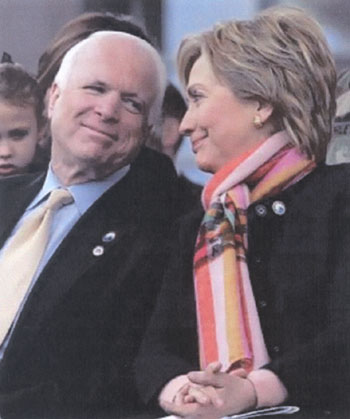
A Tryst Between John and Hillary


link to photo

In an article about a meeting between Obama and Clinton, the Washington Post throws in a very brief mention of how John McCain visited with Hillary Clinton a few weeks ago. The WP didn't say much, just:

[McCain's] unexpected visit with Clinton did raise a few eyebrows.

Seems like an odd occurrence. Does this happen between candidates of opposing parties? What could they have talked about? Why hasn't it been mentioned anywhere else, or with more emphasis in the WP if, as the reporter says the meeting did "raise a few eyebrows?"

If "raising eyebrows" means that someone is questioning the appropriateness of an event, then why weren't there more questions published?


----
In D.C., Obama Meets With Clinton
Nominee Apparent Also Sets Fundraising Curbs

By Jonathan Weisman and Shailagh Murray
Washington Post Staff Writers
Friday, June 6, 2008; A04

Sen. Barack Obama moved quickly yesterday to unite his party around his candidacy, paying an unexpected visit to his soon-to-be-former Democratic rival, while dispatching one of his top field operatives to help run the Democratic National Committee.

After a day spent campaigning across Virginia, Obama delayed a trip home to Chicago last night to visit Clinton at the Washington home of Sen. Dianne Feinstein (D-Calif.), a senior Democratic source said. A joint statement issued by the campaign said: "Senator Clinton and Senator Obama met tonight and had a productive discussion about the important work that needs to be done to succeed in November." Coming just before Clinton's expected departure from the race, it was seen as a reconciliation gesture to the senator from New York and her millions of disappointed supporters.

In addition to DNC staff changes, Obama extended his campaign's prohibition on raising funds from lobbyists and political action committees on the party's fundraising operations. Paul Tewes, one of the architects of Obama's primary strategy and the field general of his critical victory in the Iowa caucuses, will serve as Obama's point man at DNC.

The party chairman, Howard Dean, has been pursuing a "50-state" strategy since 2005, an effort many Democrats have criticized because it has been an enormous drain on the party's resources. The DNC has trailed its Republican counterpart badly this election cycle and had just $4.4 million in the bank at the end of April, compared with the Republican National Committee's $40.6 million.

Obama said his special-interest money ban is "not a perfect solution" but is an important symbolic move. "It does at least signal that we are going to make an effort to reverse a culture in Washington that has come to be dominated by the wealthy and the powerful," he said in a news conference aboard his campaign plane en route from Bristol in the state's southwest corner to the Nissan Pavilion in Northern Virginia, where he held a rally to kick off his general-election campaign...

Clinton, meanwhile, tried to quiet a campaign by her allies to force her onto the Democratic ticket. "While Senator Clinton has made clear throughout this process that she will do whatever she can to elect a Democrat to the White House, she is not seeking the vice presidency, and no one speaks for her but her," her campaign said in a news release. "The choice here is Senator Obama's and his alone."

Obama said he "appreciated very much" the statement, and he instructed reporters to dismiss all speculation about possible running mates. He said he will neither discuss the selection process nor parade prospects in public, as the GOP candidate, Sen. John McCain, appeared to do last month when Florida Gov. Charlie Crist, Louisiana Gov. Bobby Jindal and former opponent Mitt Romney visited his Arizona ranch -- although his unexpected visit with Clinton did raise a few eyebrows...

for complete WP article click here

Thursday, February 28, 2008

Are you American if you were born in Panama?


Senator John McCain as an infant. His grandfather (in Naval officer's uniform) is holding him. McCain's father is to the left of them. Were they in Panama when the picture was taken?


My father once told me that could never run for U.S. President because he was not born in the United States - his mother had been a U.S. citizen (who lost her citizenship when she married a Mexican citizen). I was about ten years old at the time. His comment made me sad - although I knew he would never want to be President, I wanted to know that he could at least have the right to try. I remember thinking about it from time to time throughout my childhood. Now that I am an adult it seems somewhat comical - or "cutely innocent." But you know little girls often adore their fathers, and I certainly did.

As for McCain, we all know that if immigration would not be such a contentious issue these days, no one would have noticed his birthplace issue - there would not have been any question. The NYT does not say where the story came from. McCain's citizenship issue came up when there was some notice about Romney's Mexico connection. One (or more) of the major newspapers published the photo (above), but it didn't seem to go anywhere. So why now?

In a previous post I quoted ICE director Julie Myers saying that ICE wanted to send: "a strong message to those who choose to disregard our nation's laws"

Personally I hope this issue does not eliminate him from the race. But as many people are saying these days "illegal is illegal." What would the Republicans say if they were pressured to go by the letter of the law and pull McCain out for having been born in Panama? It wasn't his fault he was born there, why should he be punished for it? --- These days, its only DREAMERS that get punished for not having born here.

-----
February 28, 2008
New York Times

McCain’s Canal Zone Birth Prompts Queries About Whether That Rules Him Out

WASHINGTON — The question has nagged at the parents of Americans born outside the continental United States for generations: Dare their children aspire to grow up and become president? In the case of Senator John McCain of Arizona, the issue is becoming more than a matter of parental daydreaming.

Mr. McCain’s likely nomination as the Republican candidate for president and the happenstance of his birth in the Panama Canal Zone in 1936 are reviving a musty debate that has surfaced periodically since the founders first set quill to parchment and declared that only a “natural-born citizen” can hold the nation’s highest office.

Almost since those words were written in 1787 with scant explanation, their precise meaning has been the stuff of confusion, law school review articles, whisper campaigns and civics class debates over whether only those delivered on American soil can be truly natural born. To date, no American to take the presidential oath has had an official birthplace outside the 50 states.

“There are powerful arguments that Senator McCain or anyone else in this position is constitutionally qualified, but there is certainly no precedent,” said Sarah H. Duggin, an associate professor of law at Catholic University who has studied the issue extensively. “It is not a slam-dunk situation.”

Mr. McCain was born on a military installation in the Canal Zone, where his mother and father, a Navy officer, were stationed. His campaign advisers say they are comfortable that Mr. McCain meets the requirement and note that the question was researched for his first presidential bid in 1999 and reviewed again this time around.

But given mounting interest, the campaign recently asked Theodore B. Olson, a former solicitor general now advising Mr. McCain, to prepare a detailed legal analysis. “I don’t have much doubt about it,” said Mr. Olson, who added, though, that he still needed to finish his research.

Senator Lindsey Graham, Republican of South Carolina and one of Mr. McCain’s closest allies, said it would be incomprehensible to him if the son of a military member born in a military station could not run for president.

“He was posted there on orders from the United States government,” Mr. Graham said of Mr. McCain’s father. “If that becomes a problem, we need to tell every military family that your kid can’t be president if they take an overseas assignment.”

The phrase “natural born” was in early drafts of the Constitution. Scholars say notes of the Constitutional Convention give away little of the intent of the framers. Its origin may be traced to a letter from John Jay to George Washington, with Jay suggesting that to prevent foreigners from becoming commander in chief, the Constitution needed to “declare expressly” that only a natural-born citizen could be president.

Ms. Duggin and others who have explored the arcane subject in depth say legal argument and basic fairness may indeed be on the side of Mr. McCain, a longtime member of Congress from Arizona. But multiple experts and scholarly reviews say the issue has never been definitively resolved by either Congress or the Supreme Court.

Ms. Duggin favors a constitutional amendment to settle the matter. Others have called on Congress to guarantee that Americans born outside the national boundaries can legitimately see themselves as potential contenders for the Oval Office.

“They ought to have the same rights,” said Don Nickles, a former Republican senator from Oklahoma who in 2004 introduced legislation that would have established that children born abroad to American citizens could harbor presidential ambitions without a legal cloud over their hopes. “There is some ambiguity because there has never been a court case on what ‘natural-born citizen’ means.”

Mr. McCain’s situation is different from those of the current governors of California and Michigan, Arnold Schwarzenegger and Jennifer M. Granholm, who were born in other countries and were first citizens of those nations, rendering them naturalized Americans ineligible under current interpretations. The conflict that could conceivably ensnare Mr. McCain goes more to the interpretation of “natural born” when weighed against intent and decades of immigration law.

Mr. McCain is not the first person to find himself in these circumstances. The last Arizona Republican to be a presidential nominee, Barry Goldwater, faced the issue. He was born in the Arizona territory in 1909, three years before it became a state. But Goldwater did not win, and the view at the time was that since he was born in a continental territory that later became a state, he probably met the standard.

It also surfaced in the 1968 candidacy of George Romney, who was born in Mexico, but again was not tested. The former Connecticut politician Lowell P. Weicker Jr., born in Paris, sought a legal analysis when considering the presidency, an aide said, and was assured he was eligible. Franklin D. Roosevelt Jr. was once viewed as a potential successor to his father, but was seen by some as ineligible since he had been born on Campobello Island in Canada. The 21st president, Chester A. Arthur, whose birthplace is Vermont, was rumored to have actually been born in Canada, prompting some to question his eligibility.

Quickly recognizing confusion over the evolving nature of citizenship, the First Congress in 1790 passed a measure that did define children of citizens “born beyond the sea, or out of the limits of the United States to be natural born.” But that law is still seen as potentially unconstitutional and was overtaken by subsequent legislation that omitted the “natural-born” phrase.

Mr. McCain’s citizenship was established by statutes covering the offspring of Americans abroad and laws specific to the Canal Zone as Congress realized that Americans would be living and working in the area for extended periods. But whether he qualifies as natural-born has been a topic of Internet buzz for months, with some declaring him ineligible while others assert that he meets all the basic constitutional qualifications — a natural-born citizen at least 35 years of age with 14 years of residence.

“I don’t think he has any problem whatsoever,” said Mr. Nickles, a McCain supporter. “But I wouldn’t be a bit surprised if somebody is going to try to make an issue out of it. If it goes to court, I think he will win.”

Lawyers who have examined the topic say there is not just confusion about the provision itself, but uncertainty about who would have the legal standing to challenge a candidate on such grounds, what form a challenge could take and whether it would have to wait until after the election or could be made at any time.

In a paper written 20 years ago for the Yale Law Journal on the natural-born enigma, Jill Pryor, now a lawyer in Atlanta, said that any legal challenge to a presidential candidate born outside national boundaries would be “unpredictable and unsatisfactory.”

“If I were on the Supreme Court, I would decide for John McCain,” Ms. Pryor said in a recent interview. “But it is certainly not a frivolous issue.”


for link to NYT article click the title of this post

the article was previously posted on the Huffington Post
photo: http://www.friendsofmccain.com/images/father_grandfather.jpg