Sunday, May 31, 2009

California and Proposition H8 - CA no longer ahead of the country


From:

Sunday, May 31, 2009
California's Prop H8: The State Supreme Court Punts.

Upon hearing the decision of the Supreme Court of California on Prop H8, the first comment I made to my friend Juanita was made 'off-the-cuff', she asked me what I thought and I said "The Supreme Court is buying time", the reason I felt that was the case is very simple, in the previous rulings they have pleased the Pro Prop H8 proponents and angered the LGBT Community when they ruled that licenses for same-sex marriage were invalid under State Law because it barred such unions (California Proposition 22 (2000)), next, in another decision, they pleased the LGBT Community and angered the Prop H8 Proponents when they ruled that Prop 8 was an unconstitutional abridgment of civil rights, oookey... So, in their latest ruling, which they announced on Tuesday May 26, 2009, they declared the Prop H8 constitutional amendment is valid, albeit it takes away rights protected under the 'equal treatment under the law constitutional clause' (Part of the Fourteenth Amendment to the United States Constitution), furthermore, they ruled that the 18,000 or so same-sex marriages performed in between their second and third ruling, were valid, because of their second ruling which was apparently reversed on their third.

He, he, he... I don't mean to laugh at this very serious issue, but, in addition to being a little confusing to follow their steps and logic, it brings to my mind overtones of the 'Keystone Cops' on a State Supreme Court Scenario, bumbling and fumbling.

But just taking a sample of the opinion pieces out there, here is Dan Walter's on the San Jose Mercury News on May 27th:

    Opinion: California Supreme Court followed the law on Prop. 8

    "marriage licenses that San Francisco was issuing to same-sex couples at the behest of Mayor Gavin Newsom were invalid because state law prohibited such marriages.

    A year ago, the same court pleased gay rights groups and angered conservative "pro-family" groups when it declared that the statute barring same-sex marriages, although enacted by voters, was an unconstitutional abridgment of civil rights.

    The court seemingly reversed itself again Tuesday, declaring that Proposition 8, a constitutional amendment again outlawing same-sex marriages, is valid. But all three decisions were correct, even courageous, because they upheld the limited role that courts play in public policy.

    As the court itself said, "In a sense, this trilogy of cases illustrates the variety of limitations that our constitutional system imposes upon each branch of government — the executive, the legislative and the judicial."

    In petitioning the court to set aside Proposition 8, gay marriage advocates wanted the court to rule that it was a constitutional revision, rather than an amendment, and thus could not be enacted via initiative. But had it done so, it would have made a mockery of the initiative system — which, for all its flaws, remains a valuable tool for effecting public policy — and created a legal quagmire with unimaginable unintended consequences."

It is not a simple issue no matter which way you look at it, but two points are blatantly clear, 1. Protection of Civil Rights on equal treatment under the Law and, 2. Public Policy or, putting it another way, pure, unbridled democracy, the worst kind of government but the best thing we got going for us, on the one hand, the governed have, supposedly, participatory prerogatives on a democracy, on the other, notwithstanding that nobody is either better or worse than the other, we humans have differences on how we look, what we think or our nature, but... And this is a big but, regardless of our differences, all of us are supposed to have the same inalienable rights, hence, "Individual rights are not subject to a public vote; a majority has no right to vote away the rights of a minority; the political function of rights is precisely to protect minorities from oppression by majorities.". but, there seems to always be a but, isn't?, what about democracy? Well, this beautiful monster called democracy, in it's extreme, purest form, is what is known as 'anarquism', another extreme manifestation of unbridled democracy is that "Fifty-one percent of a nation can establish a totalitarian regime, suppress minorities and still remain democratic."

Is it just? According to Erik von Kuehnelt-Leddihn, "The voice of the majority is no proof of justice", Maximilien Robespierre said that "Any law which violates the indefeasible rights of man is essentially unjust and tyrannical; it is not a law at all." and the great humanitarian, Mahatma Karumanchi Gandhi, left us one of his tenets "In matters of conscience, the law of majority has no place.", the answer to me appears to be a resounding no!

Going back to my comment that the California Supreme Court was 'buying time' or, as stated in this post's title, they 'punted', I must say that the point is valid because a) in their first ruling they validated the voice of the majority and, b) on their second ruling they upheld the inalienable rights of the individual and, c) in their latest ruling they upheld unbridled democracy as the supreme policy-maker of the land, making a little aside to say that because in their second ruling, they temporarily made legal the marriage between persons of the same sex, the legal marriage contracts made during that period, remained legal (Something to do with legal retroactivity versus current legal status, I think)

Yes, the State Supreme Court punted, they decided to go the political route, they left it to the electorate to decide public policy instead of settling once and for all the issue of whether or not a majority has the prerogative to take away constitutional rights from a minority, or until the US Supreme Court rules on the issue, which will happen, since already legal suits challenging the Cal Supremes' ruling have been filed.

I do totally agree with Dan Walter's point that the California Supreme Court have "created a legal quagmire with unimaginable unintended consequences", fortunes and majorities change, public opinion attitudes change as well, today's majority may in the near, or far future, whichever may be the case, change too; so, let the 'political pin ball game' commence, the 'pro-this' or 'pro-that' will win a scrimmage or a battle here and there, only to be reversed later by the 'con-this' or 'con-that' majority, only to be set back later by the 'pro or con on this or that', yes indeed, by all means, let the 'political pin ball game' commence instead of answering two simple, yet vital, questions: "Does the individual has inalienable rights?" and "Does a majority has the right to abridge them?"

I do also agree with Dan on another point he makes because there is no question on my mind that same-sex marriage contracts will be legal in California and other states sooner than later, but I disagree that it is the appropriate course of action, as he and others are saying:

    The appropriate course for same-sex marriage advocates to take is to pursue their cause in the same political arena in which their opponents prevailed in November. Polls indicate that Californians are split roughly 50-50 on the issue of gay marriage, but support is growing over time, and a pro-gay marriage measure has a fair chance of succeeding next year.

In closing, I do most fervently disagree with the opinion of many and that Dan also exposes in his piece, while leaving for another post the role of "Organized Religion", more aptly called "The Religious Right" And the innumerable and outrageous ironies and the accompanying plethora of hypocrisies in this matter:

    A victory at the polls would have much more moral validity than the Supreme Court's ignoring legal precedent and blithely overturning Proposition 8.

I'll state why I disagree, moral validity is acquired when what is just is followed, what Dan and others are saying is that they expect that their views will be validated by political Trends/Will - What legal precedent? It seems to me this claim was done in a vacuum due to his not specifying to which precedent he is referring to.

I heard somewhere that the California State Supreme Court's ruling on Prop H8 was courageous, excuse me?

They punted, the stage is set thus bringing up a final question: Which minority will be next? link

Getting Sunshine vs. getting dark skinned

My Mom, who I adore, but has her quirks.  She told me just before my big wedding day (when I was 22) that I should not go to the beach because I would be too dark for the wedding.

Its a big thing in Mexican culture (and many others) - that if you are dark skinned you are lower on the social scale...

Especially for a wedding, a bride needs to look white.


What a problem. For one, we are told that the UV rays from the sun can kill us. We may be made fun of if we are dark. 

Now we are being told that we need more sunshine so we won't get cancer.

Maybe the answer is balance. Go walking in the late afternoon. Don't weed your flower bed in the middle of the day.

But if you are already brown and have a good tan, don't be embarrassed about being dark. I know that is a hard one for many people. It often happens if you are Latino and look white, many people tell you so... "oh, you don't look like a Mexican!" or "you don't look Puerto Rican!" - And you are supposed to take that as a compliment.

One of dreamacttexas' readers sent a comment recently about "the darks" taking over the world. I have to admit I reacted to that. But now I'm thinking, hey, that isn't so bad for someone to say that We are always talking about "the whites taking over the world." Why be insulted when someone says it?...  the reality is that the power balance isn't changing anytime in the near future, even if people think they see the hoards of brown people coming.

More on whiteness and darkness later.

In the meantime, read this article about the sun, vitamin D, and cancer prevention:

"Revealed: the best protection against cancer: Global study discovers astonishing power of vitamin made by the sun" London Independent, May 30, 2009

Twice a Minority - Twice the Anger

Sotomayor is a woman.  That becomes a significant issue for the Supreme Court since there have been only two women before her (in how many years?).  Adding to this is her "identity,"  which some people think is worth fighting about.

Of course, those who are honest and know about politics realize this the normal ideological battle that happens between Republicans and Democrats whenever an important appointment comes up.  As usual, the other side has a need to say a few nasty things.

For some of you that have access to this book through a library, it is worth looking at.  You can't buy it anymore:  Twice a Minority, by Margarita Melville


Here is a link to information from N.C.L.R.* on the Sotomayor nomination and the backlash:
http://capwiz.com/stopthehate/issues/alert/?alertid=13443366&type=CU


A blog post from the Houston Chronicle that addresses the "Raza" issue:
"Debate redux: Sotomayor, La Raza and racism," Houston Chronicle - Immigration Chronicles, May 28, 2009


thanks to the following blogs for passing this information on:
http://elrinconcitodeaurora.blogspot.com/
http://hladc-sf.blogspot.com/


The Long Term Effects of War - Gaza

It often occurs to me that we don't see much in the news about what happened to the people in Gaza.  There was much hoopla about it in the beginning, but now that it has been six months, its like the conflict never happened.

Thank goodness the NYT decided to say something about it.  I think this is especially commendable since they are highly pressured by their Pro-Israel Jewish constituency.

"Misery Hangs Over Gaza Despite Pledges of Help," New York Times, May 28, 2009

Arpaio thinks he is being picked on...


--
"Sheriff Questions Motives of Probes," Washington Post, May 31, 2009

Saturday, May 30, 2009

From a wise white woman: on Sotomayor


this is from the Staff Blog at the  New Yorker:

May 29, 2009
Close Read: The Lady Is a Judge

Sonia Sotomayor’s critics are up in arms about her lecture from 2001, “A Latina Judge’s Voice,” and especially these words:

    I would hope that a wise Latina woman with the richness of her experiences would more often than not reach a better conclusion than a white male who hasn’t lived that life.

It is, in one sense, funny that Newt Gingrich and the like hear this as Sotomayor saying that Latina women simply make better decisions than white men—as though the word “wise” weren’t there. What is it about the proximity of the word “Latina” that renders the word “wise” invisible? Or is it that “wise Latina” is heard not as a description of, say, a person who is wise and a Latina but as a call to central casting for the older friend in the chick flick who knows a lot about relationships and soup? (Or rice, beans, and pork—also, bizarrely, a point of contention.) Whatever else she may be, Sotomayor is not a stock character.

But she is saying something slightly complicated, or at least less suited for printing on a coffee mug than the saying, attributed to Justice Sandra Day O’Connor, that “a wise old man and wise old woman will reach the same conclusion in deciding cases.” Sotomayor says that she’s “not so sure,” noting that “wise men like Oliver Wendell Holmes and Justice Cardozo voted on cases which upheld both sex and race discrimination in our society.” But she adds—and this is the point:

    We should not be so myopic as to believe that others of different experiences or backgrounds are incapable of understanding the values and needs of people from a different group…nine white men on the Supreme Court in the past have done so on many occasions and on many issues including Brown.

    However, to understand takes time and effort, something that not all people are willing to give. For others, their experiences limit their ability to understand the experiences of others. Others simply do not care. 

And how does her experience—“Being a professional Latina woman in a world that sometimes looks at me with suspicion”—affect how she judges?

    I am reminded each day that I render decisions that affect people concretely and that I owe them constant and complete vigilance in checking my assumptions, presumptions and perspectives and ensuring that to the extent that my limited abilities and capabilities permit me, that I reevaluate them and change as circumstances and cases before me requires. 

In other words, it inclines her to question biases—most importantly, her own. It makes her, in a way, a blinder justice, and thus one who is better able to see the things that actually matter.

Meanwhile, all those throwing John Roberts’s line about a judge just being an umpire, calling balls and strikes, at Sotomayor: Have they been to a ballgame lately? It’s not just that “unreasonable” and “cruel and unusual” are harder terms to call than “low and outside.” Warnings to pitchers, ejections, preventing brawls—those aren’t things that robots do. Just look at last night’s Red Sox game. (And there are other problems with the analogy—Sherrilyn Ifill has a good point regarding checked swings.) That gets back to the odd idea, explored in the Times today, that her reputation as a tough judge is a bad thing. So how mean is Sotomayor? Judge Guido Calabresi, her colleague on the Second Circuit, told the Times that “her behavior was identical” to that of her colleagues: it was the reactions that were different.

    “Some lawyers just don’t like to be questioned by a woman,” Judge Calabresi added. “It was sexist, plain and simple.”

And, anyway, when the manager comes charging from the dugout—or when a government lawyer offers an argument whose logical extension might be that citizens who are tortured have no recourse in court—how ladylike do we want our umpires to be? Sometimes it can help to yell back.

Posted by Amy Davidson in CLOSE READ  link


Friday, May 29, 2009

New York Mayor and Numerous NY Companies Endorse the DREAM Act


 This was released today (May 29, 2009) from nilc.org

 click here to see Bloomberg's letter

Mayor bloomberg and nyc business leaders endorse the dream act

New York, NY - Yesterday, eighteen New York City-based businesses and Mayor Michael Bloomberg sent a letter to Senators Richard Durbin (D-IL) and Richard Lugar (R-IN) pledging their full support of the DREAM (Development, Relief, and Education for Alien Minors) Act and urging passage of the legislation.

The DREAM Act is a bipartisan bill that addresses the situation faced by young people who were brought to the United States years ago as undocumented immigrant children, and who have since grown up here but are being denied the ability to fully contribute to society.

The letter authored by Mayor Bloomberg and co-signed by the following companies:

    *  Hughes Hubbard & Reed LLP
    * Con Edison
    * Welsh, Carson, Anderson & Stowe
    * National Grid
    * American Express Company
    * JPMorgan Chase & Co.
    * Pfizer
    * Ogilvy & Mather Worldwide
    * Wachtell, Lipton, Rosen & Katz
    * Macy's Inc.
    * Morgan Stanley
    * New Corporation
    * Citigroup
    * WL Ross & Co. LLC
    * Tishman Speyer
    * Partnership for New York City
    * Boston Properties

The signatories stress that the "passage of the DREAM Act would go a long way towards correcting an inequitable situation that drains our economy of talent and resource." They go on to state, "[T]the DREAM Act offers a fair bargain benefiting both children and the country."

"This bold step taken by Mayor Bloomberg and these industry leaders follows on the heels of a similar letter from Microsoft and shows the business communities' understanding of the positive and much needed contributions these young people can make to our nation," said Marielena Hincapié, Executive Director of the National Immigration Law Center. 

A Few Comments on Judge Sotomayor's Words, part II

continued:

Sotomayor:  as Professor Martha Minnow has noted, there can never be a universal definition of wise. Second, I would hope that a wise Latina woman with the richness of her experiences would more often than not reach a better conclusion than a white male who hasn't lived that life.


 Let us not forget that wise men like Oliver Wendell Holmes and Justice Cardozo voted on cases which upheld both sex and race discrimination in our society. Until 1972, no Supreme Court case ever upheld the claim of a woman in a gender discrimination case. I, like Professor Carter, believe that we should not be so myopic as to believe that others of different experiences or backgrounds are incapable of understanding the values and needs of people from a different group. Many are so capable. As Judge Cedarbaum pointed out to me, nine white men on the Supreme Court in the past have done so on many occasions and on many issues including Brown.


Hernandez:  There are all sorts of ways of being wise.  Oliver Wendell Holmes said many wise things about the law, but as Sotomayor mentioned, he was part of those Justices who consistently voted against any claims of gender discrimination for decades and decades.  It could be a wise Latina with a richness of experience, or a wise woman, or a wise Bosnian that may have more sense about things than your typical White American Male.  No I am not a man hater, not at all (I am actually married to a white male - and I like him a lot).  But I am sure that the U.S. and many other Western countries have provided a societal framework that keeps white males from learning about the realities of the world.  There are many unconscious privileges some people have that we are often not aware of.

I could say that as a Latina professor I have experiences that white male professors don't have.  But I can also say that I was a social worker and psychotherapist for over fifteen years before I began my PhD studies in Cultural Anthropology.  I had a significant amount of mental health training, including that of the psychoanalytic study of groups.  I was also trained as a photographer.  So which experience makes me a better professor?  Is it being Latina?  Is it being a photographer (who certainly see the world in a unique way)?  Is it being a psychotherapist (some people say that could be a hindrance)?

Surely, hearing Agustin Lara and eating rice, beans and flour tortillas gave me a unique background and perspective while I was reading European social theorists.  Growing up in a Jim Crow town certainly helped me understand Faulkner.  Having brown skin made me stand out among the blonde kids at school, and sometimes their comments did hurt me (this did not keep me from making friends with some of them).  But now I understand a more realistic map of the world.  Most of the world is brown (or olive skinned) like me.  Many people that are my shade of brown are Jewish, highly educated, and well read.  I fit in most anywhere.  

If I had been born Jane Smith in Houston, Texas, and had blue eyes and blond hair, my life wouldn't nearly as interesting.  I can say the same for Judge Sotomayor. 

These comments are not necessarily about prejudice, they are about differences.

A Few Comments on Judge Sotomayor's Words, part I

Sonia Sotomayor with her parents


In this post I will expand on a few comments from her speech just published by the NYT - 

Sotomayor:  Who am I? I am a "Newyorkrican." For those of you on the West Coast who do not know what that term means: I am a born and bred New Yorker of Puerto Rican-born parents who came to the states during World War II.

Hernandez:  The family moved to NY during WWII - they were American citizens because all people born in Puerto Rico are U.S. citizens.

Sotomayor:  The Latina side of my identity was forged and closely nurtured by my family through our shared experiences and traditions.

Hernandez:  The stereotype that being Latina or Latino means being poor and uneducated is absolutely wrong.  There are millions of Latinos who are like Judge Sotomayor, we just don't stand out.  We blend in with the rest of the nation.  People don't write about us because we are regular people.  Actually, its a really rich experience to be educated, financially solvent and be Latina...  You develop a fascinating view of the world  - and of the people who stereotype you as poor and undocumented.

Sotomayor:  For me, a very special part of my being Latina is the mucho platos de arroz, gandules y pernil - rice, beans and pork - that I have eaten at countless family holidays and special events. My Latina identity also includes, because of my particularly adventurous taste buds, morcilla, -- pig intestines, patitas de cerdo con garbanzo -- pigs' feet with beans, and la lengua y orejas de cuchifrito, pigs' tongue and ears.

Hernandez:  Well, I can attest to the food thing.  Although I never ate pigs feet.  My family, who is of Mexican descent age cabrito (baby goat, considered a delicacy in northern Mexico and southern Texas) - to be honest I couldn't get myself to eat it.  But I loved beans, rice, and the flour tortillas that my aunt Rosa made me.  My Mom never made tamales, but lots of other people did and we always ate them at home.  We loved watermelon too...and canteloupe.  I lost a tooth eating canteloupe at a bull fight in Nuevo Laredo when I was six.

Sotomayor:  It is the memory of Saturday afternoon at the movies with my aunt and cousins watching Cantinflas, who is not Puerto Rican, but who was an icon Spanish comedian on par with Abbot and Costello of my generation.

Hernandez: In our small town, there was a movie theater just for Mexicans.  It was called the State Theater.  I used to go see movies with the singer/actor Miguel Aceves Mejia.  When I was six I saw him  in person and told all the kids at school I was going to marry him.

Sotomayor:  My Latina soul was nourished as I visited and played at my grandmother's house with my cousins and extended family. They were my friends as I grew up. Being a Latina child was watching the adults playing dominos on Saturday night and us kids playing loteria, bingo, with my grandmother calling out the numbers which we marked on our cards with chick peas.

Hernandez:  At my great grandmothers house (in Laredo, TX), the kids would gather around the bed of my great aunt Chata.  She would tell us stories about La Llorona.  Her sister, aunt Luisa would dance the charleston for us.  A couple of blocks away at my maternal grandmother's house I would run around the yard with my cousins and play hide and seek.  I was always afraid of the dark because the kids said a witch used to live next door in a house that had burnt down.

Sotomayor:  Being a Latina in America also does not mean speaking Spanish. I happen to speak it fairly well. But my brother, only three years younger, like too many of us educated here, barely speaks it. Most of us born and bred here, speak it very poorly.

Hernandez:  My brother and I did not speak Spanish as children.  We both learned it when we were older.  I wasn't actually fluent until I lived in Monterrey, Nuevo Leon when I was in my mid 40s.  While just about everyone in my grandparents generation only spoke Spanish, the family says my maternal grandfather, Eugenio E. Hernandez was fluently bi-lingual (he was a WWI Veteran).  Both my parents are fluently bi-lingual.  When my Dad was just starting school, his wealthy grandfather had an English speaking teacher come to the house so my Dad and his cousin would be bi-lingual.  

My daughter learned Spanish while we lived in Mexico, but doesn't speak it much now.  My son now lives in Argentina and is studying an MBA at an Argentine university - he has studied Spanish for four years- but didn't speak a word before then.  (When he was (really) little he said "carne," "leche," and "mamon")  

Sotomayor:  Many of us struggle with this tension and attempt to maintain and promote our cultural and ethnic identities in a society that is often ambivalent about how to deal with its differences.

Hernandez:  Being educated and wanting the best for my kids, I moved my family to an upscale Houston neighborhood (West University).  My mother had always told me not to live in the Barrio.  Now that the kids are grown and I am more secure with my identity I have moved to the Barrio (Houston's East End).  And I love it.  People are much nicer.  There are more trees.  There are chickens and roosters on every block.  Some of my neighbors and I trade plant cuttings.  

Sotomayor:  I became a Latina by the way I love and the way I live my life. My family showed me by their example how wonderful and vibrant life is and how wonderful and magical it is to have a Latina soul. They taught me to love being a Puertorriqueña and to love America and value its lesson that great things could be achieved if one works hard for it.


photo:  with my maternal grandmother Petra Paredes Hernandez, and my mother Maria de la Luz Hernandez


Hernandez:  I can say the same about my family.  It was a mixed experience (in terms of national identity), because while they didn't teach me Spanish, we were always listening to Agustin Lara.  My Dad told me all about Mexican history.  I knew about Mexican President Benito Juarez (who was a Zapotec Indian) and how the Catholic Church said all Masons should be excommunicated.  At the same time, my Dad took us to see the Alamo, the San Jacinto Battleground.  He is very proud of being a WWII veteran and an American citizen, but still sees himself as Mexican (he immigrated to the U.S. as an infant).


In Her Own Words - Sotomayor on being a Latina and a Jurist


Below is an excerpt from a speech that Judge Sotomayor gave at UC Berkeley in 2001

click here for the text of the speech

Judge Sotomayor:
...America has a deeply confused image of itself that is in perpetual tension. We are a nation that takes pride in our ethnic diversity, recognizing its importance in shaping our society and in adding richness to its existence. Yet, we simultaneously insist that we can and must function and live in a race and color-blind way that ignore these very differences that in other contexts we laud. That tension between "the melting pot and the salad bowl" -- a recently popular metaphor used to described New York's diversity - is being hotly debated today in national discussions about affirmative action. Many of us struggle with this tension and attempt to maintain and promote our cultural and ethnic identities in a society that is often ambivalent about how to deal with its differences. In this time of great debate we must remember that it is not political struggles that create a Latino or Latina identity. I became a Latina by the way I love and the way I live my life. My family showed me by their example how wonderful and vibrant life is and how wonderful and magical it is to have a Latina soul. They taught me to love being a Puertorriqueña and to love America and value its lesson that great things could be achieved if one works hard for it. But achieving success here is no easy accomplishment for Latinos or Latinas, and although that struggle did not and does not create a Latina identity, it does inspire how I live my life...link

Thursday, May 28, 2009

The White Wise Guys are Talking About Sotomayor

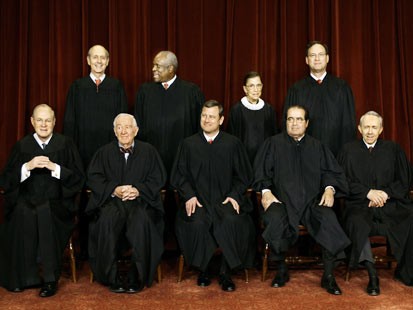
Can you see Sotomayor hanging around with these guys (and Ginsburg)?

The Sotomayor Supreme Court nomination is getting some tugs from those who think her comment about wise Latina women and white guys who haven't lived a life was a bad thing.

How can this comment even count after you look at her stellar achievements?  So what if she thinks Latina women are wise?  What is wrong with that?

To be honest, I don't think all Latina women are wise.  But a good number are.  If they have used their experience well, they become awesome people.  Some end up spending their lives doing too much for their husbands and watching too much TV.  But then that sounds like a lot of women in general.

Now, is it true that there are white guys out there that "haven't lived a life?"  I think many people agree that the white guys from our former presidential administration (Bush II) would be in this category, especially Bush, Cheney, and Rumsfeld.  I think Rove has actually lived a life and gone through a lot, but I don't think he has learned much from his experiences except to be mean.

If you want to use stereotypes, you can say that successful Latinas can be tough.  They work hard and study hard.  They are like Sotomayor.  I don't know if she and I could be friends, but I will certainly respect her as a Supreme Court judge.  I bet lots of white guys will too.

Sotomayor's "controversial comment" -

"I would hope that a wise Latina woman with the richness of her experiences would more often than not reach a better conclusion than a white male who hasn't lived that life,"


"Latina Woman - Tongue Tied Man," Washington Post, May 27, 2009

Wednesday, May 27, 2009

"Popular Opinion" Based on Mis-Information


When I woke up this morning and saw the front page of the Houston Chronicle I saw this huge headline about the selection of Sonia Sotomayor for the Supreme Court.  I mean it was BIG.

It is almost 11 am and the headline is gone from the web page of the paper...  There have been over 1100 responses, some nasty---. 

One of them caught my eye:  here it courtesy of the GRAB program on my computer:


For one, ALL people born in Puerto Rico are American Citizens... It is not a state but is an American Territory.  I guess this is something people in Houston don't learn in high school.  I will have to make sure my students know about this when we start school this fall.

For another...  why so much hate?  A few days ago my daughter was flying back from LA and two women in their 60s were sitting in front of her.  One was white and one was black.  They were talking about one of them moving to Houston.  After a few minutes their conversation became much softer... when one of them said the word "illegals."  

Considering these women are on the brink of needing their Social Security benefits, it might be good for them to know they are only getting their checks because of the billions of dollars undocumented people have left in the social security fund.  If you are not a legal resident, you cannot use the money you put it, but if you work on a salary in the U.S. you are obligated to put part of your salary in the fund...  Undocumented workers have kept our social security system afloat.  Too bad so many people don't know that, kind of like so many don't know that all people born in Puerto Rico are American citizens.

Did the Houston Chronicle change its headline because of all those people who are mis-informed?

Thank Goodness for Justice - the nomination of Sotomayor


The writer of the article below is a law professor at the University of Houston.  He is well noted for his work on the DREAM Act and Civil Rights.
-
CNN
by Michael Olivas
May 26, 2009

 (CNN) -- I recently saw an old episode of "West Wing," where Edward James Olmos, playing a fictional Puerto Rican federal judge, was nominated to become the first Latino on the U.S. Supreme Court. I cried, thinking how remote this possibility seemed, yet how close.

Now that Judge Sonia Sotomayor has been nominated by President Barack Obama to the Court, that episode finally rings true. When I heard the news, I wept, for the long-overdue acknowledgement that Latinos matter.

Judge Sotomayor's life and legal career are arcs possible only in this country: a hardscrabble life in a south Bronx housing project, educational opportunities made possible by her own intelligence and hard work, and a legal career devoted to public service. When she assumes her position on the bench in October, no other justice will have had the depth of legal experience she holds, and none will have served as a trial judge.

The sum of her life is exactly what we should look for on this court: excellent academic credentials, an accomplished legal career in private and government practice, and appointments to federal benches by Republican and Democrat presidents. Her decisions have been well-reasoned and well-written, and she will ably take her place on the Supreme Court bench.

The search for a justice with "empathy" is no less coded than is the traditional search for "judicial temperament" and a person who will "judge, not legislate." All nominees have the requisite merit badges, as does Judge Sotomayor. And to make their way to such a short list, all have the combination of personal and professional lives that warrant their consideration.

What Sonia Sotomayor will have, as few other candidates, is the additional weight of historical expectations and the hopes of Latinos.

In today's culture, Latinos are marginalized and demonized and feared. In Judge Sotomayor's New York, roving gangs of thugs go "beaner hunting," looking to harm undocumented Mexicans. Such racial hatred knows no nuance, as one such mob killed a permanent resident Ecuadorian, thinking him to be Mexican.

Vigilantes along the Mexican border have taken the law of enforcement into their own hands. In cultural programming, this community is described as either lazy and shiftless, or stealing jobs from real Americans. They are typecast as drogeros or maids, long characterized as banditos or greasers. The racial rhetoric against Latinos has been tolerated for too long on cable television news and in political and polite discourse.

I will be carefully watching the confirmation hearings for the coded political messages, knowing that Justice-elect Sotomayor's many merits will ultimately win her confirmation. But also watching will be little girls in a south Bronx housing project, in the valley of South Texas, and in rural New Mexico.

Her service on our country's highest court will be the evidence that they, too, have reason to hope and to achieve. All of this country's citizens should realize that it is not just Latinos' dreams being realized, but our collective accomplishment. link to article


thanks to Tatcho Mindiola for passing this along

The Pictures You Take in Your Twenties

Photos of Barack Obama in 1980, by Lisa Jack

Telling you the truth, I am 56 years old, probably much older than some of my DREAMer readers would imagine.  Back when I was an 18 year old college student, I asked a cute photographer at Wharton County Junior College to take my photograph.  I still remember his name, it was Brian Noble.  I always wondered what happened to him.  He ended up taking pictures of me on a motorcycle.  He was nice enough to go into the dark room and print them for me.  I have to admit, I had a crush on him and it was an excuse to have a conversation, but he was courteous, took the pictures, gave them to me and never spoke to me again (except to say hi in the hallway).  Someday I'll find them and put them on the blog.

So here we have a young woman photographer (Lisa Jack) at Occidental College in 1980.  She asked a cute freshman if he'd let her photograph him.  Who would have thought that 29 years later, the guy would be President of the United States.  I think it is awesome.  

What it teaches us is that you never know what is going to happen in the future.  He may have shown his charisma then, but to be President?  

There is an exhibition opening at M+B Gallery in West Hollywood tomorrow (May 28, 2009).  If you are in the neighborhood, drop by and see it.

The moral of the story?  Always take pictures when you can.  You never know what will happen 30 years later.

"Photos Show Barack Obama as Barry the Freshman,"  Los Angeles Times, May 27, 2009

click here for Lisa Jack's Photos of Obama as published in Time Magazine

Tuesday, May 26, 2009

Sonia Sotomayor: She will not be like Alberto or Clarence

The Honorable Sonia Sotomayor, Nominee for the Supreme Court


Alberto Gonzalez embarrassed many of us.  He moved bad stereotypes of Mexican Americans back half a century.  Now Obama has nominated Judge Sonia Sotomayor for Supreme Court.  All indications are that she will do her job well and will help the image of Latinos in the U.S. and the world.

"Obama Picks Sotomayor for High Post," Boston Globe, May 26, 2009

 
link to Washington Post video of announcement

London Paper:   "Obama picks first Hispanic supreme court justice,"  The Guardian, May 26, 2009


,

Monday, May 25, 2009

America: A "Linguistically Neutered" Nation


How many languages can you speak? I can speak English, sort of fluent in Spanish, and can read French. But none of this has to do with going to high school or college. I decided way after college that I needed to seriously learn a language other than English.  My mother used to suggest I take Spanish in high school, but at the time it only seemed necessary when I went on vacation to Mexico.  

Only thing is, learning a second or third language isn't just about going on vacation.  It is about having an open mind about the world, realizing that you can gain so much knowledge if you look outside your own orbit.

Speaking of orbit, these days it isn't a bad idea to think about learning Chinese or Arabic. Everything isn't about the English and other European languages, especially in this era of mass globalization.  The article I post is about a woman in the UK saying that the other European Union nations are way ahead of Great Britain in learning additional languages.  What she doesn't mention is that a high percentage of UK residents are now multilingual -- they speak English, Arabic, Farsi, Polish or any other dozens of languages.  This isn't because their parents or schools insisted on it.  It is because of immigration to the UK - and globalization in general.

Just as learning Arabic in the UK may not be considered so important, Spanish is also downgraded because of our close-minded American attitude towards immigration. It is OK if our ancestors spoke Spanish or German, or Italian, but we are Americans now, and we HAVE to be English speakers - don't let your children waste their time learning anything else, because as you know, we (Americans) are the masters of the universe.* 

here is a different perspective from a parent in the UK:


"We Must Lift Our Children Out of Linguisitic Poverty" by Carolyn Sarll, London Independent, January 15, 2009

I was finding out how they [Germans] get their youngsters speaking a second language at such an early age – at six or seven years of age, at least four years before we traditionally get our pupils started. With four 50-minute lessons of English a week, that's how.

Compare this with our state school average of three lessons of German, French or Spanish over two weeks, and it becomes clear that time invested is the key. Forget technical and whiteboard wizardry – neither school that I visited possessed such gizmos, yet the pupils could converse brilliantly in English after just a year. That was a real fillip for us chalk'n'talk teachers, who still insist on the entire class parsing a verb at the expense of all those wacky visual aids.

The results prove that the Germans and other European states have got it right. In a recent survey, nearly 70 per cent of Britons said that they could not speak any language other than their mother tongue. Across the EU, this figure is 44 per cent.

Our reputation as a linguistically neutered nation is reflected, too, in the alarming nosedive in GCSE language entries. In 2001, 78 per cent of all pupils took at least one language; this year, it was a mere 46 per cent. In Wales, a nation that parades its bilingual badge unashamedly, the figures are even more depressing: in 1996, 46 per cent of pupils took at least one language, but this was down to a dismal 28 per cent this year. Cymru Am Byth (look it up) is all very well – and, before you think otherwise, as well as speaking German and French, I am a Welsh learner and proud of it – but not at the expense of our ability to function within a European and global context. To survive in today's world, we Welsh citizens must start speaking other languages, not just our own.
link to entire article


*and everyone should learn our language


Monolingual American

Avoiding Diabetes


Yesterday I went to visit my brother.  As I have written before, he has diabetes and is on dialysis.

I took him a cantaloupe.  I decided that everytime I go see him I'm going to take him some fruit.
With this in mind I am going to start posting occasionally with bits of information about how NOT to get diabetes.

Suggestion #1:

Avoid Fast Food (i.e. hamburgers, fries).  If you aren't convinced, go see "Fast Food Nation."

Using your brain for your hands


NYT Magazine:
'A gifted young person who chooses to become a mechanic rather than to accumulate academic credentials is viewed as eccentric, if not self-destructive. There is a pervasive anxiety among parents that there is only one track to success for their children. It runs through a series of gates controlled by prestigious institutions. Further, there is wide use of drugs to medicate boys, especially, against their natural tendency toward action, the better to “keep things on track.”'


Use to be that kids of color were guided by school counselors to do manual work.  This was because of the assumption that only the "smart ones" should go to college and Mexican or Black kids weren't smart.  Now the NYT is thinking about all those Hedge Fund Managers that want to become mechanics.  It's trying to make them feel better.

The truth is that people who do things with their hands (of course their brains help) are just as gifted and can usually be considered "artists"  - like the person who tiles your bathroom, puts up your siding, straightens your car out after an accident.  

But there is that old class issue, that goes back a milenium.  The rich and noble didn't (and don't) have to do anything but use their brains.  Can you change the oil in your car?


"A Case for Working with Your Hands," New York Times Magazine, May 24, 2009


Saturday, May 23, 2009

Bait & Switch at Immigration Court in LA

A number of Immigrants thinking they are moving forward  their immigration cases have been given a big surprise.  ICE has been arresting them when they go to their hearings.  

According to the LA Times:

"[ICE] Agents have arrested people at Immigration Court in downtown L.A. and expelled them. Authorities say they're reinstating previous orders. Lawyers say the legal process is being flouted."

Where is Napolitano these days?  Does she know this is happening?  Does she approve?


Friday, May 22, 2009

Cheney's Mouth


This detail from a Mike Luckovich cartoon says enough for me not to want to listen to Cheney.  It is difficult to understand why the news media seems to be hooked on him these days.  Obama (and the rest of us) should just ignore him.  Isn't that what you are supposed to do with a bully?


see "Obama and Cheney clash on fight against terror,"  Boston Globe, May 22, 2009


You are White and Want to do the Right Thing?

One of the things I have found in my classes over the years is that people generally don't want to be hateful or discriminatory or (!) racist.  Often there seems to be a problem with lack of information.

Another problem is that white people have a really hard time talking about being racist (well, maybe all of us do).  

Here is an interesting essay on being a white person in an imperfect (or excuse me, racist) society.  It focuses on people working as college professors, but we can all learn from it. Click the title for the link.

A few days of silence

It has been a few days since I have posted anything.  My co-blogger asked me what was going on, since I usually keep pretty busy with dreamacttexas.  

The thing is, my brother is really sick.  He is one of your millions of Latinos with diabetes.  I am really worried about him and don't know what will happen from one day to the next.  I tell myself it probably isn't bothering me but it really is.  There are only two of us.   I am eight years older than he is.  I was in third grade when he was born.  

He is on dialysis now.  He had to retire from his job as a fireman.  He can barely walk around, and one doctor has recommended amputation.  

Between that and working really hard to finish a book, the hour I had been spending on dreamacttexas has somehow gotten lost.  Even when I have the time, the enthusiasm I had for the writing slipped away.  I am hoping that in a few days I will get it back.  

I apologize for not writing more, but you know how it is...


Thursday, May 21, 2009

Harvard's President Supports DREAM

Now that Harvard's president has supported DREAM, what will it take for southwestern states to get on the bandwagon?

Harvard's Faust backs path to legal residency
Illegal immigrant bill called 'lifeline'

By Maria Sacchetti, Globe Staff | May 21, 2009

Harvard President Drew Gilpin Faust yesterday backed federal legislation that would clear the way for illegal immigrant students to apply for legal residency, an endorsement that stunned students and drew criticism for a president who has largely steered clear of fierce debates.

In a letter this week to federal lawmakers, Faust expressed "strong support" for legislation known as the Dream Act, which would allow students who have been in this country since they were 15 to apply for legal residency under certain conditions. She acknowledged that students with "immigration status issues" attend Harvard, and said the bill would be a "lifeline" to such students.

"I believe it is in our best interest to educate all students to their full potential - it vastly improves their lives and grows our communities and economy," she wrote in a letter to Senators Edward M. Kennedy and John F. Kerry and Representative Michael E. Capuano, thanking them for their support for the legislation. "This bill will help move us closer to this goal."

Faust, who declined to be interviewed, is not the first leader to endorse the Dream Act. But her action adds a powerful new voice to the debate over a bill that has languished in Congress since 2001.

The Dream Act often surfaces in the debate in individual states over whether illegal immigrant students should pay resident tuition at public colleges and universities.

But the latest version of the Dream Act focuses largely on allowing illegal immigrant students to apply for legal residency, which is an issue that affects public and private colleges such as Harvard because its graduates cannot legally work in this country. (The act would make it easier for states to charge resident tuition, but does not require it).

Private colleges do not rely on government funding and can decide to finance those students on their own.

Harvard students said they have been lobbying Faust for months on the issue. They held a rally and submitted a petition with 120 signatures, said Harvard junior Kyle de Beausset, one of the organizers.

In recent months, two Harvard students who are in the United States illegally met with Faust in her office to seek her support. Yesterday, one of those students, an 18-year-old former high school valedictorian who has been in the United States since he was 9, said he was thrilled.

"We realized that what we were asking her to do wasn't an easy thing. The issue of immigration is politically charged," said the student, who spoke on the condition that his name not be used. "I am and will forever be indebted to this institution."

But Bob Dane, spokesman for the Federation for American Immigration Reform, said Harvard should not admit illegal immigrants because they displace students here legally.

"Maybe the elites at Harvard should come down from their ivory tower and get some ground perspective on what kind of cost and competition that legal US residents are actually incurring these days," said Dane.

Maria Sacchetti can be reached at msacchetti@globe.com.

Saturday, May 16, 2009

An Imam in Detention in Houston


Sheikh Zoubir Bouchikhi was placed in immigrant detention just before Bush left office.  News reports have not been clear as to exactly what he did that caused him to be detained so long.  

The Houston Muslim community has rallied around him and he has now been released, but he may still face deportation.

"Now a free man, Houston imam clings to hope," Houston Chronicle, May 16, 2009

Our cows are killing our earth


This morning I opened up the web page of the London Guardian and found this startling information:

"the livestock industry is responsible for a staggering 18% of all anthropogenic greenhouse gas emissions."

I knew something was strange when I drove by a cattle feed lot in the San Joaquin Valley and couldn't breathe easily for miles.  The smell was so horrible I wanted to throw up.  I couldn't imagine how people could live nearby.  The smell was even worse than the one emitted by the horse meat factory near Monterrey, Nuevo Leon that I used to go by when I lived in Mexico.

It is interesting that this information (and about the village in Belgium that is not eating meat once a week) doesn't make it to the U.S. newspapers.


"Can vegetarians save the world?" London Guardian, May 16, 2009

Friday, May 15, 2009

Death in War, Death at Home

The stress of military service in Iraq and Afghanistan is reported in an article published by the London Guardian.  

A Young Man Dead, One of Many


We don't know his name, but his sister found him dead in the back of a pick-up truck yesterday.  He was coming to Houston from Guatemala.  He was undocumented.  She was told he was dehydrated.

There are thousands others who have died this way - in the desert, in box cars, in the river.  How much sadness are they leaving to take such a chance?

Today's NYT announces that immigration has dropped significantly.  I guess some people are happy.  But the whole immigration debacle is not a happy situation.  You either have to leave your family and your home, or you leave and then die, like this 15 year old did as he arrived in Houston.

"Teen Being Smuggled Found Dead in Truck,"  Houston Chronicle, May 14, 2009

"Mexican Data Say Immigration to U.S. Has Plummeted,"  New York Times, May 15, 2009

A Pandora's Box Named Rove

Today Karl Rove is going to be questioned by a prosecutor regarding the U.S. Attorney firings.  It is a criminal investigation that has been going on quietly.  

Rove knows a lot.  It will be interesting to see what comes out of this.  It could be the beginning of the end for the Bush monarchy.

see "Prosecutor to Interview Karl Rove Today, Sources Say,"  Washington Post, May 15, 2009

Thursday, May 14, 2009

Local Immigration Enforcement: A Fresh Perspective from the Houston Chronicle

The Houston Chronicle Opinion page let us know that the paper is not completely out of the loop.  In an impressive move, the Chronicle made a statement against local police randomly asking for proof of residency status without probable cause.  This is in response to the Houston Police Officers Union requesting a change.

It is 6:30 am in the morning.  There are 10 comments to the editorial, and they are all anti-immigrant.  Why can't someone send in something supporting the Chronicle's position?  Do only people full of hate know how to write?

Or could it be --- those who are not so hateful are concerned about any consequences related to going against the ones who want to blast all undocumented people out of the country.  Hatred often misfires and hurts more than just a few.


just to let you know, if Houston were to change it's position regarding this policy acc. to the Chronicle:  "would make Houston the only major city police force in Texas to allow police questioning of non-suspects about their citizenship status."


status won’t make neighborhoods safer," Houston Chronicle, May 14, 2009


LA, Ventura, and San Diego County get closer to xenophobia

LA Times:  "Los Angeles, Ventura and San Diego will become the first counties in California to begin checking the immigration status of all inmates booked into jail"  - 

our state (California)  that is generally ahead of the curve is regressing.  Maybe its related to all the budget pressure.  People get stressed and start looking for someone else to blame.


Eat a Veggie - Save the Planet


How can eating veggies save the planet?  Because to produce meat and fish takes MUCH more energy and earth resources than it takes to make your ear of corn or your sweet potato.

A city in Belgium has decided to avoid meat once a week.  I wish Houston would do the same, but it would take a lot to get the meat eaters to give up a little of their beef.


also see:  "Why eating less meat could cut global warming," London Guardian, November 11, 2007

Monday, May 11, 2009

Houston's Cops and Immigration Enforcement

Another right-wing anti-immigration article by the Chronicle.  Please - send in your comments - help the Chronicle move away from the right...

"Officer Union Calls for Change in Immigration Rule," Houston Chronicle, May 11, 2009

The Pope can tell the Isrealis what he really thinks

Official Flag of Vatican City


Pope Benedict is not my favorite of Vatican leaders.  I may be nostalgic, but I have always thought Pope John XXIII was the best (and most open minded).  This week, however, Benedict's worth has gone up a notch in saying openly that the Palestinians need their own homeland. 

Now, without going overboard in praise, I need to add that it may be easier for Benedict to say this because he was in the the Hitler Youth and you can't tell me that all those ideologies just get erased when you grow up.

Even so.  A Pope can speak more openly about something like this than a U.S. Congressman.  The Isreali Lobby can't have the Pope defeated in re-election.

see "Pope Backs a Palestinian Homeland," New York Times, May 11, 2009

Sunday, May 10, 2009

A Day for My Mom


My Mom, Maria de la Luz Hernandez, 1943, Laredo, TX

In a few minutes I am getting in the car to drive 35 miles to go see my Mom.  I just went to Walgreens to get her a card.  The place was full of flower bouquets and people buying cards.  It has been so long since I lived in a regular upscale neighborhood I can't remember if people were just as crazy about buying things for their mothers as we are here in East End.

Today I want to write about my Mom.  This is not an idealized treatise on her.  She is not perfect, but boy did she help me become who I am.

In the picture above she was only 15, and had just finished high school.  For a time after that she worked at the front desk at The Plaza Hotel in Laredo, TX.  She met some fancy people there -- John Wayne and Betty Davis.  She also met a Canadian baseball player who wanted to marry her.  But she was committed to my Dad who was a soldier in the Pacific.

After my parents married in 1947, and moved to San Antonio, she worked as a PBX operator at Santa Rosa Hospital.  Then they went to a small town near Houston  named Rosenberg.  There she helped my Dad start a funeral home business.  Everyone in the family admits that she was the business brain behind my Dad.  He had a great outgoing personality, but she really made things happen.  When I was six she decided to get a Funeral Directors license, which was extremely unusual for women those days.  She drove (by herself!!!) 30 miles from Rosenberg to downtown Houston every weekday for six months - and finished the program.  That doesn't seem like much now, but in 1958 those kinds of things just didn't happen.


Me, my grandmother (Petra Paredes Hernandez), and my Mom, 
Maria de la Luz Hernandez, 1956


Even though her father offered to pay for her college (before or after marriage) she declined.  She said she regretted it later.  But she helped her brother go to graduate school.... and helped me all the way through - even when I was 43 getting a PhD - a single Mom with 2 kids.

One of the most important things she did for me was buy me a set of suitcases.  When I was 11, she put the first one on lay-away.  It was a small white one called "Tiara" by American Tourister.  She bought two more over the next few years until I had a nice set.  It sent a message to me - that I would be ready to go anywhere or do anything.  I have passed the suitcase on to my daughter.  Its an heirloom now.


She taught me:

1.  About having good social skills, to be "educada" - to be able to talk to anyone, if they were important or not.  To show respect, and to listen to people.

2.  About being pretty yet competent.  She always looked great - but was a really shrewd businesswoman.

3.  Not to give all of myself (and my money) to a man.  Always keep your own money she would say.

4.  Not to put too many miles on my car.... remember that when it wears out you might have to get another one (I didn't listen to her until much later).

5.  Get an education, no one can take it away from you.

6.  Get an education so that if something happens in your life you can always support yourself. (in other words, if you are married, don't think that is enough) 

7.  Travel as much as you can.  You can't always do it because you need 3 things, money, time, and health - and it is difficult to have all three.

8.  You can get what you want so much easier with honey than with vinegar.

9.  Shop carefully.  Check out the expensive stores but buy at outlets.

10.  When you are at party and there is lots of drinking, restrain yourself. Then you can watch everyone else get silly.

11.  Have kids when you can, because sometimes you can't if you wait too long.

12.  Learn Spanish - its the most practical foreign language to know (this was in the 60s when everyone was pressured to only speak English).


Maria de la Luz Hernandez, 2005


By the way, her nickname is "Chickie." She has the prettiest hair of anyone I've ever known.

She just came back from being in Argentina for 10 days for my son's wedding.  Her doctor told her to learn the tango while she was there, but she didn't get a chance.

Berlusconi wants to keep Italy Italian

link to image


No surprise that Italian Prime Minister Berlusconi has put his foot in his mouth again.  He is not the nicest guy; he insults his wife, and now he is saying openly that Italy shouldn't be multicultural - in other words, there should be no immigrants.  Some people in his country think that is a great idea, but the reality is that Italy has always been multicultural ---  maybe he hasn't read any history books.

see "Berlusconi's anti-immigrant comments spur outcry," Washington Post/Reuters, May 10, 2009

Comments ARE Necessary


Your newspaper NEEDS commentary on its articles concerning immigration.  A reporter working for a large newspaper told me last week that they get tons of anti-immigrant hate commentary - and they respond by moving their articles to the right (in other words they push up the hate so they can look like they agree with their hate-mongering readers).

A while back citizenorange.com organized a group of activists to send pro-immigration - anti-hate commentaries to newspapers.  Apparently the Houston Chronicle REALLY needs this now.  The last few months the immigration articles in the paper have been sounding like something out of an ethnic cleansing magazine.

please - respond when you see hate -  your newspapers are like your lawmakers.  They like getting  responses and if its all negative they move that way like a wave --  so send some positive ideas and lets hope its a strong enough wave to keep immigration news in a positive spin.

If the article you read does not have a space for comments, send an email to the paper.  Believe me, they read it...

You can start by making comments on this article:


"We need open debate on border security," Houston Chronicle, May 10, 2009

Please send your newspaper something today...

Newspapers: How much death is self inflicted?

link to image

---
After reading an article in The Nation that states George W. Bush was "arguably our worse president ever." I move over to the NYT and see something by Frank Rich (disclosure - I love the way the man writes) - titled "The American Press on Suicide Watch," - that describes how one major aspect of the current newspaper death spin is how journalists acted like patsy's while W. was bringing us down.

Yet, I can't help but think about all those dumb articles that mimicked Karl Rove without blinking -- remembering how I went "oh well - another one of those" and skipped on to the next article or the next newspaper....  Our beloved Houston paper was not the only one to do this.  The NYT so stupidly bowed to the unethical Judith Miller when she said WMDs really did exist in Iraq.  Just think of all the millions (Americans and Iraqis) who have died as a result of this chicanery.

For those newspapers that are left.  Try being more ethical, don't get so swayed by the big boy corporations, or the way out wacko Minute Men types - and more people will support you.

***
It is however, only fair to say that newspapers were also done in by the proliferation of blogs (like dreamacttexas) - who clip articles and in essence "take business away"  - and the global economic disaster of 2008-2009. 

As for helping out newspapers in an hour of need, dreamacttexas will make a concerted effort to provide only links to newspapers, and not copy articles.

We are worried however.  If newspapers start charging for reading - we are in trouble.  As it stands, we subscribe to the NYT, the Houston Chronicle, The Nation, The New Yorker, and the Texas Observer.  We have access to many others through the university library.  But if we can get sued for publishing a paragraph from an AP article, we won't have the money for legal representation (NO PLEASE!  this doesn't mean to send us money).  

A NYT article today said that we were in a crisis like the time when the world encountered the Gutenberg Press, the distribution of information is in a global transformation.  Maybe so...  it will be very interesting to see what happens next.  Lets hope dreamacttexas can stay alive and non-monetary, when most of the blogs get totally sucked in by capitalism.

Friday, May 8, 2009

U.S. History - The meaning of a noose

A Houston Fire Chief is in trouble because he had a noose in his locker at work.  I read the article and see the commentaries about how many people think that was OK.  They must not realize what the hanging noose symbolizes.  It reflects a horrible aspect of U.S. History, that we need to be ashamed of.  For more information on this see Bill Moyers Journal - PBS


article on Houston Fire Chief and his noose:
"HFD rebukes captain for noose," Houston Chronicle, May 7, 2009
 
Little Pieces of Rope - 1888

When William Caldwell, from Richmond, TX was hanged on charges of murder, men from Fort Bend County attended the hanging.  For souvenirs, they cut little pieces of rope from the hanging noose and pinned them to their lapels.  


American Moses

Chicago Congressmen Luis Gutierrez


Congressman Luis Gutierrez has been going around the country, talking to people about immigration reform.  It has become his personal quest.  The Spanish language TV networks call him:


Reform a Personal Cause," Washington Post, May 8, 2009

Thursday, May 7, 2009

U.S. History - 1970 - The Bloody Story of Kent State


New York Times
Tuesday, May 5, 1970
News Summary and Index

Major News of the Day

The Senate Foreign Relations Committee accused the Nixon Administration of usurping the war-making powers of Congress by sending American troops into without Congressional consent.  The charge came as the committee urged approval of a move to repeal the Gulf of Tonkin Resolution.  [1:7l

President Nixon has been urged by the presidents of many colleges and universities to "demonstrate unequivocally your determination" to end promptly the United States military involvement in Southeast Asia.  Strikes of indefinite duration at many of the nation's colleges are scheduled to begin today to protest the war and to mobilize public opinion for a withdrawal of United States forces in Indochina.  [1:6]

A blast of gunfire from the National Guard killed four students, two of them women, at Kent State University.  Eight other students were wounded.  The shooting came shortly after the guardsmen broke up a noon rally of about 1,000 students by lobbing tear gas at the crowd.  Robert I. White, the univeristy president, ordered the closing of the college for an indefinite time.  [1:2-5]... 


..
Ohio by Crosby Stills Nash and Young

Lyrics to Ohio

Tin soldiers and Nixon's comin'.
We're finally on our own.
This summer I hear the drummin'.
Four dead in Ohio.

Gotta get down to it.
Soldiers are gunning us down.
Should have been done long ago.
What if you knew her and
Found her dead on the ground?
How can you run when you know?

Na, na, na, na, na.....

Gotta get down to it.
Soldiers are cutting us down.
Should have been done long ago.
What if you knew her and
Found her dead on the ground?
How can you run when you know?

Tin soldiers and Nixon's comin'.
We're finally on our own.
This summer I hear the drummin'.
Four dead in Ohio.
Four dead in Ohio.
Four dead in Ohio.
-------
By John Kifner
Special to The New York Times
May 5, 1970

Kent, Ohio, May 4 -- Four students at Kent State University, two of them women, were shot to death this afternoon by a volley of National Guard gunfire. At least 8 other students were wounded.

The burst of gunfire came about 20 minutes after the guardsmen broke up a noon rally on the Commons, a grassy campus gathering spot, by lobbing tear gas at a crowd of about 1,000 young people.

In Washington, President Nixon deplored the deaths of the four students in the following statement:

"This should remind us all once again that when dissent turns to violence it invites tragedy. It is my hope that this tragic and unfortunate incident will strengthen the determination of all the nation's campuses, administrators, faculty and students alike to stand firmly for the right which exists in this country of peaceful dissent and just as strong against the resort to violence as a means of such expression."

In Columbus, Sylvester Del Corso, Adjutant General of the Ohio National Guard, said in a statement that the guardsmen had been forced to shoot after a sniper opened fire against the troops from a nearby rooftop and the crowd began to move to encircle the guardsmen.

Frederick P. Wenger, the Assistant Adjutant General, said the troops had opened fire after they were shot at by a sniper.

"They were understanding orders to take cover and return any fire," he said.

This reporter, who was with the group of students, did not see any indication of sniper fire, nor was the sound of any gunfire audible before the Guard volley. Students, conceding that rocks had been thrown, heatedly denied that there was any sniper.

Gov. James A. Rhodes called on J. Edgar Hoover, director of the Federal Bureau of Investigation, to aid in looking into the campus violence. A Justice Department spokesman said no decision had been made to investigate. At 2:10 this afternoon, after the shootings, the university president, Robert I. White, ordered the university closed for an indefinite time, and officials were making plans to evacuate the dormitories and bus out-of-state students to nearby cities.

Robinson Memorial Hospital identified the dead students as Allison Krause, 19 years old, of Pittsburgh; Sandra Lee Scheuer, 20, of Youngstown, Ohio, both coeds; Jeffrey Glenn Miller, 20, of 22 Diamond Drive, Plainsview, L.I., and William K. Schroeder, 19, of Lorain, Ohio.

At 10:30 P.M. the hospital said that six students had been treated for gunshot wounds. Three were reported in critical condition and three in fair condition. Two others with superficial wounds were treated and released.

Students here, angered by the expansion of the war into Cambodia, have held demonstrations for the last three nights. On Saturday night, the Army Reserve Officers Training Corps building was burned to the ground and the Guard was called in and martial law was declared.

Today's rally, called after a night in which the police and guardsmen drove students into their dormitories and made 69 arrests, began as students rang the iron Victory bell on the commons, normally used to herald football victories.

A National Guard jeep drove onto the Commons and an officer ordered the crowd to disperse. Then several canisters of tear gas were fired, and the students straggled up a hill that borders the area and retreated into buildings.

A platoon of guardsmen, armed- as they have been since they arrived here with loaded M-1 rifles and gas equipment - moved across the green and over the crest of the hill, chasing the main body of protesters.

The youths split into two groups, one heading farther downhill toward a dormitory complex, the other eddying around a parking lot and girls' dormitory just below Taylor Hall, the architecture building.

The guardsmen moved into a grassy area just below the parking lot and fired several canisters of tear gas from their short, stubby launchers.

Three or four youths ran to the smoking canisters and hurled them back. Most fell far short, but one landed near the troops and a cheer went up from the crowd, which was chanting "Pigs off campus" and cursing the war.

A few youths in the front of the crowd ran into the parking lot and hurled stones or small chunks of pavement in the direction of the guardsmen. Then the troops began moving back up the hill in the direction of the college.

Students Cheer

The students in the parking lot area, numbering about 500, began to move toward the rear of the troops, cheering. Again, a few in front picked up stones from the edge of the parking lot and threw them at the guardsmen. Another group of several hundred students had gathered around the sides of Taylor Hall watching.

As the guardsmen, moving up the hill in single file, reached the crest, they suddenly turned, forming a skirmish line and opening fire.

The crackle of the rifle volley cut the suddenly still air. It appeared to go on, as a solid volley, for perhaps a full minute or a little longer.

Some of the students dived to the ground, crawling on the grass in terror. Others stood shocked or half crouched, apparently believing the troops were firing into the air. Some of the rifle barrels were pointed upward.

Near the top of the hill at the corner of Taylor Hall, a student crumpled over, spun sideways and fell to the ground, shot in the head.

When the firing stopped, a slim girl, wearing a cowboy shirt and faded jeans, was lying face down on the road at the edge of the parking lot, blood pouring out onto the macadam, about 10 feet from this reporter.

Too Shocked to React

The youth stood stunned, many of them clustered in small groups staring at the bodies. A young man cradled one of the bleeding forms in his arms. Several girls began to cry. But many of the students who rushed from the scene seemed almost too shocked to react. Several gathered around an abstract steel sculpture in front of the building and looked at the .30-caliber bullet hole drilled through one of the plates.

The hospital said that six young people were being treated for gunshot wounds, some in the intensive care unit. Three of the students who were killed were dead on arrival at the hospital.

One guardsman was treated and released at the hospital and another was admitted with heat prostration.

In early afternoon, students attempted to gather at various areas of the Commons but were ordered away by guardsmen and the Ohio Highway Patrol, which moved in as reinforcements.

There were no further clashes, as faculty members, graduate assistants and student leaders urged the crowd to go back to dormitories.

But a bizarre atmosphere hung over the campus as a Guard helicopter hovered overhead, grim-faced officers maneuvered their men to safeguard the normally pastoral campus and students, dazed, fearful and angry, struggled to comprehend what had happened and to find something to do about it.

Students carrying suitcases and duffel bags began leaving the campus this afternoon. Early tonight the entire campus was sealed off and a court injunction was issued ordering all students to leave.

A 5 P.M. curfew was declared in Kent, and road blocks were set up around the town to prevent anyone from entering. A state of emergency was also declared in the nearby towns of Stow and Ravenna. link

U.S. Kids - Deported Moms


Democracy Now


Last November, Maria Guadalupe Zamudio, a Mexican national with temporary immigration status, was deported after trying to apply for permanent residency. She was banned from the US for ten to twenty years. Maria’s three children, aged nine to twelve, are all US citizens. Last Thursday, they joined their aunt and uncle to make a twenty-hour drive from Worthington, Minnesota to Washington, DC. They’ve each written letters to President Obama asking him to let their mother return. We speak to twelve-year-old Gerardo Zamudio.

JUAN GONZALEZ: Amidst two foreign military occupations and an economic crisis, the issue of immigration reform is slowly returning to the national stage. On Friday, thousands turned out across the country in May Day rallies for worker and immigrant rights. Meanwhile, in Washington, the Senate’s Immigration subcommittee opened hearings last week towards crafting a long-awaited immigration reform bill. President Obama is expected to speak publicly on immigration in the coming weeks. The New York Times reports Obama will convene working groups that would prepare legislation for as early as the fall.

AMY GOODMAN: At the top of the agenda for immigrant rights advocates is ending the spate of deportations that have separated more than a million families. We’re going to turn now to one family torn apart by deportation who have brought their case to Capitol Hill. Last November, Maria Guadalupe Zamudio, a Mexican national with temporary immigration status, was deported after trying to apply for permanent residency. She was banned from the US for ten to twenty years. Her three children, aged nine to twelve, are all US citizens. Well, last Thursday, they joined their aunt and uncle to make a twenty-hour drive from Worthington, Minnesota, to Washington, DC. They’ve each written letters to President Obama asking him to let their mother return.

We’re going to go now to Washington, DC, where we’re joined by Gerardo Zamudio, Maria Zamudio’s oldest son. He’s twelve years old. We’re also joined by Mariano Espinoza, the executive director of the Minnesota Immigration Freedom Network, who’s gone to Washington, DC, to join the Zamudio family.

We want to begin right now with Gerardo. Gerardo, why are you in Washington?

GERARDO ZAMUDIO: I am in Washington, because I would like—I would like my mom back, and I would like to talk to President Obama, because I want my mom back and I know that he can help us.

JUAN GONZALEZ: And you went back with your mother to Mexico last November when she was deported. What happened there when you were in Mexico in the schools there?

GERARDO ZAMUDIO: At school, I mean, I could write and read in Spanish, but my brothers had a hard time. And we just decided that it was no good, because in Mexico they teach us what we already know. So it was just like review.

AMY GOODMAN: Gerardo, what happened when they took your mother?

GERARDO ZAMUDIO: Well, when they took my mother, I—we all—we were all very sad. And, well, we all thought it wasn’t fair, because we didn’t have our mother. And right now, we think it’s still not fair, because now we don’t have our mother or our father.

JUAN GONZALEZ: Mariano Espinoza, the government’s reason for deporting her and your decision to come to Washington to appeal to Obama, could you talk about that?

MARIANO ESPINOZA: Yes. This family reflects the bad policies that we have in place. Guadalupe was a legal resident in this country and, the day she was trying to become a permanent resident of the United States, was detained. And five days later, she was deported. Just like—

AMY GOODMAN: She had actually gone to the immigration office?

MARIANO ESPINOZA: Yes, on November the 5th in 2008, she went to the immigration offices. And five days later, again, she was deported from this country.

JUAN GONZALEZ: So, if she was a legal resident, what reason was it that they deported her?

MARIANO ESPINOZA: In 2009, her mother was sick in Mexico from a heart attack, so she went to immigration offices to ask a permit to leave the country temporarily, because she needed to be with her mom. And the permit was denied. So she took the decision to leave the country and come back without authorization. She was detained on the border and then deported. She re-entered the country, but later in 2008, ICE and the immigration offices in Michigan authorized the employment authorization card to work in the country, and they also issued a Social Security to be able to work in this country.

AMY GOODMAN: Gerardo, you have, and your—you and your brother have written a letter to President Obama? Have you brought it with you?

GERARDO ZAMUDIO: We did not bring it with us, but we did.

AMY GOODMAN: And what did you tell him in that letter?

GERARDO ZAMUDIO: Well, I still remember what we wrote. I wrote, “Dear President Obama, I would like you to help us with our case, because we need our mother back in the United States.” And I wrote, “Because we were living in a house that was just too in bad conditions for us to live, because it was falling, and in Mexico, us, the United States citizens had no rights to medical care or anything.” So we were like, “We had no rights in Mexico, because we were United States citizens.” We wrote all that. We told him the conditions that we were all in.

And we never got a chance—we delivered them to the—in the mail, we delivered them to them, and we haven’t received anything back. And we wanted to deliver them directly to the President, but we never had a chance to see him.

JUAN GONZALEZ: And Mariano Espinoza, we just have a few seconds left. Could you tell us how extensive is this problem of children being separated when their parents are being deported or face deportation?

MARIANO ESPINOZA: Well, this is a difficult problem for not just us, but for this country. When we have this opportunity [inaudible] America, we have to make sure that Gerardo is reunited with his mom. Children are affected psychologically, and a lot of times they are not—they don’t have the tools to succeed today. Gerardo went to Mexico, and now he’s back here in this country. And he’s going to probably miss the school year. This is unfair, and this is also, at the same time, the opportunity to bring families together...link

Higher Education Periodical Brings Up DREAM Act

---

In-State Tuition for Undocumented Students: Not Quite Yet

Congress likely to hold legislation for inclusion in larger package on immigration
Chronicle of Higher Education  -  May 8, 2009
By Megan Eckstein

Washington

Members of Congress are gearing up for a battle over educational benefits for undocumented students.

At issue is the Development, Relief, and Education for Alien Minors, or Dream, Act, which would allow states to charge illegal immigrants in-state tuition and would provide a multistep path to citizenship for some residents who were brought to the United States illegally as children...

The Bill's Status

As of now, it is unclear whether the bill will be considered on its own or wrapped into a broader immigration package.

The Senate's bill has been referred to the Judiciary Committee, which last week discussed how to approach comprehensive immigration reform. A Senate staff member, who spoke on condition of anonymity because key committees hadn't yet taken official stances on the Dream Act, said it would be difficult for Congress to take up a small piece of immigration legislation without it "snowballing into a larger discussion on comprehensive immigration reform."

The Democratic strategy could become clearer in the next couple of months, after a planned immigration summit by Mr. Obama, said Ms. Fisseha. If a broader package fails, Congress could still try to take up the measure as a stand-alone.

"If, as we try to pursue comprehensive immigration reform, we cannot get this simple element done, I'm not sure what we can" do, said Senator Menendez at the news conference. "This should be the most fundamental of all of the immigration-related issues." link to complete article

http://chronicle.com
Section: Government & Politics
Volume 55, Issue 35, Page A19

Sugar Land Wants to Stay Sparkly Clean - and Wealthy


Our new America suburban prototype, Sugar Land, TX, is fighting to keep low-income housing out of the city. A few years ago there was a significant controversy over a restaurant in the city wanting to paint its outside walls a bright color.  A number of Sugar Land residents were aghast over this breech of propriety.  Others thought the reaction was silly.  * 


"Residents oppose low-income housing development," Inside  Sugar Land Blog/Houston Chronicle, May 6, 2009

----------------

* I have a specific interest in the city because I wrote a book about the place.  The title of the book is Cemeteries of Ambivalent Desire:  Unearthing Deep South Narratives in a Texas Graveyard.

Wednesday, May 6, 2009

Black immigrants overlooked in the immigration Debate

Addressing Black Immigrants’ Overlooked Rights
Written by Larry Aubry, (Columnist), on 04-30-2009 00:00


Black immigrants from Africa, the Caribbean, Haiti, et.al, are barely footnotes in the immigration reform conversation. A recent meeting of the fledging Black Immigration Network (BIN) in Baltimore, addressed this issue that is largely ignored by the public and the media.


The gathering was sponsored by the Black Alliance for Just Immigration (BAJI), Which Way Forward program of the Center for New Community (WWF) and the American Friends Service Committee. Over the past two years, these organizations, working together, shared a vision of creating a Black immigration network that encompasses people of African descent who reside in the United States.


The meeting's Vision and Goals Statement reads, "Our shared African ancestry and similar experiences with racism and exploitation in the U.S. and globally can give us a common frame of reference for common struggle. BIN can be an important space for gathering the African Diaspora for joint strategizing, information-sharing and work for the benefit of all of our respective communities."


The specific goals were 1) To examine critical issues around African-American immigrant relations, especially the relations between African Americans born in the U.S. and immigrants of African descent; 2) Strategize about ways to address immigration and other key social and political issues facing our communities; 3) Foster group cohesion and explore networking and collaboration.


The sponsors considered the meeting an opportunity to bring Black groups and communities together to address some critical issues of the day that impact all of us. They believe that the struggle for immigrant rights is one of the cutting edge issues in the fight for racial justice and full democracy in the U.S. today.


They contend that racism and economic globalization have created displacement and poverty in virtually all of our communities and countries. And they also maintain that immigrants and others of color, in general, were exploited and scapegoats for many of the country's economic problems, even before the current economic crisis. African Americans are being locked out of the formal economy and immigrants of color "super-exploited" as a way to undercut the wages and working conditions of the U.S. workforce as a whole, creating greater profits for U.S. corporations.


The sponsoring organizations have developed overlapping networks of individuals and organizations they work with consistently. They believe that bringing a range of groups together to address immigration and related issues can magnify the impact of (separate) groups in changing immigration policy and promoting racial justice. They also feel that BIN can be instrumental in bringing the issues and perspectives of various Black immigrant communities and African Americans into the broader immigrant rights and racial justice movements.


Participants at the BIN confab included African American immigrant rights groups as well as representatives of Black African groups here in the U.S. Discussion ranged from the virtual absence of a national focus on Black immigrant rights and labor unions' role in immigration reform, to pending immigration legislation, Black-Latino relations and the need to deal specifically with the complex issue of Black immigrants.


The last day of the gathering was the most challenging. It included brain-storming and strategy development related to the formation of a sustainable national BIN. Discussions were intense, but not contentious and focused on key internal matters such as respect, values, structure, communication and the need for unapologetic advocates for Black immigrant rights.


There was consensus that there is a critical need for people of African descent to work together in order to achieve mutually agreed upon goals and objectives and that this is based on operational unity within each group, indispensable for successful collaboration between all participating groups.


Sustained follow-up determines the value of any attempt at group unity, particularly where actual change is the desired outcome. Considerable time was devoted to linking recommended structure, capacity-building, accountability, and concrete results to BIN's mission. A Continuation Committee was formed to review and synthesize the content and recommendations of the meeting. The Black Alliance for Just Immigration, together with the other sponsoring organizations and other volunteers, constitute the Continuation Committee, that will make its first report via E-mail within thirty-days.


The magnitude of issues facing Black Americans and immigrants of African descent remind us that we must work collaboratively, and on a sustained basis, to secure our own future. No one else will. Turning public education on its head so that good schools for Black children are the norm, effective, group-oriented leadership, and Black immigration networks, are part of the Herculean challenge to improve the quality of life for Black people. link


Larry Aubry can be contacted at E-mail l.r.aubry@earthlink.net.

Napolitano comes out supporting DREAM!

Ok, so this means a lot coming from Janet Napolitano. I hope that she keeps her word when it comes to voting and asking for the support of others in DC. Her voice and support will bring a lot of weight towards DREAM.

link to video of hearing

Napolitano Ducks on Immigrant Legalization

By Daphne Eviatar 5/6/09 12:23 PM

At the Senate Judiciary Committee’s oversight hearing this morning, Homeland Security Secretary Janet Napolitano carefully skirted repeated questions about her views of whether longtime undocumented immigrants living in the United States ought to get a chance at legalization.

Although Napolitano did say she supports the DREAM Act — which would provide some children of undocumented immigrants raised in the United States a path to legalization if they complete two years of college or military service — Napolitano carefully avoided questions about whether a comprehensive immigration reform bill should include broader opportunities for legalization of the 11 million or so undocumented immigrants living in the United States. Her refusal to offer an opinion on that highlights just how controversial and politically dicey that issue will be as a new proposal for comprehensive immigration reform gets hammered out over the next few months.

Napolitano’s refusal to sanction legalization seemed to please Sen. Jeff Sessions (R-Ala), the new ranking Republican on the committee, who pressed the issue by saying that while “we need to fix our immigration system,” in his view, “the American people correctly are dubious of a plan that gives lawfulness now to people who came in illegally without confidence that the legal system is going to work in the future.” That “amnesty” would become “a magnet or a message abroad,” he said. “When the American people realize that the broken pipe is being fixed … we can have a far better discussion about how to deal fairly and humanely with people who have been here a long time.” That echoes a common argument from restrictionist quarters that strict border enforcement must precede any considerations of legalization.

Sen. Pat Leahy (D-Vt.), the Judiciary Committee chairman, presented a more sympathetic case for legalizing undocumented immigrants now “living in the shadows” and tried to elicit Napolitano’s support. She wasn’t biting. The secretary refused to say she supports legalization, saying only, in response to Leahy’s question about whether it makes sense to try to deport 11 million people, that “the sheer logistics of doing that are overwhelming.” link

Whatever it Takes

Investigating the death of Luis Ramirez - Sign a Petition

-


On July 14, 2008, Ramirez lost his life after he was knocked unconscious and severely beaten by a group of Shenandoah teenagers who yelled racial epithets throughout the fatal beating. Charging documents and eyewitness accounts indicate that Ramirez was punched and kicked in the body and head causing him to foam at the mouth, to sustain two skull fractures, and ultimately, to die.

While local officials initially failed to bring charges against the perpetrators and denied that race played a role in the attack, MALDEF intervened to pressure the local prosecutor to charge the defendants with a hate crime. Soon thereafter, the county district attorney filed murder and ethnic intimidation charges against the assailants.

A retired Philadelphia police officer testified at a preliminary hearing that she heard one of the defendants yell “Tell your [expletive] Mexican friends to get the [expletive] out of Shenandoah or you’ll be [expletive] laying next to him.” The defendant’s comments were directed at Ramirez’s friends who came to his aid after receiving a distress call from him on a cell phone during the beating.

On Friday, May 1, 2009, a jury in Schuylkill County found two of the defendants accused of beating the 25-year-old, father of two, guilty of simple assault. Despite the mounting evidence of a hate-driven and violent attack, the jury acquitted the defendants of third-degree murder and ethnic intimidation. The jury's conclusion is an outrage. Most shocking is the recent news article describing the Jury Foreman’s view that the trial appeared to be biased because of the racism and prejudice he noted among his fellow jurors. Luis Ramirez was brutally murdered and, even in death, Ramirez remains a victim of extreme racism which denies his family the justice they deserve.  link 


Single Mothers by Deportation

Whoever has been a single mother in her life knows an experience that few can imagine.  It's exhausting - if you have the flu you still have to do everything, make yourself drive the kids to school - buy groceries - bathe them, make dinner.  Having gone through the experience myself for most of my children's lives, I can say that it is hard to remember how difficult it was.  But at the same time, I am really close to my kids (who are now well into adulthood).  

I was lucky.  I already had a masters degree and work experience.  Our income was enough to get us good childcare - and decent housing.  Plus my parents and kid's aunt helped out when they could.  

But what about mothers left single because their husbands have been deported?  What kind of situation could this be?  With a mother who makes a bare bones salary - and probably undocumented to boot?

This week La Voz - Houston Chronicle writer Silvia Struthers wrote a great article on Single Mothers by Deportation.  I wish the Chronicle had the sense to translate it and place it in their English Speaking section.

In Spanish:
Madres solas: la otra cara de las deportaciones, La Voz - Houston Chronicle, May 5, 2009

UN - Gaza - Israel

The photo above is of phosphorus hitting a United Nations school in Gaza.  link


We may not be hearing much about Israel and Gaza these days, but there is still a lot going on...
--


Aipac urges Congress members to sign letter to Barack Obama calling for Israel to set pace of negotiations with Palestinians

    * Chris McGreal in Washington
    * guardian.co.uk, Wednesday 6 May 2009 13.55 BST
    

US congressional leaders and the most powerful pro-Israel lobby group in the US are attempting to forestall a significant shift in the White House's Middle East policy.

The move comes amid growing signs that the US president, Barack Obama, intends to press for urgent efforts to be made towards the creation of a Palestinian state.

The Israeli prime minister, Binyamin Netanyahu, is visiting Washington later this month amid growing expectations that Obama is preparing to take a tougher line over Israel's reluctance to actively seek a two-state solution to its conflict with the Palestinians.

It will be the first time that Netanyahu and Obama have met since both were elected.

The American Israel Public Affairs Committee (Aipac) this week sent hundreds of lobbyists to urge members of Congress to sign a letter to Obama.

The letter, written by two House of Representatives leaders, calls for Israel to be allowed to set the pace of negotiations.

The lobbying came despite critics saying Netanyahu has consistently failed to commit himself to the creation of a Palestinian state.

The letter calls for the maintenance of the status quo, with an emphasis on Palestinian institution-building before there can be an end to Israeli occupation.

It says the US "must be both a trusted mediator and devoted friend of Israel".

Aipac's move to put pressure on members of Congress came at the end of its annual conference in Washington this week.

Some of the loudest applause at the gathering came in response to calls for military attacks on Iran's nuclear facilities – something Netanyahu has attempted to portray as a more urgent issue than the Palestinian question.

But Aipac delegates were told by the US vice-president, Joe Biden, that the administration favours "mutual respect" in dealing with Iran.

Biden said the Israeli-Palestinian conflict strengthened Iran's strategic position and Israel must take concrete steps – including fulfilling often-broken commitments to stop the expansion of Jewish settlements – towards the creation of a Palestinian state.

Last week, General James Jones, Obama's national security adviser, told a European foreign minister that the new administration would be "forceful" with Israel, according to a classified Israeli memo reported by the Ha'aretz newspaper.

Jones was quoted as saying that Obama believes Washington, the EU and moderate Arab states must define "a satisfactory endgame solution".

"The new administration will convince Israel to compromise on the Palestinian question," he was quoted as saying. "We will not push Israel under the wheels of a bus, but we will be more forceful toward Israel than we have been under Bush." link to complete Guardian article

Tuesday, May 5, 2009

Whose party is Cinco de Mayo?


Who decided that Cinco de Mayo is a big deal in the U.S.?  Many Americans think it could compare to our July 4th.  But its not.  Cinco de Mayo was a battle that Mexico won against France.  Yes, it was important.  The French army was the most powerful in the world at the time (in 1862).  But it is no Mexican July 4th.  See PBS for more on Mexico's Cinco de Mayo May 5.

A few years before I returned to graduate school I worked as an elementary school social worker (that had a mostly white student body).  When Cinco de Mayo came up, everyone was so excited about the celebration.  I asked why didn't the school honor Mexico's Independence day which is September 16th.  They said it was more convenient to have a celebration in May instead of September.

This morning my husband said something about Cinco de Mayo.  I said "that's not really a holiday for Mexico," and he said, "but it is for Chicanos and Mexican Americans."  Maybe so, but to me it seems like the NON-Mexican Americans have decided to have a party - better to celebrate a battle against the French than contemplate that Mexico is an independent sovereignty (and acknowledge isn't all about picante sauce and narcos).  See Mexico's Independence Day - September 16th

Monday, May 4, 2009

Supreme Court Case on Using a False Social Security Number

The Roberts Court, known for its extreme Right Wing leanings, has ruled unanimously in favor of an undocumented immigrant (Ignacio Carlos Flores-Figueroa) who inadvertently used the social security number of another person, when he gave the number to his employer.  This is really great news for the millions of undocumented immigrants that have to use false social security cards in order to get jobs.  This is not to say it is OK to use someone else's number, but at least for the DREAMers, they won't be penalized for having used a fake SS# so they could work.

See  "Court Rules for Immigrant in ID Theft Case," Washington Post/AP, May 4, 2009

U.S. Military Recruiting Targeting More Immigrants


U.S. Military recruitment officers in the LA area are expanding their inclusion of immigrants.  Those who are here on temporary visas or asylum orders are now eligible to enlist.  

The Army must be thinking "better to recruit immigrants than felons."  Before we blink, the DREAM Act will pass and our dear DREAMers will be on their way to Afghanistan.  Let's hope more DREAMers consider college than the military.

LA Times, May 4, 2009:

"starting today, 10 Los Angeles-area Army recruiting offices will begin taking applications from some foreigners who are here on temporary visas or who have been granted asylum."


Sunday, May 3, 2009

Fewer Raids, but Still a Mess - U.S. Immigration Policy

--
May 3, 2009
New York Times
Editorial
A Shift on Immigration

Last week, immigration enforcement policy shifted a little. The administration issued guidelines for Immigration and Customs Enforcement that place a new emphasis on prosecuting employers who knowingly hire illegal immigrants.

That is a good idea, and a break from the Bush administration method — mass raids to net immigrant workers while leaving their bosses alone. The raids were tuned to the theatrics of the poisoned immigration debate, using heavy weapons, dogs and helicopters to spread the illusion that something was getting fixed.

But as policy, they were worse than useless. They netted about 6,000 undocumented immigrants, out of 12 million, and 135 employers or supervisors. They destroyed families, tearing parents and grandparents from children, many of them citizens. The fear they caused went viral in immigrant communities, driving workers further into the arms of abusive employers while bringing us no closer to a working immigration system.

So the new guidelines are smarter than cruel idiocy, but raids are still not a solution. They keep the country trying to arrest, prosecute and deport its way toward a working immigration system. Enforcement alone will never get us there. Workplace raids, no matter how sensibly or tactfully redesigned, will never fix immigration by themselves. Indeed, they make things worse.

Raids do not uphold or reinforce workers’ rights, a non sequitur in the world of off-the-books labor, where employers erode conditions for Americans by hiring workers at deplorable conditions and pay. They do not fix long backlogs in legal immigration, lines that extend years or decades, forcing people who want to follow the rules to make an agonizing choice between intolerable separations from their families or lawbreaking.

They do not protect illegal immigrants from the arbitrary cruelties of the detention and deportation system, in which due process is limited and detainees face unacceptable risk of sickness, injury and death in prison.

And the new enforcement regime, like the old, might lead employers to purge their payrolls of people they merely suspect are here illegally, to avoid the hassle and expense of a raid. When raids are coupled with electronic hiring-verification schemes like E-Verify, which the government has been inching toward, the likelihood of mass firings becomes greater. Without a path to earned legalization, undocumented workers who lose their jobs will have nowhere to go — except to endure ever-lower wages and worse abuse from bottom-feeding employers. The cycle of illegality will not have been broken.

The administration has promised to tackle comprehensive immigration reform this year. President Obama has consistently said the right things, defending a path to assimilation and citizenship for illegal immigrants rather than the futility of mass expulsion.

The decision to adjust the policy on raids seems sensibly motivated. But we agree with immigration and labor experts like Professor Jennifer Gordon of Fordham Law School, who sees the new guidelines as a smarter version of a bad idea. Far better, she says, for the government to redouble enforcement of laws like the minimum wage, the right to organize, and health and safety protections. This would reduce the incentive to hire the undocumented, and raise standards for all workers. It would not end up devastating immigrant families, as raids do. In times like these, that would be a step toward immigration reform that all workers could support. link

Kill a person and its considered assault not murder?


They beat Luis Ramirez. They beat him to a pulp. A jury in Shennandoah, Pennsylvania said the boys did not murder Ramirez. But how can this be since Ramirez died? In an irrational moment of myopic justice, a jury has decided that two teenage boys were only beating Luis Ramirez - and that the consequences of their physical actions apparently didn't count. Seems to me that the people on the jury were thinking with only part of their brains. How many murder convictions have been decided when there is an assault that leads to the death of the victim?

The newspaper articles say it was an all white jury. So was the jury in Simi Valley, CA who decided the L.A. policemen were not guilty in the beating of Rodney King in 1992 (judge for yourself, link to video of King beating: http://www.youtube.com/watch?v=ROn_9302UHg)

It sounds like the Pennsylvania jury made up a fantasy about what happened. The bottom line is that Luis Ramirez died from being beaten by Derrick Donchak and Brandon Piekarsky.

see "Pa. teens cleared of serious charges in beating," Washington Post/AP, May 3, 2009

Michelle Obama: The Real Dream


Can you be a grown up and still have a role model? Can you idealize someone and not feel stupid? I hope so.

A few weeks ago I was at Reagan Airport in Washington DC, waiting for a flight. I walked into a small shop and saw a Michelle Obama doll. I called my husband and told him I wanted the doll. He kind of chuckled. She cost $25. It seemed kind of silly since I am in my 50s, have a 31 year old married son, and a 27 year old daughter. Plus I am a tenured college professor who has published 2 books. Not only that. I am not African American. I am of Mexican descent.

Well, I didn't buy the doll, and now I regret it.

Oh, but Michelle is really something.  She has a voice.  She isn't just a pretty picture looking for some charity to endorse.  You know that she gives her husband an earful everyday - She will help keep him and our country on track.

Today's London Guardian published commentary about Michelle Obama, by a number of different women.


Reasons why I like Michelle Obama:

1. She is an Ivy League educated First Lady who doesn't play dumb.

2. She is honest and candid: admitted that she had lost faith in our country (before Barack's election).

3. She gets along with her Mom - and likes having her nearby.

4. She is a superior achiever - and comes from a really special, hard working family. Who else do you know that grew up with their bedroom as the living room and still went to Princeton?

5. She really likes her husband.

6. She admits she has a goofy dog.

7. She treated Queen Elizabeth like a real person.

8. She takes her job as a Mom seriously and carefully considers the developmental needs of her daughters.

9. She has an organic garden.

10. She doesn't feel she needs to wear only "designer clothes" - and has given new, upcoming designers a chance instead of going with only the "old faithfuls."

Saturday, May 2, 2009

Avoid Catching Hate - Wash Your Hands and Don't Blame


Michael Savage is a savage.  How can anyone tolerate a radio broadcaster who says a group of people are used for "germ warfare?"  As for hate monger Jay Severin, it is a good thing that his employer, WTKK Radio suspended him for saying that a certain group is the "lowest of primitives?" 

The idea that people with dark skin should be quarantined is crazy - that means most of the whole world! Wake up people, those with "white" skin are a very small minority of the global population.  Are we wanting to make the world like the old South Africa?


-----
Globe editorial
The Boston Globe
May 2, 2009
ANOTHER DANGEROUS contagion is accompanying swine flu as it makes its way through the country: the spread of ugly invective aimed at Mexicans, and xenophobia more generally about the outside world. Calls to close the border with Mexico, kill massive herds of pigs, halt international trade, or quarantine people with dark skin are not supported by science and should be called out for what they are: paranoia.

On Thursday, talk-show host Jay Severin was suspended by WTKK Radio for referring to Mexicans as "the world's lowest of primitives" and other, more juvenile slurs. He is hardly unique in this strain of bluster. Nationally syndicated talk-show host Michael Savage speculated that Mexicans could be human weapons of germ warfare, set loose into America by our terrorist enemies. A Houston city councilor blasted a local hospital for even admitting the little boy who died from the virus - the only confirmed death so far in the United States - because he was visiting from Mexico.

In Egypt, the government ordered the slaughter of some 300,000 pigs, inflaming tensions between the Muslim government and the Christian minority that includes almost all the pig farmers in that volatile country. (Muslims do not eat pork.) This even though the World Health Organization is adamant that the virus is not foodborne and that no one has been infected through contact with pigs.

Closing international borders won't help contain the virus and could hurt, because it can slow down trade in vaccines and goods needed to treat a pandemic. And there's a generalized misunderstanding about scale that inflates the threat of the new strain. In an ordinary year, flu causes about 36,000 deaths in the United States. So far, out of 140 confirmed cases in the United States as of yesterday, the swine flu has caused one.

Naturally, cautions should be taken. In Lowell, the two boys who contracted the flu after visiting Mexico on a family vacation were right to stay home from school, and the Harvard dental school was wise to shut down its clinic and classrooms there while several suspected cases are confirmed.

But there are so many more important things to be concerned about that this new flu scare has brought into relief: the fact that 43 million Americans still don't have a healthcare provider to advise or treat them if symptoms occur, for just one example. Pointing fingers and stoking passions about "others" may satisfy a need for scapegoats. But Americans can do more to stay safe by simply washing their hands.
© Copyright 2009 Globe Newspaper Company. link

Friday, May 1, 2009

Hunger Strike at Detention Facility in South Texas


Transcript:

AMY GOODMAN: We turn now to the vast network of immigration prisons in Texas, many of which are privately operated by for-profit corporations. As many as a hundred people held at the Port Isabel Processing Center near Brownsville, Texas, have been on a hunger strike since last week to draw attention to alleged abuses in the facility and their extended detention without due process. Prisoners say their complaints to the Immigration and Customs Enforcement Agency, or ICE, about lack of medical attention, denial of food and other abuses have fallen on deaf ears.

They began the hunger strike last Wednesday and are demanding to meet with Dora Schriro, the newly appointed special adviser on detention and removal for the Department of Homeland Security.

Independent journalist Renee Feltz interviewed one of the hunger strikers, Rama Carty, for the Texas Observer. Carty was born to Haitian parents in the Democratic Republic of Congo thirty-nine years ago today. He has lived in the United States for thirty-eight-and-a-half years and has been detained by ICE for over thirteen months after serving a two-year sentence for what he says was a wrongful drug conviction. Carty described why people at the facility are refusing to eat.

      RAMA CARTY: The main reason is that the extended or prolonged detention that we’re all subjected to is unconstitutional, it’s unjust. Many of us shouldn’t be here in the first place. We’re held well past any reasonable time under the law or just any reasonable time, period. So, many of us basically have legitimate reasons for doing this. And we’re not stopping at this time.

      We’re under the impression that they are looking to contain and control the situation, so that Washington does not get involved, or actually the media doesn’t start to cover this story more.

      The vast majority of us do not understand immigration law or constitutional law. We don’t understand how significantly our rights are being violated. And so, people end up getting deported. And also people end up giving up and signing out and letting themselves be deported, because they cannot deal with being detained for three, four, six, ten months, twelve months, and not—through a very slow process, you know, which is designed just for that, to actually get people to sign out. So people are signing out, and also they’re getting also deported, because they’re mandatorily detained.

      Previously, under the law, pretty much everyone was able to get a bond. And it’s important to understand that this is a civil process; this is not a criminal process. Anybody who’s done time prior to this, they actually are not doing time now. So, to actually not give somebody a bond, a reasonable bond, is unconstitutional. It’s a violation of our due process rights. And that’s the major issue, is that people are not given an individualized determination for bond and mandatorily detained based upon certain alleged crimes.


AMY GOODMAN: That was the voice of Rama Carty, being held at the Port Isabel Processing Center near Brownsville, Texas, where up to a hundred people have been on a hunger strike since last week.

Today, the Southwest Workers Union and other community organizations begin a solidarity fast outside the center, demanding to be allowed in to monitor the condition of the striking prisoners.

We invited ICE onto the show today, but they didn’t respond.

For an update on the state of immigration prisons in Texas, I’m joined now here in Austin by Bob Libal of Grassroots Leadership.

Welcome to Democracy Now!, Bob. Explain the situation, both—of Carty, in prison, it’s his birthday today, he’s thirty-nine years old, part of this hunger strike—where this prison is, who owns it.

BOB LIBAL: Well, Port Isabel is in the Rio Grande Valley, which is in the far south of Texas, and it’s one of a number of immigrant detention centers in the South Texas area. And Port Isabel happens to be one of the facilities that is government-owned and government-operated. It does have a private company that provides a lot of the employees for the facility, but it’s one of the only facilities that is actually government-operated. The vast majority of these facilities are operated by private prison corporations, such as the GEO Group or Corrections Corporation of America.

AMY GOODMAN: And so, why are people striking? Why are people on a hunger fast?

BOB LIBAL: People are protesting the conditions at the facility. And unfortunately, these are conditions that we see at a lot of these facilities: lack of medical care, lack of adequate provisions in terms of food, and then also the—what seems to a lot of detainees to be the indefinite nature of their detention. Detentions can last months and oftentimes years, especially for people who may have issues of seeking asylum in this country or have a criminal—criminal issues, that are being deported for a potential criminal violation within the country. And so, you know, what we really see are—and then, I think that the other issue is a lack of access to counsel. You know, immigrants are not guaranteed access to a lawyer, and so a lot of people fighting for their right to stay in the country here are doing so from detention without access to counsel, which makes it very difficult.

AMY GOODMAN: So this hunger strike has been going on for…?

BOB LIBAL: It’s been going on for—I think it’s been going on for about a week. And, you know, the reports say that from fifty to several hundred people are participating in it.

AMY GOODMAN: And now, today, outside the jail, there will also be a hunger strike?

BOB LIBAL: Right. The Southwest Workers Union and organizers down in the Rio Grande Valley are participating in a solidarity fast outside of the facility.

AMY GOODMAN: What do you think has to happen right now?

BOB LIBAL: I think that certainly putting pressure on ICE, and as the clip from Renee Feltz indicates, Dora Schriro is the new inspector for ICE, certainly to resolve this issue immediately. But I think that there are certainly long-term steps that need to be taken to ensure that detainees have access to proper medical care, have access to counsel, have—and I think that also sort of pushing back on this massive expansion of the immigrant detention system, that we’ve seen a real explosion in the number of immigrant detention beds here in Texas and across the country, and that implementing some alternatives to detention programs that allow people who are especially in these long-term situations, where they’re detained for a number of months or even years, to be outside of the facilities while their immigration hearings are pending.

AMY GOODMAN: The riots that have taken place at GEO Group’s Reeves County Detention Center, where is this, and why are they rioting?

BOB LIBAL: Reeves County is out in West Texas, and it’s actually a Federal Bureau of Prisons-contracted facility, so—but it’s one of the FBOP facilities that is specific for immigrants. So it has people who are within the immigration—in the Bureau of Prisons system but are immigrants. And it’s operated by the GEO Group.

And the GEO Group has had a track record here in Texas in the last several years which has been absolutely horrendous. They’ve had a number of facilities that have been closed due to conditions violations, suicides, mysterious deaths, etc. And at this facility, there have been a number of mysterious deaths in the last year, and prisoners rioted both in December and then in January in protest of medical conditions and the ongoing deaths at the facility. The second riot in January burned a significant portion of the facility.

You know, and I think that the other thing about the Reeves County facility is that it is a facility where people are being—where people are in prison, Federal Bureau of Prisons custody, but a lot of these people are immigrants who are being prosecuted for illegal entry and illegal reentry into the country, something that was in the past a civil violation. It was dealt with civilly in immigration courts. So there are a lot of people who will have, due to this program of Operation Streamline, been put from the detention system into the criminal system, when before they would have been dealt with civilly in the immigration system.

AMY GOODMAN: And GEO, G-E-O, is what we formerly knew as Wackenhut?

BOB LIBAL: Right, right. Several years ago, you know, and I think what was sort of a rebranding effort, the Wackenhut Corrections Corporation changed its name to the GEO Group. Although the GEO Group brand here in Texas has certainly taken some pretty serious hits in the last couple years.

AMY GOODMAN: Well, I want to thank you very much, Bob Libal, for joining us, Texas coordinator of Grassroots Leadership.

Video of Senate Judiciary Committee Hearing on Immigration from April 30

Click HERE for the link to the April 30 Senate Judiciary Committee hearing on immigration.  This video is over 3 hours long, however, it is worth watching if you want to know what the Congress is considering in relation to changing immigration policy.

Photo of Senator Charles Schumer, Chair of Senate Judiciary Subcommittee

Latinos in the Movies: TCM in May


They may look white, but they are supposed to be Latino* - at least that is what the movie producers and directors tried to do when these movies were made. Turner Classic Movies will be showing a series of movies featuring Latino "characters" in the month of May. Take a look, maybe you'll find someone that looks like your grandmother.


link to images above


If you want to learn more about Latino representation in the movies, read The Ethnic Eye by Professor Chon Noriega * Just to let you know, there are a significant number of "Latinos" who look white or are white.  We come in all colors.  The trouble with the "white" Latino actors, is that this type of representation encourages our negativity against dark skinned people.